
How to Remove Mold Flash, Dead Skin and Burrs: Routes and Costs
Table of Contents
A pallet of 48,000 PA66 connector housings sits on hold at incoming inspection. The parting-line web measures 0.35 mm and the print allows 0.10 mm. Sorting and hand-trimming that lot runs 45 seconds per part, about 600 labor hours and 3 to 5 working days of schedule. The customer still receives a containment report, and removal labor is the line item most programs price last.
This article prices the six removal routes for mold flash, dead skin and burrs. It sets the material window each route needs, and states who carries that cost before the RFQ is signed.
The Snapshot
- Three residues, three sizes. Flash is a 0.02 to 0.5 mm web at the parting line. Dead skin is a 10 to 50 micron oriented layer at the gate. A burr is a 0.05 to 2 mm raised edge left by cutting.
- In-die cut is the cheapest path at volume. It costs 1 to 5 cents per part on a 2,000 to 10,000 USD trim tool. Hand trim burns 15 to 60 seconds per part at 3 to 8 USD per hour.
- Cryogenic deflashing buys internal geometry. Liquid CO2 or dry ice at -70 to -100 °C embrittles the web before blasting. It runs 0.10 to 0.50 USD per part on paths no blade reaches.
- Acceptance is measurable, not visual. Automotive drawings cap burr height at 0.2 mm, and a profilometer reads residual flash at 0.05 mm. Trim-die clearance belongs inside 5 to 10 percent of material gauge.
Three Residues, One Line Item
Buyers say flash for all three, and the finishing quote pays for it. Each residue forms differently, sits in a different place and needs a different removal mechanism. Naming the residue on the drawing changes the route, and the route changes unit cost by a factor of ten.
Flash is a web of material squeezed across the parting line, a shut-off gap or a vent. It forms when cavity pressure beats the clamp force, or when a shut-off land wears. Typical thickness runs 0.02 to 0.5 mm on injection molds and 0.1 to 1.5 mm on die castings. It wraps the perimeter of the part, and a sharp blade with correct clearance cuts it cleanly.
Dead skin is the frozen outer shell of the melt that enters the cavity first. The leading material cools against the runner wall and shears into a skin of oriented molecules 10 to 50 micron thick. It lands at the gate or in the first third of the flow path. A blade cannot skim it off without marking the face, so dead skin is a gate design problem first. It is a finishing problem second, covered in the gate vestige and cosmetic quality guide.
A burr is a raised edge, not a web. It is what a cutting tool fails to separate: 0.05 to 2 mm of material left standing along a punched, machined or trimmed edge. It appears on stamped terminals after the punch and die wear past their clearance band, on machined bores at a drill exit, and where a trim blade has chipped. A burr is a cutting-condition signature. Grinding it off without fixing the tool guarantees it returns.
The Route Matrix and What Each Path Costs
Six routes carry almost all production residue removal: in-die cut, hand trim, cryogenic deflashing, robotic grinding, barrel finishing and laser trim. Each one differs on four axes: reachable geometry, part cost, tool or fixture cost, and material sensitivity. The matrix below is the working table a finishing engineer starts from.
| Route | Cost per part | Tooling or cell cost | Geometry it reaches | Best fit |
|---|---|---|---|---|
| In-die cut on trim press | 0.01 to 0.05 USD | 2,000 to 10,000 USD | External parting-line flash, runner, gate | Above 250,000 parts per year |
| Hand trim, hook knife or shear | 0.01 to 0.15 USD (15 to 60 s at 3 to 8 USD/h) | Under 100 USD per station | Any visible edge, operator dependent | Prototypes, soft tooling, lots under 20,000 |
| Cryogenic deflashing | 0.10 to 0.50 USD | 0 USD tooling, outsourced cell | Internal bores, undercuts, blind pockets | Complex geometry above 500,000 parts |
| Robotic grinding or deburring | 0.03 to 0.20 USD | 40,000 to 120,000 USD cell | Programmed edges, one part family per cell | Hard plastics and castings, 250,000 plus |
| Barrel or vibratory finishing | 0.03 to 0.15 USD | 5,000 to 30,000 USD | All edges at once, no local control | Small durable parts, 50,000 to 250,000 |
| Laser trim | 0.05 to 0.40 USD | 60,000 to 150,000 USD cell | Any profile, no contact, no tool wear | TPE and LSR seals, overmolds, Class A edges |
← swipe to scroll →
Table note: cost bands are typical industry values for mid-volume plastic and non-ferrous cast parts, labor at 3 to 8 USD per hour. Confirm the figure against your own cycle study, media life and scrap rate before selecting a route.
Two rules read out of the matrix. Route cost per part falls as tooling cost rises, so volume is the selector. Geometry is the harder constraint. A 3 mm bore with a 0.15 mm web inside cannot be reached by a blade, and that limit is why cryo and laser routes cost a multiple of the in-die price.
In-Die Cut and Trim-Die Arithmetic
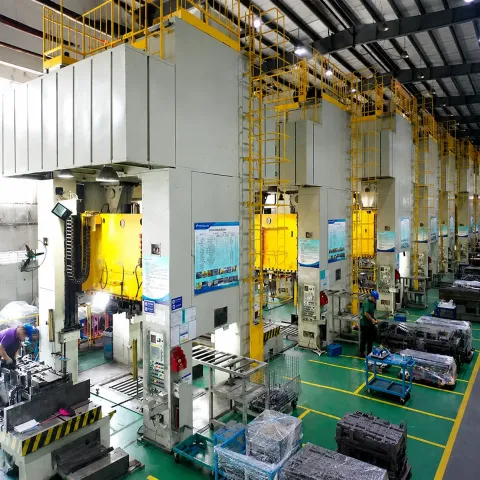
The cheapest removal is the one that never touches a labor rate. An in-die cut trims flash, runner and gate inside the mold or on a trim press, integrated with ejection. Cycle contribution is 2 to 5 seconds, part cost lands at 1 to 5 cents, and the only cost after the tool is blade regrind every 30,000 to 60,000 cycles.
Blade arithmetic decides whether the cut is a cut. Blade steel runs HRC 58 to 62, and DieStrike holds hardened work to HRC 62 maximum. Punch-die clearance must stay inside 5 to 10 percent of material gauge. On 0.3 mm flash that is 0.015 to 0.03 mm per side. Drift past that band and the edge rolls instead of shearing, and burr height grows past the 0.2 mm drawing limit.
The same clearance law governs stamped edges. A punch worn 0.02 to 0.05 mm oversize on a 1 mm steel sheet pushes burr height from 0.05 mm to 0.3 mm or more. The finishing cell then inherits the defect. The fix belongs at the die, not at the grinder. Trimming castings follows the same sequence with its own hold-down rules, laid out in the trim die design guide for die casting.
Tool cost for an in-die cut runs 2,000 to 10,000 USD for the trim station, blades and fixture. On a 2 million part program, a 3 cent in-die cut replaces a 15 cent hand trim and saves 240,000 USD a year. Even at the top of the tooling band, payback is under 4 weeks. That arithmetic makes in-die cut the default above 250,000 parts per year on accessible edges.
Two limits stop it from being universal. The web must be reachable by a straight blade path, so internal bores and blind pockets are out. The part must also be held rigidly at the cut line. A 0.02 to 0.05 mm deflection under the blade tears the web and leaves a witness mark on the cosmetic face.
Hand Trimming: What It Really Costs
Hand trimming with a hook knife, micro-shear or scalpel is the route every program starts on and most should leave. Station cost is under 100 USD, lead time is zero, and it handles any visible edge. The price is labor and variability: 15 to 60 seconds per part at 3 to 8 USD per hour, which lands at 0.01 to 0.15 USD per part before rework.
Convert the seconds honestly. A 45 second trim is 0.04 to 0.10 USD of direct labor, but the loaded cost adds bench space, training and a 5 to 10 percent escape rate. Hand-trimmed lots show a 3 to 5 percent rework rate for blade marks and missed webs, and each escape that reaches assembly costs 10 to 50 times the trim.
Soft tooling is the legitimate home for hand work. A prototype mold cut for 5,000 to 20,000 parts rarely justifies an in-die trim station: 2,000 to 10,000 USD of tooling amortized over 20,000 parts adds 0.10 to 0.50 USD each. Aluminum prototype molds also flash 0.2 to 0.5 mm because the shut-offs wear early, which is why prevention matters most on soft tools, as the flash prevention guide covers.
Where hand trim survives at volume, instrument it: torque-limited shears, blade changes every 2,000 to 5,000 parts, and a boundary sample at every station. Without those controls, the last 10 percent of a lot is usually worse than the first.
Cryogenic Deflashing and Embrittlement Windows
Cryogenic deflashing turns the residue's own weakness into the removal mechanism. Parts travel through a chamber cooled to the embrittlement temperature of the flash. A media or CO2 blast then shatters the brittle web and leaves the ductile part untouched. Liquid CO2 or dry pellets carry most chambers to -70 to -100 °C, and a blast cycle runs 5 to 30 seconds plus load and unload.
The material window is the whole decision. Below its glass transition, a resin stops deforming and starts fracturing, and only then does the blast remove flash instead of peening the part. Polyolefins are the hard case: PP and PE stay rubbery even at -40 °C, so a dry ice chamber at -78 °C is the minimum.
Nylon and PC embrittle between -40 and -70 °C, comfortably inside a standard liquid CO2 chamber. Conditioning runs 30 to 90 seconds on a 2 mm wall, set by thermal mass. Glass-filled compounds deflash at the shorter end because the fibers propagate the crack through the web.
Elastomers need the deepest cold. TPE and LSR flash stays flexible above -80 °C. Chambers for seals run dry ice or LN2-assisted air at -80 to -100 °C, with conditioning extended to 2 to 5 minutes on thick sections. Molded rubber tells a separate story: above about 60 Shore A the flash tears at room temperature and can be twisted off with no cooling.
Cost lands at 0.10 to 0.50 USD per part outsourced, with no tooling. Media consumption runs 0.5 to 2 kg of dry ice or 0.3 to 1 kg of CO2 per kilogram of parts. Deflashing clears 0.05 to 0.5 mm flash from geometry a blade cannot reach, and a tuned process leaves the surface inside 0.02 mm of the as-molded face.
Robotic Grinding, Barrel Finishing and Laser Trim
Robotic grinding is the route when the residue is hard, the edge is programmed and the volume is real. A six-axis arm carries a grinding wheel, belt or deburring tool at 10,000 to 60,000 rpm against a fixed fixture, and force-control compliance absorbs 0.1 to 0.3 mm of part variation. Cycle runs 5 to 30 seconds, part cost 0.03 to 0.20 USD, and the cell is 40,000 to 120,000 USD before programming.
It earns its keep on glass-filled nylon, PEEK and aluminum castings, where cryo cannot break the flash and a blade dulls in 5,000 cycles. A wheel or carbide tool lasts 2,000 to 8,000 parts between dressing or change, adding 0.01 to 0.03 USD per part in consumables. The limits are reach and rigidity: the arm finishes only edges a fixture can present at a repeatable angle, and a 0.8 mm rib deflects under grinding force.
Barrel and vibratory finishing is the bulk route. Parts, ceramic or plastic media and a compound tumble run 30 to 120 minutes, and every exposed edge deburrs at once. Cost runs 0.03 to 0.15 USD per part with a 5,000 to 30,000 USD machine, removing 0.05 to 0.3 mm spread over the whole edge. Three rules decide eligibility: the part must not chip, nest or mark itself, so flat Class A faces are usually out; the media-to-part ratio must be 2 to 4 to 1 by volume; and the process is not local, so a 0.1 mm break-edge spec fights the medium.
Laser trim is the contactless answer for elastomers and cosmetic edges. A CO2 or fiber laser vaporizes the flash along a programmed profile in 1 to 10 seconds per part, at 0.05 to 0.40 USD on a 60,000 to 150,000 USD cell. Nothing touches the part, so soft TPE and LSR seals deflash without smearing. Power settings are the whole process: 50 to 200 W cuts a 0.2 to 0.5 mm TPE web at 50 to 300 mm/s, and overshoot scorches the lip. With no tool wear the cut is identical on every part.
Acceptance Criteria and Inspection
A finishing route without a written acceptance criterion is a cost center with no output spec. Four checks prove the residue is gone to print.
Dimensional limit. Automotive and connector drawings commonly cap burr height at 0.2 mm maximum and residual flash at 0.05 to 0.10 mm on sealing faces. Write the number on the print with the measurement location, and make 0.2 mm the default burr note where the drawing has none.
Tactile and tape test. Run a glove or a strip of painter's tape along the trimmed edge. Tape that snags marks the spot where a 0.1 to 0.2 mm burr still stands. It is the fastest screen on a line and it belongs in the control plan beside the gauge.
Profilometer or optical height. A stylus or chromatic sensor reads residual flash at 0.05 mm resolution, which turns the debate from opinion into a number. Sample 5 parts per lot at 3 defined locations, and trend the readings: a rising residual over 10,000 to 50,000 cycles is blade wear, and it schedules the regrind.
Backlight silhouette on Class A faces. Hold the part against a light source; a 0.1 mm residual web throws a visible line on a glossy face even when it feels smooth. The same sight line governs gate vestige decisions in the cosmetic quality guide.
Instrument the cause, not just the part. If burr height on a trimmed edge climbs above 0.2 mm, check the cutting clearance before blaming the finishing cell. A wear limit of 0.02 to 0.05 mm on blade and punch steel separates a defensible process from sorting. Shut-off wear on the mold is a repair scope item, covered in mold repair and maintenance.
Cost Logic: Which Route Wins by Volume
The route decision is one equation: variable cost per part times volume, plus tooling, against the alternative. Run it on the two common crossovers before defaulting to whatever the last program used.
Manual against in-die cut. A hand trim at 0.15 USD per part on a 2 million part program is 300,000 USD a year of labor. A 25,000 USD in-die trim station at 0.03 USD per part costs 60,000 USD a year in variable expense and pays the tool back in under 4 weeks. The same tool on a 20,000 part program adds 1.25 USD per part in amortization and loses to the knife by an order of magnitude. The crossover sits near 150,000 to 250,000 parts per year at these rates.
Cryogenic against hand trim on complex geometry. At 0.10 to 0.50 USD per part with no tooling, cryo beats a 45 to 60 second hand trim once loaded labor passes 0.30 USD and the geometry has internal features. Above 500,000 parts of undercut-heavy work, cryo wins on consistency: a manual route holds a 3 to 5 percent escape rate and a tuned cell holds under 1 percent.
| Annual volume | External flash only | Internal or undercut flash | Why |
|---|---|---|---|
| Under 20,000 | Hand trim | Hand pick or outsourced cryo batch | No tooling can amortize at this quantity |
| 20,000 to 250,000 | Barrel finish, then in-die cut | Cryogenic deflashing | Trim tool amortizes at 0.04 to 0.50 USD per part across this band |
| 250,000 to 2,000,000 | In-die cut | Cryo above 500,000, robotic grind on hard resins | 1 to 5 cents per part beats every labor and batch route |
| Over 2,000,000 | In-die cut, blade wear logged | Laser trim or robotic grind cell | Cell cost per part collapses below outsourced batch rates |
← swipe to scroll →
Table note: bands assume labor at 3 to 8 USD per hour, trim tooling at 2,000 to 10,000 USD and outsourced cryo at 0.10 to 0.50 USD per part. Rebuild the arithmetic with your own rates before committing to a cell.
One more number belongs in the model: the cost of doing nothing. A 0.3 mm residual web on a sealing surface fails a leak test at assembly. Containment on a 48,000 part lot, like the housings on hold in the opening, runs 0.30 to 0.60 USD per part in sorting alone. That is three to four times the removal route it should have been specified against.
Who Pays for Finishing
Finishing cost moves to whoever did not write it down, and it usually lands on the buyer. If the drawing carries no flash allowance and no removal route, the molder quotes a bare part. When parts arrive with a 0.3 mm web and the assembler needs 0.05 mm, the invoice appears as an engineering change at 0.15 to 0.50 USD per part.
The clean sequence puts three numbers on the print before the RFQ. First, the residue allowance: residual flash 0.05 to 0.10 mm maximum, burr 0.2 mm maximum, at named locations. Second, the acceptance method: profilometer, tape test or backlight, typically 5 parts per lot at 3 points. Third, the assumed removal route, because the tool design follows the route.
Each route then has a natural owner. In-die cut belongs in the mold price, so the tool builder carries it and the part price stays clean at 1 to 5 cents. Dead skin and gate vestige are mold design outputs, and a prevention change costs 2,000 to 10,000 USD of steel against a permanent per-part removal fee. Outsourced cryo, barrel and laser cells are converter scope when the molder owns the cell, buyer scope when it does not.
Under IATF 16949 programs, the control plan closes the loop. The removal route, its parameters and the acceptance gauge sit in one document, so a blade wear event or a cryo chamber drift is a contained process change, not a customer dispute.
Finishing Decision Checklist
Run these eight lines before a finishing route is locked into a quote or a tool design. Each one carries the number that decides it.
- Name the residue. Flash at 0.02 to 0.5 mm, dead skin at 10 to 50 micron, burr at 0.05 to 2 mm. The size class picks the mechanism.
- Map the reach. External parting-line web only, or internal bores and undercuts? Blades and trim dies are external-only routes.
- State the volume band. Under 20,000 parts, hand trim. 20,000 to 250,000, barrel or in-die. Above 250,000, in-die cut wins on accessible edges.
- Check the material window. PP and PE need dry ice at -78 °C or colder. Nylon and PC embrittle at -40 to -70 °C. TPE and LSR need below -80 °C, or a laser.
- Write the acceptance number. Burr 0.2 mm maximum, residual flash 0.05 to 0.10 mm, one named gauge, 5 parts per lot.
- Price the tooling amortization. A 25,000 USD trim cell is 1.25 USD per part on 20,000 parts and 0.0125 USD on 2 million.
- Fix the source first. If the burr comes from 0.02 to 0.05 mm of punch wear, grinding the symptom is a permanent tax.
- Assign the cost on the drawing. Flash allowance, route and gauge before RFQ, or the invoice arrives later at a premium.
The Bottom Line
Flash, dead skin and burrs are three different residues and they price differently. A blade shears a 0.02 to 0.5 mm web for cents once volume justifies the trim station. Cryo shatters what a blade cannot reach, but only inside the embrittlement window of the resin. Grinding, tumbling and laser trim fill the niches of hard material, bulk edges and contactless cosmetic work. The route is selected by three facts: residue size, geometry reach and annual volume.
The commercial lesson is sharper than the technical one. Spec the flash allowance, the removal route and the acceptance gauge on the drawing before the RFQ. At 2 million parts a year, that one page decides whether finishing costs 60,000 USD in-die or 300,000 USD by hand. DieStrike builds and repairs the tooling behind both sides of that line, to IATF 16949 and plus or minus 0.005 mm mold accuracy. EDM and jig grinding hold plus or minus 0.002 mm, and hardened work runs to HRC 62 across a 120+ machine shop.
Standard components ship in 3 to 7 days, tool lead times run 2 to 5 weeks, and tier-1 programs with TE, Amphenol, Luxshare and Dongshan set the house standard. A tool that holds its shut-off gap under 0.02 mm is cheaper than any finishing cell that cleans up after it.
KEEP READING
Related Reading
How to Prevent Flash: Shut-Offs, Vents and Clamp Tonnage
Shut-off land widths, vent depth bands and clamp tonnage margins that stop flash before a removal route is needed.
Read articleArticleHow to Control Gate Vestige and Cosmetic Quality on Class A Parts
Gate footprint, shear skin and blush limits on faces where a finishing mark is itself a defect.
Read articleArticleHow to Design Trim Dies for Die Casting: Degating and Flatness
Degating sequence, hold-down and fixture flatness numbers for castings trimmed off the machine.
Read articleServiceMold Repair and Maintenance
IATF 16949 shut-off and parting-line rebuilds to plus or minus 0.005 mm, plus trim blade regrind and clearance reset.
Read articleNEXT STEP
Ready to Start Your Mold?
Send us your element dimensions or part numbers — our team responds within 24 hours with pricing and lead time.

Written by
Ray ChanMold Buyer's Guide Author · Precision Mold Manufacturing Specialist. Ray helps global importers, distributors and OEMs source factory-direct molds and mold parts.