
ASA Injection Molding: UV-Stable Material Guide for Outdoor Parts
Table of Contents
A mirror housing molded in ABS passed T1 with a perfect gloss reading. Eighteen months of outdoor service later, the surface chalked white. The color drifted 3 Delta E units off the approved panel. The warranty claim landed on the molder's desk. The tool was never at fault. The resin was the wrong cousin for a part that lives in direct sun.
ASA is acrylonitrile-styrene-acrylate. It shares the styrene-acrylonitrile backbone of ABS. Its rubber phase is an acrylate rubber instead of butadiene. Butadiene carries carbon-carbon double bonds that ultraviolet light attacks. That is why ABS yellows, fades, and chalks outdoors. The acrylate rubber removes that weak link, so ASA keeps the impact and gloss of ABS while resisting UV degradation.
Read this guide from the mold side. You are the mold buyer or tooling engineer who decides cavity compensation, mold temperature control, gate placement, venting, steel, and ejection. The chemistry matters only where it changes a tooling decision. For ASA, that list of changes versus ABS is short. Our ABS material guide covers the chemistry and its failure modes in depth. This guide covers what changes when the part spec says ASA.
Weatherability is the reason the material exists. Resin suppliers qualify ASA grades with accelerated weathering per ASTM G154, the fluorescent UV test. ASTM G155, the xenon-arc test, is the second standard, and automotive programs add SAE J2527 cycles. Typical color targets hold Delta E below roughly 2 after 2,000 hours of xenon exposure on pigmented grades. Gloss retention stays visibly better than ABS over the same window. Outdoor service targets of 5-10+ years without the chalk and fade ABS shows are the normal design expectation.
Chemical resistance is the second differentiator. The acrylate rubber resists diluted acids, alkalis, and aliphatic oils. Those chemicals attack the butadiene phase of ABS. That is why ASA is chosen for parts that see fuels, greases, and cleaning agents as well as sun. ASA still softens or crazes in ketones, esters, and aromatic solvents. The solvent rule from ABS tooling still applies.
Heat resistance is the material's limit. HDT sits near 85-100 °C at 1.82 MPa, grade dependent. That rules ASA out of under-hood and hot-touch zones.
The Snapshot
- ASA swaps ABS butadiene for an acrylate rubber phase. Outdoor color and gloss retention typically target 5-10+ years, versus the chalk ABS shows in 1-3 years of direct sun.
- Mold shrinkage is 0.4-0.7% at a density of 1.05-1.07 g/cm³. Shrinkage is amorphous and uniform, so cavity compensation follows the same zone rules as ABS tooling.
- Drying is mandatory. Run 80-90 °C for 2-4 hours to below 0.05-0.1% moisture, or splay appears from the first shot.
- Process at a melt of 230-260 °C into a mold at 40-80 °C. Run 60-80 °C when the part must reproduce gloss or a molded grain.
- Vent at 0.02-0.04 mm depth and draft textured walls at 1-3° per side. Standard P20 covers most ASA runs, while glass-filled grades need hardened steel. ASA resin typically costs 1.1-1.3x ABS, and the tooling is near-identical.
What Is ASA and Why Outdoor Parts Need It
ASA is an amorphous thermoplastic in the styrenic family. It was commercialized in the 1960s as the weather-resistant answer to ABS. A continuous SAN matrix carries stiffness, heat resistance, and chemical resistance. Grafted acrylate rubber particles, typically 20-30% by weight in impact grades, deliver the toughness. The grafting step matches ABS in purpose: it bonds the rubber to the matrix so the impact modifier does not separate during molding.
The rubber choice is the whole story. Polybutadiene, the ABS impact phase, absorbs UV energy and degrades through its double bonds. That produces the yellowing, gloss loss, and chalking seen on outdoor ABS parts. Acrylate rubber has a saturated structure without that UV-absorbing weakness, so the impact phase survives what the sun sends. Notched Izod impact stays in the 200-500 J/m band typical of molding grades while the surface chemistry stays stable.
Do not treat ASA as a niche ABS. It is the default spec for visible outdoor parts where ABS fails and where polycarbonate is overkill. Parts that must hold color, gloss, and impact for a decade of sun and rain run ASA. It is the resin the mold shop sees most often after ABS itself.
ASA Properties That Drive Mold Design
Five numbers on the ASA datasheet drive the mold design decisions that follow. Each one maps to a specific part of the tool. Each one sits close enough to ABS that a shop that molds ABS quotes ASA tooling from experience. The table below summarizes the values that matter before steel is cut.
| Property | Typical ASA Value | Mold Design Impact |
|---|---|---|
| Density | 1.05-1.07 g/cm³ | Part weight and press sizing |
| Mold shrinkage | 0.4-0.7%, uniform | Cavity compensation by wall zone |
| HDT at 1.82 MPa | 85-100 °C, grade dependent | Cooling layout and safe ejection temperature |
| Notched Izod impact at 23 °C | 200-500 J/m | Ejection robustness and draft margin |
| Melt flow index | 3-30 g/10 min by grade | Flow length, gate count, runner sizing |
← swipe to scroll →
Table note: Values are typical published ranges for injection-molding grades of ASA. Confirm against the specific grade datasheet. Test methods include ASTM D792, D955, D648, D256, and D1238.
Shrinkage drives the cavity. At 0.4-0.7% mold shrinkage, ASA sits in the band of ABS. It sits well below the 1.5-2.5% of semicrystalline resins such as nylon or polypropylene. Because ASA is amorphous, shrinkage is low, uniform, and nearly isotropic. Warpage risk stays manageable, and cavity compensation is a zone exercise. Thick sections still shrink more than thin ones, so the split-by-wall-zone method applies exactly as it does for ABS.
Impact and HDT set the mechanical envelope. Notched Izod values of 200-500 J/m mean the part takes abuse at ejection. Ejector pins do their job without the deep-draft caution needed for brittle resins. The 85-100 °C HDT at 1.82 MPa is the practical ceiling. Parts eject cleanly when the skin cools below roughly that range. The cooling layout must remove heat fast enough to hold cycle without distorting thin walls.
Flow determines gates. MFI spans about 3-30 g/10 min across ASA grades. That matches ABS behavior. Low-flow weatherable grades fill long cosmetic panels slowly, so they need more gate positions or larger runners. High-flow grades fill complex housings from a single gate. Runner and gate sizing starts from the same rules as ABS, with gate count set by the flow length to wall thickness ratio.
Mold Design Considerations for ASA
ASA tooling is not exotic. A mold that runs ABS well runs ASA well. That is the most useful fact for a buyer: the two resins share shrinkage, flow, and mold temperature windows. The considerations below are the deltas a tooling engineer checks when the spec changes from ABS to ASA. They also protect the glossy outdoor surface that ASA is specified for.
Resin condition is a tooling input. ASA is hygroscopic and picks up moisture from ambient air. Saturation sits in the range of roughly 0.2-0.4% in humid storage. Wet resin flashes steam in the barrel and produces silvery splay across the first cosmetic surface. The drying spec of 80-90 °C for 2-4 hours belongs to the molder. The mold must still be ready for the failure mode, with vents that handle the gas and a gate layout that adds no shear splay. Our splay and silver streaks guide covers the full mold-side diagnosis when the defect appears.
Mold temperature is the gloss lever. ASA runs into a mold at 40-80 °C. The low end shortens cycle and delivers a matte surface. The 60-80 °C high end is where gloss parts live. Hotter cavity surfaces freeze a smoother skin, which raises gloss readings by tens of units. Fine texture also reproduces more faithfully. Because ASA is specified for visible outdoor surfaces, most ASA tools run at the top of the window.
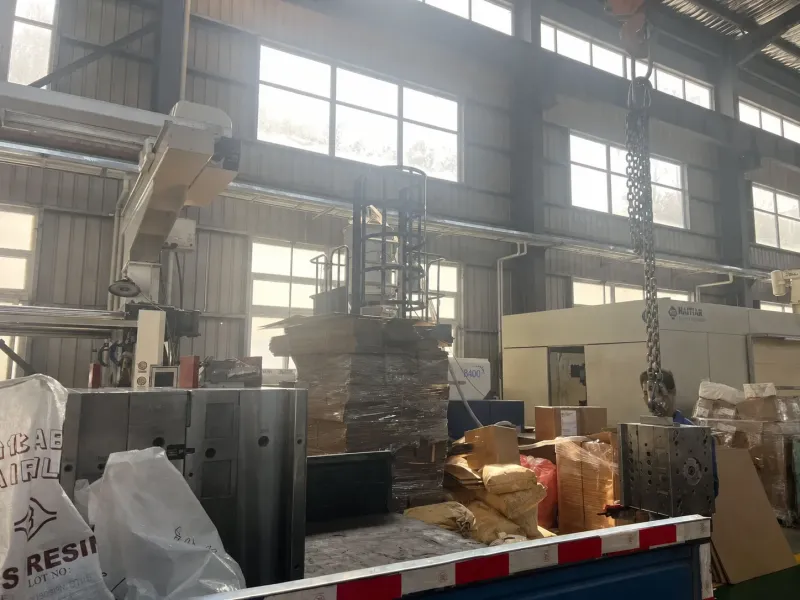
The cooling layout must hold cavity and core temperature within a few degrees of each other across the part. Shrinkage compensation follows the same rules as ABS. Compensate the cavity for 0.4-0.7% shrinkage, split by wall-thickness zone. The datasheet range is confirmed and tuned at the first molding trial. Parts with ribs and bosses need the zone split applied carefully. A boss that shrinks onto its core pin will sink unless the local wall is controlled.
DFM before steel. A 24-hour manufacturability review catches the ASA-specific mistakes before machining. Gate placement can put a weld line across a grained A-surface. Cooling channels may not hold 60-80 °C uniformly. Venting can be too shallow for the flow length. Every one of those decisions is cheaper on a drawing than in a steel change order.
Steel, Gates and Venting for ASA Molds
Steel selection. Standard prehardened P20, roughly 28-32 HRC, carries most ASA programs through hundreds of thousands of shots. ASA is not abrasive, so cavity wear is mild and the steel budget stays low. Two cases upgrade the steel. Glass-filled ASA grades exist for stiffness-critical outdoor parts, and the glass wears gates and shut-offs. High-volume tools running millions of parts also upgrade to hardened steel and replaceable gate inserts.
Gates. ASA accepts the same gate family as ABS. Edge, pinpoint, submarine, fan, and tab gates all run clean. Hot runner systems are standard on multi-cavity automotive tools, because ASA processes like ABS at similar melt temperatures. Typical starting points are a gate land near 1 mm and a gate depth at 50-80% of wall thickness. Gate placement decides weld line position, so gate count and location are set before steel is cut.
Venting. Vent depths of 0.02-0.04 mm are the typical guideline for ASA and the styrenic family. Deeper vents flash at the parting line. Shallower vents trap air and cause burn marks or short shots at the end of fill. Long cosmetic panels and textured A-surfaces need real venting paths at the last-filled points. Texture that crosses the parting line must stay off the shut-off land so the vent stays clean.
Texture and draft. ASA is one of the best resins at reproducing a molded grain. That is why automotive interior and exterior textures are specified on it. The cavity finish and texture class are set on the drawing. Draft follows the texture class: 1-3° per side depending on the SPI or VDI spec, with coarse grains at the deep end. Our how to specify mold texture guide covers the SPI/VDI mapping and the draft math per etch class. Ejection stays conventional with pins and sleeves, and sticking is rare when draft and texture class are matched.
The ASA Processing Window
The processing window below is the standard starting point for injection-molding grades of ASA. Values are typical of published resin guidance. The grade datasheet overrides it. The mold must be designed to survive the top of the window, because that is where the material actually runs.
Drying: 80-90 °C for 2-4 hours. ASA picks up moisture like ABS. The processing target is below 0.1% moisture, with 0.05% or better for high-gloss parts. Wet resin produces silver splay streaks and blisters on the surface. It also causes a measurable drop in impact, because moisture vaporizes in the barrel and flashes at the flow front. Use a desiccant dryer, keep dried resin covered, and treat the hopper analyzer reading as the pass line.
Melt temperature: 230-260 °C. ASA is amorphous, so the barrel profile is set for viscosity, not phase change. The practical window for most grades is 230-260 °C. That sits slightly above typical ABS because the acrylate phase needs the extra heat to flow. Long residence near the top of the window degrades the resin. Degraded melt shows up as odor, yellowing, and falling impact values on the molded part.
Mold temperature: 40-80 °C. The low end gives fast cycles and a matte skin. The 60-80 °C high end is mandatory for gloss parts and faithful grain reproduction. It also lowers molded-in stress and reduces weld line visibility. A mold temperature controller that holds the set point across the full plate matters more on ASA than on matte ABS parts. Surface appearance is the reason the material was chosen.
Pressures and speeds. Typical injection pressure runs 60-100 MPa. Hold pressure sits at roughly 30-60% of injection pressure. That is similar to ABS. First-stage fill speed is the cosmetic control. High-speed fill through a small gate risks jetting on gloss surfaces, so gloss ASA parts fill with a moderate profile that keeps the flow front attached to the cavity wall. Screw speed stays moderate to avoid shear heating in the barrel.
Shrinkage in the window. Molded shrinkage lands in the 0.4-0.7% band. It moves with wall thickness, mold temperature, and hold pressure. Higher mold temperature and higher hold pressure push shrinkage to the low end. Because the shrinkage is uniform and isotropic, dimensional drift stays small. The cavity compensation set at design survives production within normal process variation.
Common ASA Applications
ASA applications share one trait. The part is visible, outdoors, or both, and it must still look right years after it leaves the factory. That combination is rare among commodity thermoplastics. It is why ASA owns the outdoor cosmetic niches below.
Automotive exterior trim is the largest home for ASA. Mirror housings, grille surrounds, roof rails, body-side moldings, and rear spoilers sit in direct sun for the life of the vehicle. They are color-matched to painted body panels. ASA holds that color and gloss through weathering cycles that would chalk an ABS part. It also takes the molded grain textures that automotive programs specify. The tooling follows the discipline of our automotive injection molding work: multi-cavity tools, hot runners, and 60-80 °C mold temperature control for class-A surfaces.
Outdoor appliance and power equipment housings are the second cluster. Garden tractors, lawnmower covers, chainsaw bodies, leaf blowers, and pressure washer housings see sun, rain, fuel, and cleaning chemicals in the same week. ASA delivers ABS impact with acrylate chemical resistance, molded in color that skips the paint line. Recreational and marine parts follow the same logic. ATV body panels, jet ski shrouds, and boat consoles all face sunlight plus abrasion plus chemical exposure.
Consumer electronics with outdoor exposure round out the list. Security cameras, satellite housings, and EV charging equipment enclosures sit on facades and charging posts in full sun. ASA keeps the housing from yellowing while meeting the same flame and impact specs that ABS would carry indoors. Color-in-mold ASA also removes a painting operation. That is why the total cost case often beats painted ABS despite the higher resin price.
ASA Defects: Mold-Side Root Causes and Fixes
Most ASA rejects trace to a mold design decision or a resin-condition miss. They do not trace to a bad shot. The four defects below are the ones that appear on outdoor cosmetic parts. Each is mapped to its mold-side root cause and the tooling fix.
Splay on the first cosmetic surface. Silver streaks fanning from the gate mean the resin was wet. ASA picks up moisture like ABS. The mold-side contribution is a gate and runner design that adds shear splay on top of moisture splay. Venting that cannot exhaust the gas is the second mold-side factor. Drying to below 0.05-0.1% is the primary fix. Gate land, cold slug wells, and vent depth are the tooling checks when splay survives drying.
Jetting on gloss parts. Worm tracks on a high-gloss ASA surface mean the melt left the gate as a free jet. It snaked across the cavity instead of spreading as a front. The fix is gate placement and geometry. Aim the gate at a wall within 2-3 times the gate depth so the jet folds against steel. Use a fan or edge gate to spread the front, and slow the first-stage fill. The gate design rules in our how to prevent jetting guide apply directly. They matter more on ASA than on textured parts, because gloss shows every worm track.
Weld lines on textured panels. Flow fronts that meet around a core produce weld lines. Grain may hide the visual line, but not the strength loss. The weld zone also weathers differently and roughens over time. Place gates so weld lines land at vents or in non-cosmetic zones. Keep the melt front hot with mold temperature at 60-80 °C so the fronts knit properly.
Sink marks over thick bosses. A gloss A-surface sinks over a thick mounting boss when the local wall passes roughly 1.5 times the nominal wall. The boss packs late and pulls the surface inward. The mold-side controls are boss design, not process. Core out the boss to hold the wall ratio near 1:1. Gate near thick sections so they pack before freeze-off. Run cooling channels under the boss zone. Sink that survives those changes usually needs a part drawing correction, not a steel change.
ASA vs ABS vs PMMA: Comparison Table
Three materials compete for the visible outdoor part. ASA is the weatherable ABS replacement. ABS is the cheap indoor cousin. PMMA, acrylic, is the maximum-gloss option, and ASA/PC blends add a fourth path where heat and impact demands exceed straight ASA. The table below uses typical published values for injection-molding grades.
| Property | ASA | ABS | PMMA | ASA/PC Blend |
|---|---|---|---|---|
| UV and weathering retention | Excellent, 5-10+ years outdoor target | Poor to fair, chalk and fade in 1-3 years | Excellent, best clarity retention | Very good, slightly below ASA |
| Notched Izod impact at 23 °C (J/m) | 200-500 | 150-400 | 15-30, brittle | 400-700 |
| Gloss in service | Holds gloss for years outdoors | Glossy at mold, drops fast in sun | Highest initial gloss and retention | Good with correct molding |
| Chemical resistance | Better than ABS, resists dilute acids and oils | Fair, attacked by ketones and esters | Poor to solvents, prone to crazing | Similar to ASA, PC cautions apply |
| HDT at 1.82 MPa (°C) | 85-100 | 85-105 | 85-100 | 95-115 |
| Mold shrinkage (%) | 0.4-0.7 | 0.4-0.7 | 0.2-0.6 | 0.4-0.7 |
| Relative resin cost (ABS = 1.0) | 1.1-1.3 | 1.0 | 1.2-1.5 | 1.3-1.6 |
| Typical outdoor service life target | 5-10+ years | 1-3 years | 5-10+ years with care | 5-8 years |
← swipe to scroll →
Table note: Values are typical published ranges for injection-molding grades. Relative resin cost is an index of typical market pricing, not a quote. Color, additives, and volume move the real number.
ASA vs ABS is the key buyer decision. The two resins are near twins in the mold. They share the same 0.4-0.7% shrinkage, the same flow behavior, and the same 40-80 °C mold temperature window. Gate, vent, and steel rules are identical. That is the practical headline of this guide. A program switching from ABS to ASA does not need a new mold. It needs a drying and process window change, so the weathering upgrade can ride on existing tooling. Resin cost runs 1.1-1.3x ABS. That is cheap insurance against warranty returns on a part that lives outdoors.
ASA vs PMMA is a gloss and toughness trade. PMMA delivers the highest gloss and the best clarity. That is why it owns lenses and show surfaces. Its notched Izod impact of 15-30 J/m is an order of magnitude below ASA, and it crazes under solvent and stress. ASA is the choice when the part must keep a good surface and survive handling, fasteners, and thermal cycling. Parts that need a PMMA-class look with ASA toughness use ASA/PC blends or ASA/PMMA coextrusion.
ASA/PC blends fill the heat and impact gap. Blends lift HDT into the 95-115 °C range. Notched Izod rises to 400-700 J/m. That is why automotive interior parts with sun-load heat specs run ASA/PC instead of straight ASA. The blend costs more, roughly 1.3-1.6x ABS, and molds with the same styrenic rules. Choose the blend when the outdoor part also sees high cabin temperatures. Choose straight ASA when UV stability is the whole story and cost stays tight.
Frequently Asked Questions
Q1. What does ASA stand for and how is it different from ABS?
ASA stands for acrylonitrile-styrene-acrylate. It shares the SAN matrix of ABS, but the butadiene rubber phase is replaced by an acrylate rubber phase. Acrylate rubber has no UV-sensitive double bonds. ASA therefore holds color, gloss, and impact outdoors for a typical service target of 5-10+ years. ABS chalks and fades within 1-3 years in direct sun.
Q2. Does ASA need drying before injection molding?
Yes. ASA is hygroscopic and absorbs moisture from ambient air. Dry it at 80-90 °C for 2-4 hours to below 0.1% moisture. Aim below 0.05% for gloss parts. Wet resin produces silver splay streaks, surface blisters, and reduced impact strength, exactly as it does with ABS.
Q3. Can ASA be molded in a mold built for ABS?
In nearly every case, yes. ASA and ABS share 0.4-0.7% mold shrinkage, similar melt flow, and the same 40-80 °C mold temperature window. Cavity compensation, gating, and venting carry over. The changes are on the process side: dry at 80-90 °C, run a melt of 230-260 °C, and hold 60-80 °C mold temperature for gloss surfaces. A switch to a glass-filled ASA grade should trigger a steel review, because the glass is abrasive at gates and shut-offs.
Q4. What mold temperature gives the best gloss on ASA?
Run the mold at 60-80 °C. A hotter cavity freezes a smoother skin, which raises gloss readings by tens of units. Molded grain also reproduces faithfully. Below roughly 50 °C the surface turns matte and fine texture loses fidelity. That is why cosmetic ASA tools run at the top of the window with controlled cooling.
Q5. Is ASA more expensive than ABS?
ASA resin typically costs 1.1-1.3x ABS resin. Total part cost can still favor ASA, because it is molded in color with no paint line. The part also avoids the warranty cost of an ABS part that fails outdoors. Tooling cost is essentially unchanged, since ASA molds like ABS.
Q6. How long does ASA last outdoors?
Typical outdoor service targets run 5-10+ years for color and gloss retention. That is validated with accelerated weathering per ASTM G154 or ASTM G155 and real-time outdoor programs. Actual life depends on pigment system, UV stabilizer loading, climate, and exposure angle. ASA is durable, not immortal. At extreme equatorial sun angles, or in thin-wall parts, expect earlier change even with premium grades.
The Bottom Line
ASA is ABS with the UV weak link removed, and it molds like ABS. Compensate cavities for 0.4-0.7% uniform shrinkage. Dry to below 0.05-0.1% moisture. Run a melt of 230-260 °C into a 40-80 °C mold, and vent at 0.02-0.04 mm. The payoff is 5-10+ years of outdoor color, gloss, and impact.
DieStrike builds ASA and ABS tooling under IATF 16949 across a 120+ machine shop. Injection molds deliver in 2-5 weeks with geometry at ±0.005 mm and precision features at ±0.002 mm. Hardened cavities run at HRC 62, and standard mold components ship in 3-7 days. Connector OEMs including TE Connectivity, Amphenol, and Luxshare run production on the same discipline. Send your ASA part drawing to our DFM team and get a moldability report within 24 hours.
KEEP READING
Related Reading
ABS Injection Molding: The Complete Material Guide
ABS is ASA closest relative: the same SAN backbone, a butadiene rubber phase, and near-identical tooling rules. Read both guides before you quote either resin.
Read articleArticleHow to Specify Mold Texture: SPI, VDI and Grain Matching
ASA reproduces automotive grain well, and the texture spec decides draft. SPI/VDI classes, etch depth, and the draft math for textured ASA walls.
Read articleArticleHow to Prevent Jetting: Gate Design and Mold-Side Fixes
Worm tracks on high-gloss ASA start at the gate. The 2-3 gate-depth wall rule, fan gates, and the mold-side fixes that clear gloss parts.
Read articleServiceMold Design and DFM
A 24-hour DFM review of your ASA part drawing covers gate placement, venting, texture, and shrinkage compensation before steel is cut.
Read articleNEXT STEP
Ready to Start Your Mold?
Send us your element dimensions or part numbers — our team responds within 24 hours with pricing and lead time.

Written by
Ray ChanMold Buyer's Guide Author · Precision Mold Manufacturing Specialist. Ray helps global importers, distributors and OEMs source factory-direct molds and mold parts.