
How to Choose Injection Mold Gate Types: Edge, Submarine, Tab, Valve
Table of Contents
A $60,000 family mold for a consumer electronics housing came back from T1 with two killers. The visible face carried a 1.2 mm gate blush ring from an oversized edge gate. A tunnel gate cutting at 15 degrees sheared the ABS so badly that every part needed a 40-second hand trim.
The mold builder quoted $11,000 and six weeks to rework the cavity inserts. That money bought back a gate decision that should have cost two hours of DFM review. Gate type is not a detail you leave to the tooling supplier. It sets vestige height, trim labor, runner scrap, steel hardness, EDM hours and sometimes the entire mold architecture.
This guide walks through the gate types we machine every week at DieStrike, an IATF 16949 certified mold maker holding cavity tolerances to ±0.005 mm. For each type you get sizing parameters, materials served, defects it prevents or causes, and its impact on the mold quote. The closing decision table maps material, cosmetic class, volume and mold architecture to a gate family. You can argue the choice from data instead of habit.
The Snapshot
- Rectangular gate depth runs 0.5-0.8x nominal wall thickness, with a 0.5-1.5 mm land before the cavity face.
- Tunnel (submarine) gates angle 20-45 degrees from the parting line and self-trim on mold open, which is why two-plate molds dominate small commodity parts.
- Banana gates curve through the core to hide vestige off the visible face. The curved channel wears fast, so inserts run HRC 58-62 hardened steel.
- Valve gate hot runner systems run $10,000-$25,000 typical. They eliminate weld lines on Class A surfaces. Gate control becomes a 1-4 mm pin stroke instead of freeze timing.
- Gate vestige height separates the classes. Pin-point leaves 0.3-1.0 mm and tunnel leaves 0.2-0.5 mm. A well-cut edge gate leaves under 0.3 mm on the parting line.
Why Gate Selection Is a Tooling Decision
The gate is the smallest feature with the largest leverage. Every gram of melt enters the cavity through an opening typically 0.5-3 mm deep and 2-10 mm wide. That opening controls shear rate at entry, fill pattern, weld line position, pack pressure transmission and how the part breaks free from the runner. Change the gate and you change all five.

From the mold-making side, the gate type drives hard numbers. Tunnel gates need wire EDM or sinker EDM plus a hardened insert, adding typical $200-$500 per gate to the tool. Pin-point gates force a three-plate architecture with an extra 50-80 mm opening stroke and a $3,000-$10,000 premium over two-plate. Valve gates pull in a hot runner manifold with sequenced pin actuators. An edge gate on a two-plate cold runner mold is the cheapest path, sometimes under $100 per gate in machining time.
The failure math punishes late decisions. If a gate choice surfaces at T1 instead of at DFM, the fix means new inserts, new EDM electrodes and another trial round. At DieStrike we hold key mold dimensions to ±0.005 mm and component geometry to ±0.002 mm.
A reworked insert lands back in spec, but it still costs weeks. Injection mold lead time is 2-5 weeks for a fresh build. A gate rework can eat half of that. Catching the problem in 24-hour DFM review costs nothing.
Cosmetic class decides gate family before anything else. Class A surfaces, meaning any face a customer touches or looks at, forbid gates that leave raised vestige. That single rule eliminates direct sprue gates on visible faces and pushes designs toward hidden tunnels, banana gates, or hot-tip and valve gates. Non-cosmetic internal brackets accept almost anything that fills. Define the cosmetic class in the RFQ, and half the gate decision makes itself.
Edge Gates: The Default Workhorse
An edge gate is a rectangular channel cut into the parting line that feeds melt onto the edge of the part. It is the most machined gate in injection tooling. It is a simple pocket in the cavity block, with no inserts and usually no EDM electrodes. An end mill and a grinder finish it. Two-plate cold runner molds with edge gates are the baseline architecture against which every other option is priced.
Sizing. Gate depth should be 0.5-0.8x nominal wall thickness. A 2.5 mm wall takes a 1.25-2.0 mm deep gate. Too shallow and the gate freezes before the cavity packs, causing short shots and sink.
Too deep and the vestige grows, trimming gets harder, and excess shear heat can burn the resin. Gate width runs 25-100% of the local part width. The land, the straight section before the cavity face, stays at 0.5-1.5 mm. That allows polishing and repair without changing dimensions.
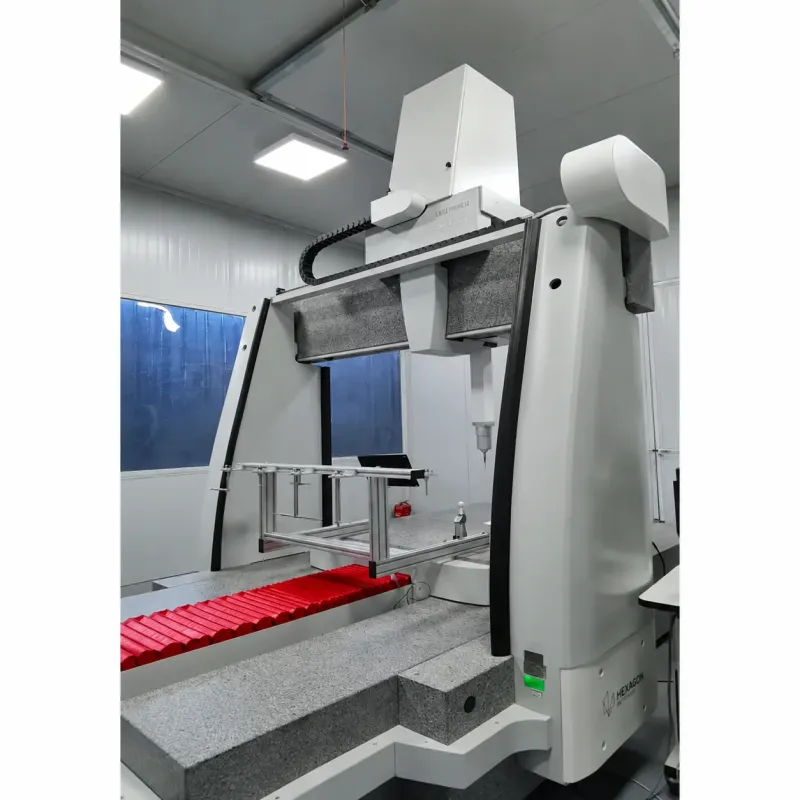
Best fit. Edge gates suit most commodity and structural resins: PP, PE, ABS, PA66 with glass fiber, and HIPS. They work well on boxes, housings, lids and brackets where the parting line already crosses the feed edge. Multi-cavity molds balance easily because each cavity gets an identical machined pocket, and our gate design practices cover the balancing math in detail.
Weak points. The vestige sits on the parting line edge, so any face that must stay clean pushes the gate somewhere else. Edge gates also invite jetting on low-viscosity resins like PA and POM, because melt shoots straight across the cavity instead of hugging a wall. High-gloss PC or acrylic parts show gate stress marks and typically graduate to tab gates or hot tips.
Cost impact. Lowest of all families. Typical added machining over a plain cavity is under $100 per gate, no extra inserts, no extra plates. When someone asks why their quote rose, an edge gate on a two-plate mold is almost never the reason.
Sprue Gates: Direct Feed, Big Vestige
A sprue gate, also called a direct gate, feeds melt straight from the machine nozzle through a sprue bushing into the part. There is no runner at all. The channel tapers 2-4 degrees per side. Minimum diameter is around 2 mm at the part face, often 4-6 mm at the bushing entry.
Why buyers pick it. Zero runner scrap, which matters when the resin costs $30-$80 per kg, as PEEK, PEI and medical-grade PC do. Pressure loss is minimal, so deep packs transmit well into thick sections. Single-cavity molds for large round or conical parts, think lenses, cups, thick gears, fill fast and pack evenly with one direct feed.
Why tooling teams push back. The vestige is a stub, often 2-5 mm across and 0.5-2 mm proud, right where the nozzle fed. That scar must be trimmed, hidden or machined away. Direct gates also concentrate heat at one point, so cycle time can stretch 10-20% while the thick gate freezes. Uneven cooling around the feed can pull warp into flat parts.
Best fit. Thick-walled single-cavity parts, optical blanks that get polished anyway, and high-temperature engineering resins where every gram of runner is expensive. For hot runner versions, the direct feed becomes a hot tip or valve gate and the freeze problem shrinks dramatically.
Submarine Gates: Automatic Trim on Two-Plate Molds
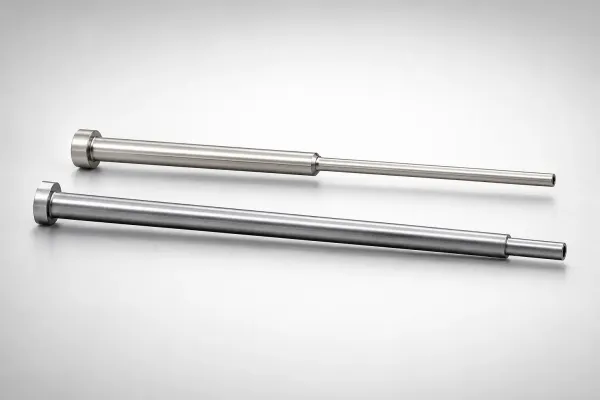
A submarine gate, also called a tunnel gate, is a round channel drilled at an angle through the mold. It dives under the parting line and pops up into the cavity. Melt flows through the tunnel during injection, and when the mold opens the part pulls away and shears the gate off automatically. That automatic trim is the whole point: it keeps two-plate simplicity while removing the hand-trim labor that edge gates on hidden faces would need.
Sizing. Tunnel diameter runs 0.8-2.0 mm typical, scaled to shot volume and wall thickness. The angle from the parting line sits between 20 and 45 degrees. Under 20 degrees the shear lip tears instead of cutting, leaving a ragged witness.
Over 45 degrees the tunnel gets long, pressure loss climbs, and the pin that forms it becomes fragile. The exit lands 0.5-1.5 mm into the cavity wall so the vestige sits on the back face, never the visible side.
Steel and wear. The shearing action cuts steel too. Tunnel gates need a hardened insert at HRC 58-62, usually in H13 or S7 tool steel, wire EDM cut and lapped. A tunnel machined straight into pre-hardened P20 will ring and mushroom after 50,000-100,000 shots. Budget typical $200-$500 per gate for the insert and EDM, plus replacement inserts in the spare parts kit.
Material limits. Submarine gates love ductile resins: PP, PE, ABS, unfilled PA. They hate brittle and fiber-filled resins. Glass-filled PA66 at 30% filler abrades the tunnel edge and can snap the gate vestige into the part instead of shearing clean.
PMMA and rigid PVC crack at the tunnel lip. For those materials, tab gates or hot runners take over.
Banana Gates: Tunnel Feed Away from the Parting Line
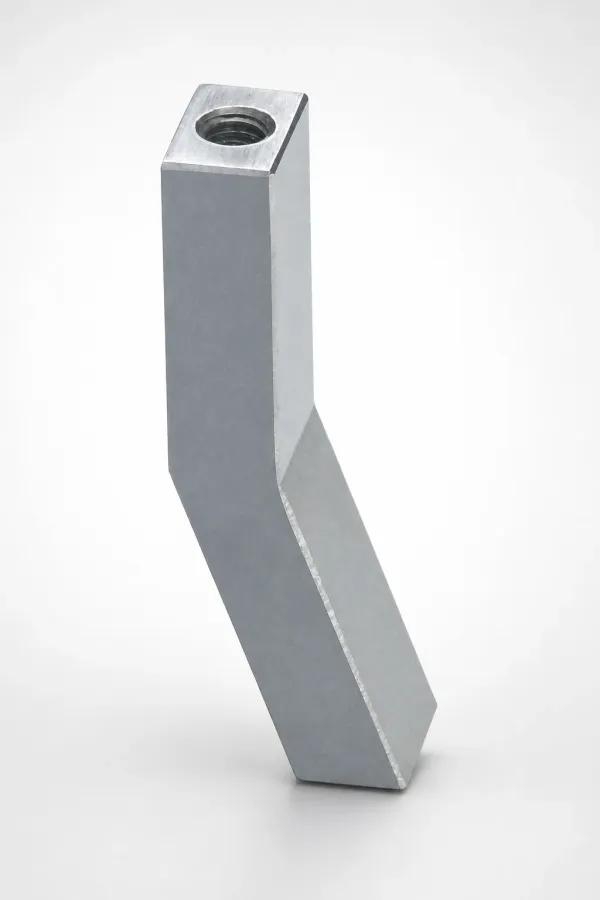
A banana gate is a submarine gate that curves through the core side instead of running straight. The channel bends like a banana, usually a 90-180 degree turn with a radius of 1.5-3x the tunnel diameter. The feed point lands far from the parting line. Designers reach for it when the natural tunnel exit would land on a visible face or a functional surface.
What it solves. On a two-plate mold for a glossy appliance panel, a straight tunnel would leave its vestige wherever the core block sits. A banana gate tunnels in and curves around. It surfaces on the back or an edge, keeping the Class A face clean.
It still auto-trims on mold open. Vestige height stays in the 0.2-0.5 mm range, comparable to a straight tunnel.
Machining reality. The curved channel cannot be drilled. It takes wire EDM through a hardened core insert, or a form electrode sunk into the block. That is why banana gates add typical $400-$800 per gate versus a straight tunnel.
The insert runs HRC 58-62 because the curve concentrates both shear and abrasive flow at the bend. Fiber-filled resins erode the inside radius first, so plan replacement inserts at 100,000-200,000 shots for 30% glass-filled material, and longer for unfilled PP or ABS.
Trade-offs. Pressure drop through the curve runs higher than a straight tunnel. Thin walls under 1 mm can short-shot unless you raise injection pressure or widen the channel. Ejection near the gate needs clearance for the vestige, and the longer flow path cools faster, tightening the fill window on small machines. Banana gates are the standard answer for two-plate consumer housings where cosmetics beat cycle simplicity, and they pair well with balanced multi-cavity runner layouts.
Tab Gates: Jetting Insurance for Clear and Brittle Resins
A tab gate, sometimes called a flush or overlap gate, feeds melt into a small cavity extension called a tab. Melt does not enter the part directly. Melt lands in the tab, slows, spreads, and only then flows into the main cavity as an established front. The tab is typically 2-5 mm long and 1-2x wall thickness wide, and it gets trimmed after molding or stays hidden inside the part envelope.
Why it exists. Low-viscosity resins, PMMA, PC, PA, POM, shoot through a plain edge gate as a free jet and snake across the cavity, leaving worm-track jetting marks. A tab gate kills the jet by giving melt a wall to hit and a pocket to fill first. For optical and clear parts this is the cheapest fix before jumping to a hot runner. Our guide covers the full mold-side playbook in how to prevent jetting.
Cost and labor. The tab pocket machines into the cavity edge for typical $150-$400 per gate. The real cost is secondary trimming. Tabs usually come off by hand at 10-30 seconds per part, or by a trim fixture.
If the tab sits at the parting line, ejection shears it automatically. For 500,000 parts a year, a manual trim at 20 seconds each adds up faster than the tooling ever did. High-volume clear parts often graduate to valve gates despite the price.
Best fit. Think clear lenses and light pipes, brittle PS and SAN housings, and thin PMMA panels. Any resin with melt flow index above 20 g/10 min that jets from a plain gate qualifies. Tab gates also reduce orientation stress at entry, which lowers birefringence in optical parts and cracking risk in PC.
Pin-Point, Fan, Film and Diaphragm Gates
Pin-point gates are round gates 0.5-1.5 mm diameter that feed from the sprue through a three-plate mold. The runner separates automatically on the second parting line. Vestige is a tiny dot, 0.3-1.0 mm proud, which is acceptable on non-cosmetic faces and even inside surfaces of containers.
The catch is architecture: three-plate molds add a runner stripper plate, 50-80 mm extra opening stroke, and a $3,000-$10,000 tool premium. Pin-point gates suit multi-cavity commodity molds, cups, closures, small housings, where cavity count matters more than plate count. We compare the full trade in two-plate vs three-plate molds.
Fan gates widen a single feed into a flat fan, 6-25 mm across and 0.5-1.5 mm thick. Melt enters as a broad curtain instead of a jet. They serve wide flat parts, panels, trays, and reduce orientation and warp by spreading flow evenly. The fan leaves a witness line the full fan width, so it belongs on edges that get trimmed or hidden.
Film gates are the extreme of the fan: a slot spanning nearly the full part width, 0.25-1.0 mm thick. They fill thin, wide, flat parts, gaskets, diaphragms, thin lenses, with almost no orientation stress and no jetting. The gate witness runs the full width and always needs trimming. Machine cost is low, but the trim fixture and secondary op are not.
Diaphragm gates feed round hollow parts, tubes, bushings, filter housings, through a ring of slots around the core. They fill concentrically so the tube stays round instead of pulling to one side. Wall thickness uniformity holds within ±0.05 mm typical on precision tubes. The slots machine around a hardened core, adding typical $300-$700, and the ring vestige needs trimming on the open end.
Valve Gates: Sequenced Hot Runner Control
A valve gate is a hot runner gate with a hydraulically or pneumatically driven pin. The pin is 1-4 mm diameter typical and opens the gate on a timed sequence. Melt sits hot in the manifold until the pin lifts, then flows into the cavity, and the pin closes when the cavity reaches 90-98% fill. The gate leaves a clean circular witness, 0.1-0.3 mm proud. That is the smallest vestige of any gate type, with no gate string, no drool, and no freeze timing to tune.
What valve gating buys. First, it eliminates weld lines from multi-gate overlap. The pins open in sequence, so each flow front pushes the next instead of two fronts meeting. Class A automotive interiors and appliance panels specify valve-gated hot runners for exactly this reason.
Second, it cuts runner scrap to zero, which pays back fast when the resin runs $30-$80 per kg or annual volume passes 100,000 parts. Third, pack control sharpens: the pin stays open through pack and closes on a set timer, so hold pressure transmits fully before freeze.
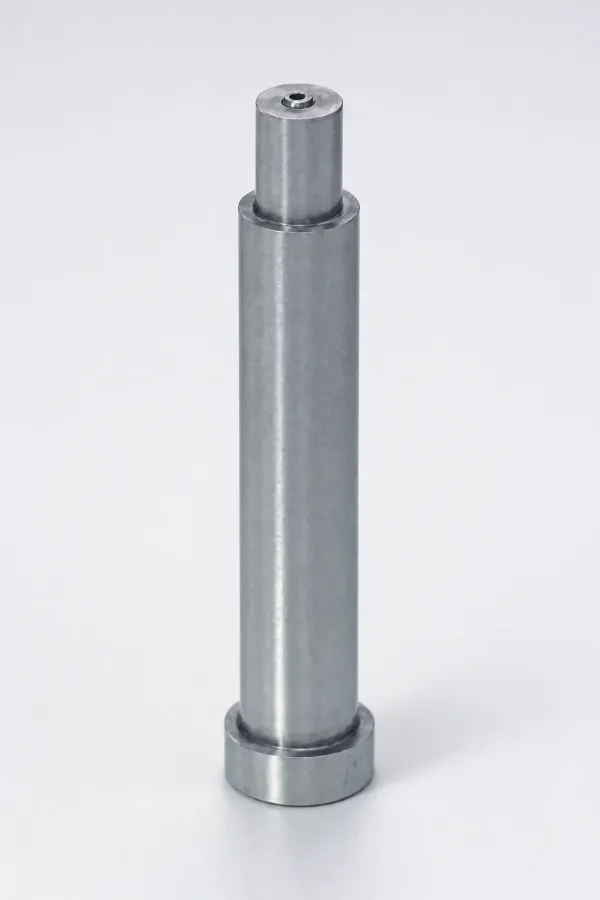
Cost and maintenance. Valve gate systems add typical $10,000-$25,000 to mold cost: the manifold, nozzles, pins, cylinders, and the sequencing hardware. Pins are wear parts, with service life of 500,000-2,000,000 shots depending on resin abrasiveness, and glass-filled materials sit at the low end. Pin bore concentricity to the gate seat must hold within 0.01-0.02 mm or melt leaks around the pin and freezes the valve shut.
That tolerance is why valve gate plates get ground and lapped, not just milled. It sits well inside the ±0.005 mm envelope we hold on critical mold dimensions.
When it is overkill. Under 50,000 parts a year with commodity resin, the payback rarely closes. A two-plate mold with tunnel gates at $500 per gate beats a $18,000 valve system on total cost. Run the crossover analysis on resin price, annual volume and trim labor before committing to the manifold.
Gate Vestige and Automatic Trim
Vestige height is the spec buyers forget to write. It is the material left after the gate separates: how proud, how wide, and whether it needs a secondary operation. Specify it per face in the drawing. Typical numbers by gate type:
| Gate Type | Typical Vestige | Trim Method | Cosmetic Class |
|---|---|---|---|
| Edge (parting line) | <0.3 mm on edge | Automatic or light hand trim | B/C faces |
| Sprue (direct) | 2-5 mm stub | Cut, grind or machine | Hidden faces only |
| Tunnel (submarine) | 0.2-0.5 mm | Automatic shear on mold open | B faces, C preferred |
| Banana | 0.2-0.5 mm, relocated | Automatic shear on mold open | A faces (gate hidden) |
| Tab | Tab trimmed off part | Hand or fixture trim, 10-30 s/part | A faces with secondary op |
| Pin-point | 0.3-1.0 mm dot | Automatic (three-plate) | B/C faces |
| Valve (hot) | 0.1-0.3 mm witness | None | A faces |
← swipe to scroll →
Table note: Vestige ranges are typical industry figures for well-built tools. Actual height depends on resin, gate land polish and pack settings.
Automatic trim changes the labor model. Tunnel, pin-point and valve gates all separate without a human. Hand trimming costs 10-30 seconds per part plus fixture cost, and it introduces variance and occasional damage to the gate area. On a 200,000-part program, 15 seconds of manual trim equals roughly 830 labor hours.
Automatic trim gates cost more in steel and EDM up front. They pay that back within the first production year on most volumes above 50,000 parts.
Gate Sizing Rules That Survive T1
Depth first, width second. The controlling dimension of any rectangular gate is depth, because it sets freeze time and shear. Start at 0.5-0.8x nominal wall. Thin-wall parts under 1 mm wall push toward 0.8x to keep the gate open through pack. Thick sections above 4 mm can go to 0.5x because freeze time is not the bottleneck.
Match gate freeze to part freeze. The gate must stay open roughly as long as the part needs pack pressure, typically within 1-2 seconds of the thickest section's freeze time. A gate that freezes 3 seconds early leaves sink on thick ribs, a defect we trace mold-side in our sink mark guide. Measure it at T1 with a seal study: ramp hold time until part weight stops climbing.
Respect shear limits. Shear rate through the gate should stay under 100,000 s⁻¹ for most resins, and under 40,000-50,000 s⁻¹ for fiber-filled materials to limit fiber breakage. A gate that is too small for the flow rate raises shear, degrades the resin, and shows up as burn marks or weak welds. Mold flow analysis catches this before steel is cut.
Land length 0.5-1.5 mm, no exceptions worth making. Zero land lets every polish or repair change the gate dimension. Long lands over 2 mm add pressure loss and freeze risk. The land is also where venting helps: 0.01-0.03 mm vent depth at the gate relieves trapped air on fast fills.
Balance multi-cavity sets by flow length, not cavity count. In a 4-cavity mold, identical gates feeding unequal flow lengths fill unequal cavities. Equalize runner lengths geometrically, or size gates per cavity to compensate, and verify with a short-shot study at T1. Our mold trial guide walks the T0-T1-T2 sequence and first article approval that closes the loop.
How Gate Type Changes Mold Cost
Gate decisions show up in the quote as line items most buyers cannot see. Here is where the money moves, in typical industry figures for a 4-cavity tool in the $40,000-$70,000 range.
Cold runner, edge gates, two-plate: the baseline. Gate machining adds under $100 per gate. Runner scrap runs 5-25% of shot weight and gets reground or lost. Cheapest tool, highest per-part scrap on commodity resin.
Tunnel and banana gates: $200-$800 per gate. Hardened HRC 58-62 inserts, wire EDM, lapped shear lips. Spare inserts recommended for programs over 500,000 shots. In exchange, trim labor drops to zero and the mold stays two-plate.
Pin-point gates: $3,000-$10,000 for the third plate. The gates themselves are cheap to cut. The runner stripper plate, extra opening stroke, and sprue puller hardware are what you pay for. Justified by cavity count and automatic degating on high-volume commodity parts.
Valve gate hot runner: $10,000-$25,000. Manifold, nozzles, pins, cylinders, controls, plus the thermal design in the mold plates. Payback comes from zero scrap, no weld lines, and clean Class A gates. Connector OEMs including TE Connectivity, Amphenol and Luxshare run valve-gated tools on high-cavitation programs where a single weld line fails an electrical spec.
The hidden line: rework. Every gate changed after steel cutting costs insert replacement plus EDM plus trial time. Our mold budgeting guide breaks the five cost levers, and gate architecture is one of the earliest and cheapest levers to pull correctly. Lock it in DFM, when design feedback is still free and measured in hours, not in weeks of rework.
Gate Selection Decision Table
Use this table as the starting argument, then validate with mold flow analysis on anything over 2 cavities or any Class A surface. Read rows as filters: material first, cosmetic class second, volume third, mold architecture last.
| Scenario | First Choice | Fallback | Avoid |
|---|---|---|---|
| PP/PE/ABS commodity part, B/C faces, any volume | Tunnel (20-45°), two-plate | Edge gate | Valve gate (overkill) |
| Glossy A-face housing, commodity resin | Banana gate, hidden exit | Valve gate hot runner | Sprue or pin-point on A face |
| Clear PMMA/PC optical part | Tab gate, or valve gate at volume | Film gate with trim op | Plain edge gate (jetting) |
| 30% glass-filled PA66 structural part | Edge gate, 0.7-0.8x wall, wide land | Valve gate (fiber shear control) | Tunnel (abrasion, rough shear) |
| Expensive resin ($30-80/kg PEEK/PEI), low volume | Sprue gate, single cavity | Hot tip, no valve pin | Large cold runner |
| Automotive Class A interior, 250k+/year | Valve gate sequenced hot runner | Banana gate if budget-capped | Anything with hand trim |
| Thin-wall flat panel (wall <1 mm) | Fan gate, 0.8x wall depth | Edge gate with wide land | Pin-point (fill pressure loss) |
| Round tube or bushing, concentricity critical | Diaphragm gate ring | Three edge gates at 120° | Single sprue gate (off-center pull) |
← swipe to scroll →
Table note: Starting positions from typical industry practice. Final gate choice should pass mold flow simulation and a T1 short-shot study before mass production.
Validate before you commit steel. Every row above is a hypothesis until simulation and T1 confirm it. Fill pattern, weld line position, gate freeze and fiber orientation all get predicted in mold flow and proven with short shots at 70-95% fill. A 4-hour simulation typically costs less than one insert rework, which runs $800-$2,500 typical.
FAQ
Q1. What is the cheapest gate type for a production mold?
The edge gate on a two-plate cold runner mold. It machines as a simple pocket for under $100 per gate typical, needs no inserts or EDM, and keeps the mold architecture at two plates. Its cost shifts to per-part labor if the vestige lands on a visible face and needs trimming.
Q2. Which gate hides its vestige from a Class A surface without a hot runner?
The banana gate. It curves through the core and exits on a hidden face or edge. It still auto-trims on mold open and leaves a 0.2-0.5 mm vestige off the visible side. It adds typical $400-$800 per gate for the wire EDM'd hardened insert versus a straight tunnel.
Q3. When does a valve gate hot runner pay for itself?
Typically above 100,000 parts a year. It also pays when resin costs $30-$80 per kg, or when a weld line would fail a Class A or electrical spec. The system adds $10,000-$25,000 to tool cost, and zero runner scrap plus no trim labor closes that gap within one to three production years.
Q4. Why do tunnel gates fail on glass-filled resins?
Glass fiber abrades the shear lip and the frozen gate snaps ragged instead of cutting clean. With 30% glass-filled PA66 the insert edge rounds off well before 100,000 shots unless hardened to HRC 58-62 and lapped. Edge gates with 0.7-0.8x wall depth or valve gates handle filled resins better.
Q5. How deep should a gate be relative to wall thickness?
0.5-0.8x nominal wall thickness for rectangular gates, with a 0.5-1.5 mm land. Thin walls under 1 mm push toward 0.8x so the gate stays open through pack. Verify freeze timing at T1 with a seal study: extend hold time until part weight stops increasing.
The Bottom Line
Gate type sets vestige, trim labor, scrap and tool cost before steel is cut. Match material and cosmetic class first, then volume, then architecture. Get it wrong and rework runs $800-$11,000 per insert plus weeks of schedule.
DieStrike builds IATF 16949 injection molds to ±0.005 mm with 2-5 week lead times. Free 24-hour DFM review means the gate decision gets argued with data while it is still cheap. Send your part drawing through our contact page and we will return gate recommendations with the quote.
KEEP READING
Related Reading
7 Gate Design Best Practices for Balanced Filling
Mold-side gate rules: depth 50-80% of wall thickness, land 0.5-1.5 mm, balanced multi-cavity filling and vestige control.
Read articleArticleHow to Design Cold Runners: Sizing, Layout and Scrap Rules
Full-round, trapezoidal and half-round runner sizing, sprue taper 2-4 degrees per side, cold slug wells and regrind limits.
Read articleArticleHot Runner vs Cold Runner: Which Is Right for Your Mold?
Hot runners cut 10-30% runner scrap and add $3,000-$15,000 tool cost. The 100,000 parts per year crossover explained.
Read articleServiceMold Design and DFM
Free 24-hour DFM feedback: gate and runner design, mold flow analysis, steel selection and firm quotation for your tooling.
Read articleNEXT STEP
Ready to Start Your Mold?
Send us your element dimensions or part numbers — our team responds within 24 hours with pricing and lead time.

Written by
Ray ChanMold Buyer's Guide Author · Precision Mold Manufacturing Specialist. Ray helps global importers, distributors and OEMs source factory-direct molds and mold parts.