
Anti-Galling Coatings for Stamping Dies: Choose by Material Risk
Table of Contents
A 4-station progressive die blanking 1.2 mm 5052-H34 aluminium ran clean for 3,400 hits, then a grey smear appeared on the punch faces and burr height climbed past 0.15 mm within one shift. The press stopped for two shifts while punches went out for polish and re-coat, and the launch schedule slipped eight days. This page addresses the decision that prevents that stop: coatings are chosen against the sheet material, not against the die steel.
The broad causes and cures live in the galling prevention guide. This page covers the selection decision only: which surface treatment and lubricant pairing buys what, grade group by grade group, with onset numbers and re-coat intervals.
The Snapshot
- 1,000 to 5,000 hits. Pure aluminium 1000 to 5000 series and soft copper cold-weld to an uncoated HRC 60 to 62 punch face inside that band. A 2 to 4 micron TiCN PVD layer moves the same pair past 100,000 hits.
- 1 to 3 GPa at the asperity. Even a lubricated punch sees 1 to 3 GPa contact pressure on its highest asperities. The boundary film collapses there first, and that is where transfer starts.
- Friction coefficient 0.05 to 0.1. DLC amorphous carbon at 1 to 3 microns cuts the punch-to-sheet friction coefficient to roughly a third of polished tool steel, and it is the default answer on SUS304 work.
- Re-coat at every regrind. Hand polishing removes 2 to 5 microns per pass, so a coated insert that is touched must be stripped and re-coated. Budget 3 to 7 days for standard recoat turnaround.
Galling Risk Map by Sheet Material
Start with the sheet, because the sheet decides the mechanism. Pure aluminium in the 1000 to 5000 series is the worst common workpiece on a steel die. It is soft, it has a tenacious oxide that fragments under pressure, and it welds metallurgically to clean steel. Uncoated punches on 1100 or 5052 show visible transfer within 1,000 to 5,000 hits, and the punch is unsalvageable by 20,000 if nothing changes.
Soft copper and oxygen-free low-brass strip behave the same way, with cold-weld onset in the same 1,000 to 5,000 hit band. Phosphor bronze at C5191 runs slightly better than pure copper because it work-hardens, but it still needs a coated punch on anything above 200,000 hits of planned life.
Austenitic stainless is the second tier. SUS304 does not weld to the punch in a solid cap the way aluminium does. It work-hardens at the surface, and flakes of hardened oxide break off and score the die in streaks. Onsets appear from 5,000 to 20,000 hits on uncoated tooling, and the damage is directional: the streaks follow the strip path and grow 0.02 to 0.05 mm deeper every 10,000 hits.
Zinc-coated AHSS and galvanneal are a third mechanism. The zinc does not weld steel to steel; it smears into the die face and builds a zinc-rich deposit that changes the die geometry by 0.05 to 0.2 mm over 50,000 hits. The coating slows the pickup but does not stop it, so the galvanneal answer is a smooth, low-surface-energy layer plus a controlled film of drawing lubricant.
Mild steel closes the map. DC01 and similar rimmed steels barely gall on a polished, hard die under normal lubrication. If you see transfer on mild steel, look first at clearance, at coating on the mating side of the assembly, or at a lubricant that has been skipped, not at the coating selection.
Why Hardened Steel Still Picks Up Aluminium
The first question a buyer asks is why an HRC 62 punch galls at all. The answer sits at the asperity scale. A ground or polished die face of Ra 0.2 micron still carries peaks 0.05 to 0.4 microns above the mean plane. Nominal blanking pressure of 500 to 1,500 MPa concentrates on those peaks, and true local contact pressure reaches 1 to 3 GPa.
At 1 to 3 GPa, a boundary lubricant film of 0.1 to 1 micron is squeezed out of the contact. Clean iron meeting clean aluminium at fresh metal temperature welds on contact. That micro-weld shears in the next stroke, and shearing is not symmetric: the aluminium-to-steel joint is usually stronger than the aluminium bulk, so a fragment of sheet stays on the punch instead of returning to the strip.
Once a speck of aluminium is anchored, it becomes a new die surface. Fresh strip welds to the exposed aluminium faster than to steel, the lump grows, and the process runs away. The runaway is visible: burr rises, hole position drifts by 0.05 to 0.2 mm, and strip-web tension spikes. The trigger is one asperity weld at 1 to 3 GPa, and every countermeasure on this page either lowers that peak pressure or removes the iron-to-aluminium pair from the contact.
Coating Decision Table by Material Risk
| Coating | Thickness | Hardness | Best on | The catch |
|---|---|---|---|---|
| TiCN PVD | 2 to 4 microns | 2,500 to 3,000 HV | Aluminium, copper | Needs an HRC 60+ substrate, size grows 2 to 4 microns |
| TiAlN PVD | 2 to 4 microns | 2,800 to 3,300 HV | Hot forming, high heat inputs | Oxidizes above 800 C, overkill on cold work |
| DLC amorphous carbon | 1 to 3 microns | 1,500 to 3,000 HV | Stainless, galvanneal, aluminium | Needs a polished substrate, re-coat every regrind |
| Hard chrome | 25 to 60 microns | 800 to 1,000 HV | Aluminium drawing, low budgets | REACH restricted in some EU supply chains |
| Gas or plasma nitriding | 10 to 20 micron case | 900 to 1,200 HV | Large dies, deep draws | Modest anti-adhesion, best as a fallback |
| Polish only, uncoated | Ra 0.1 to 0.2 microns | Base steel 60 to 62 HRC | Mild steel, short runs | Any gall-prone material fails in under 20,000 hits |
← swipe to scroll →
Table note: thickness, hardness and behavior bands are typical published values for production stamping tooling. Confirm the coating specification against your supplier process sheet and the substrate hardness measured on the actual inserts.
PVD Carbide Layers for Aluminium Work
TiCN and TiAlN are the default answer when the sheet is aluminium or copper. Both are physical vapor deposition layers of 2 to 4 microns, harder than any tool steel at 2,500 to 3,300 HV, and both chemically dislike aluminium. Iron and aluminium weld at fresh contact; titanium nitride does not offer the same metallic bond, so the micro-weld either never nucleates or shears cleanly back into the strip.
The deposition cycle runs at 150 to 350 degrees Celsius, below the tempering point of hardened tool steel, so an HRC 60 to 62 insert keeps its hardness. That is why PVD goes on after heat treat and finishing, and why the substrate must already be hard. A PVD layer over HRC 45 pre-hardened steel is a ceramic shell over soft metal; under 1 to 3 GPa asperity load the shell cracks and spalls within hours. Substrate selection comes first, and the site's stamping die steel guide covers that choice grade by grade.
PVD changes one number shops forget: punch size. The layer covers every surface, so a 10.000 mm punch grows to 10.004 to 10.008 mm. On blanking, that eats into the 8 to 12 percent per-side aluminium clearance, and on a 1.2 mm sheet the 0.10 to 0.14 mm allowance shrinks by 4 to 8 microns.
On a coining detail at 2 percent clearance the shift is no longer tolerable, so the coating must be quoted into the machine dimension before grinding. The punch clearance article works through the band-by-material table.
Expect TiCN on aluminium work to lift onset from 1,000 to 5,000 hits uncoated to 100,000 to 300,000 hits. The spread comes from lubricant coverage and strip cleanliness, which is why the maintenance loop records actual onset per material and coating pair instead of trusting the datasheet.
DLC Amorphous Carbon for Stainless and Aluminium
Diamond-like carbon is a 1 to 3 micron amorphous carbon film with a friction coefficient of 0.05 to 0.1 against steel-to-steel contact of 0.15 to 0.25, dry. That low friction is the point. If the tangential force at the punch-to-sheet interface drops by two thirds, asperity junction growth slows, and the aluminium or stainless fragment has less shear traction pulling it off the die. On SUS304, where the failure mode is work-hardened transfer streaking, DLC typically lifts onset from 5,000 to 20,000 hits to 50,000 to 150,000.
The catch is the substrate. DLC is thin and hard, so it telegraphs everything underneath. Specify a polished face at Ra 0.1 to 0.2 microns before coating, and a compound edge radius that keeps the film from bridging a sharp corner, because a 2 micron film over a sharp edge thins to near nothing. The full process, cost and life comparison sits in the DLC coating guide.
DLC also dislikes heat above roughly 300 to 400 degrees Celsius and dislikes a starved contact. Hydrogenated films graphitize and lose hardness when a hot forming stroke holds them past their window, so DLC belongs on cold stamping of stainless, aluminium and galvanneal, not on hot stamping dies. And because hand polishing removes 2 to 5 microns per pass, a DLC insert touched on the shop floor is a DLC insert stripped and re-coated. Build that cycle into the regrind schedule, not into a surprise.
Where aluminium is the only material and budget drives the answer, note that TiCN usually costs less per insert than DLC and lasts comparably on cold-weld resistance. DLC earns its premium when friction itself is the problem: stainless galling, sticky galvanneal smearing, and deep-draw walls sliding over binder radii.
Nitriding and Hard Chrome: The Cheaper Routes
Gas or plasma nitriding diffuses nitrogen into the surface to grow a 10 to 20 micron compound layer of epsilon iron nitride at 900 to 1,200 HV. The layer is metallurgically part of the steel, so it cannot spall the way a thin PVD shell can on a soft substrate, and dimensional change is small, mostly growth of 3 to 8 microns. Its anti-adhesion against aluminium is real but modest, roughly a two to four times onset lift, not the ten to fifty times a carbide or carbon film delivers.
Nitriding is the fallback where PVD is impractical: dies too large for the coating chamber, one-off repair inserts that cannot wait a week for coating, or cast tool bodies on short programs. It is also the correct first step under a solid lubricant topcoat, and the decision logic against PVD is expanded in nitriding versus PVD.
Hard chrome of 25 to 60 microns remains the low-budget anti-gall layer, and its micro-crack network usefully holds draw oil. It releases aluminium well, survives strip-back and re-plate, and costs less per part than PVD on simple geometries. Two problems cap it. The hardness stops at 800 to 1,000 HV, well below any carbide film, so onset lift on severe pairs is smaller. And hexavalent chromium plating is REACH-restricted in the EU and rejected in some automotive and consumer electronics supply chains, so a chrome-coated die can fail a customer audit even when it stamps perfectly.
Lubricant Chemistry Matched to Severity
No coating on this page works without the lubricant, and no coating is needed if mild steel is the only thing you stamp. The coating decision and the oil decision are one decision. Match viscosity to severity first: blanking and light piercing run 50 to 100 cSt so the film does not hold the strip against the die, forming and drawing move to 150 to 400 cSt or a paste, and stainless work wants the high end with extreme-pressure additives.
The boundary layer is where anti-gall chemistry earns its price. Chlorinated paraffins at 5 to 20 percent react with fresh metal at asperity hot spots to plate a sacrificial iron-chloride film, which is why chlorinated drawing oils stop aluminium pickup so well. Fatty-acid soaps, typically sodium or potassium stearate, form a physical film good to roughly 200 degrees Celsius and work as the baseline on mild and galvanized steels. Synthetic esters sit between the two: cleaner in the press, easier to remove, and more stable than soap films on stainless. Many plants now reject chlorinated chemistry for worker-exposure and wastewater reasons.
Over-oiling has its own failure. A flood of high-viscosity oil trapped under a blank holder or binder goes hydrostatic, and the sheet wrinkles before the punch reaches bottom dead center, with wrinkle amplitude of 0.5 to 2 mm that no coating fixes. Apply oil where the contact needs it: a metered roller or spray on the strip face that rides the die, not a bath on the whole coil.
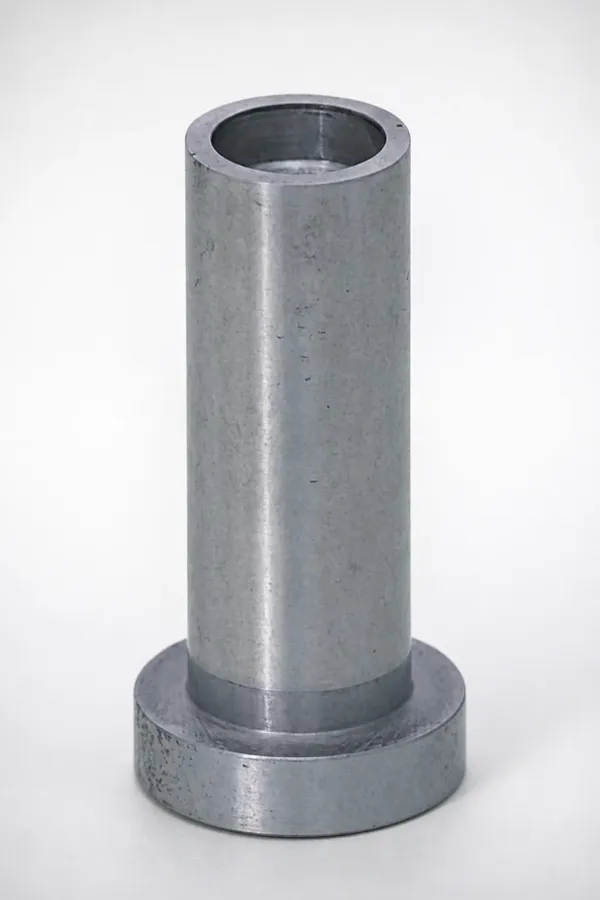
Extra lubrication stations between draw stations cost less than one re-coat and do not require a coating window at all. On a 5-station aluminium draw, two added spray nozzles at stations 3 and 4 can lift the uncoated onset band by a factor of two on their own, which is a cheaper first move than sending punches out for DLC.
Material Risk to Countermeasure Matrix
This is the selection sheet: the material group down the left, the countermeasure stack across the right. It collapses everything above into one decision per row, with the uncoated onset as the triage number.
| Sheet group | Risk | Uncoated onset | First countermeasure | Lubricant |
|---|---|---|---|---|
| Aluminium 1000 to 5000 | Severe | 1,000 to 5,000 hits | TiCN PVD 2 to 4 microns, both die and punch faces | 150 to 400 cSt, EP or chlorinated where allowed |
| Copper and soft brass | Severe | 1,000 to 5,000 hits | DLC or TiCN, polished to Ra 0.1 micron first | 50 to 150 cSt light oil, avoid sulfur stains |
| SUS304 austenitic | High | 5,000 to 20,000 hits | DLC 1 to 3 microns on forming radii and punches | 200 to 400 cSt EP paste on draws |
| Galvanneal AHSS | Medium | Zinc smear, 10,000 to 50,000 hits | DLC or TiAlN plus scheduled wipe-down | Metered film, over-flood lifts zinc into the gap |
| Mild steel DC01 | Low | Rarely galls | Polish plus nitriding for wear | Soap-film or synthetic, 50 to 150 cSt |
← swipe to scroll →
Table note: onset bands are typical production observations for uncoated HRC 60 to 62 tooling with normal lubrication. Record your own onset per material, coating and press pair before reusing these numbers for planning.
Coating Life Versus Cost Comparison
Selection is a cost-per-hit decision, so put life and price on the same row. The cost index below is relative to an uncoated finished insert, typical of short-run shop quotes for standard steel punch components of 50 to 150 mm. Coating shop rates vary by region and geometry, and the numbers only work as ratios.
| Route | Cost index | Onset on aluminium | Re-coat window |
|---|---|---|---|
| Uncoated polished | 1.0x | 1,000 to 5,000 hits | Not applicable |
| Nitriding | 0.6 to 1.2x | 5,000 to 20,000 hits | Re-nitride after 2 to 3 regrinds |
| Hard chrome | 0.8 to 1.5x | 20,000 to 80,000 hits | Strip and re-plate at wear band |
| TiCN PVD | 1.5 to 2.5x | 100,000 to 300,000 hits | Re-coat at every regrind |
| DLC | 2.5 to 4.0x | 100,000 to 250,000 hits | Strip, polish, re-coat each regrind |
← swipe to scroll →
Table note: ratios of typical shop quotes for standard punch and insert geometries; onset bands on 5052- type aluminium. A die stopping twice a shift is not a coating question, it is a downtime question, and the 2.5x index pays for itself below roughly 100,000 hits per change.
Read the cost table against the program, not the datasheet. A 20,000-hit pilot run on a lamp bracket is a nitrided or chrome tool. A 500,000-hit battery tab program on 3003 aluminium is TiCN or nothing, and the coating line item is noise against press downtime saved.
Maintenance Loop and Galling Onset Records
The loop that keeps any of this running is a schedule, not a feeling. Inspect the first-streak surfaces at fixed intervals set to roughly 10 percent of the onset number you recorded for that material and coating pair, so a 100,000-hit onset earns a look at 10,000 hits, not at 90,000. Under a lamp, transfer shows as a dull grey patch before it shows as a scratch.
Act at the streak, not at the gouge. A streak is a surface event: clean the face, re-polish the touched area or the whole land, and if polishing removed coating, send the insert for strip and re-coat. A 2 to 5 micron hand-polish pass through a 3 micron PVD film is a re-coat event whether the shop admits it or not. Once the die gouges, the fix is a regrind of 0.05 to 0.2 mm off the working face, which shortens the insert life and, on a coining or sizing detail, changes the part. Every coated tool that is ground must be re-coated.
Keep the record. Log hits-at-onset, hits-at-stop, coating type, oil batch and strip supplier for every material and coating pair, on the die record or in the maintenance file. That log becomes the estimator: after one year it tells you whether TiCN beat chrome on your particular 0.8 mm alloy, and which coil supplier delivers the oxide that starts transfer early. The stamping die manufacturing service builds recoat intervals into the tool file the same way, because the maintenance plan is a design output, not an afterthought.
Design Levers That Reduce Coating Load
A coating buys time against contact pressure, and the design levers reduce what the coating has to survive. The first lever is contact length. Shorten the punch-to-sheet bearing band wherever the drawing allows; a forming punch riding 2 mm of wall contact sees a fraction of the frictional work of one dragging 10 mm. Reduce stripper contact pressure to 0.2 to 0.5 MPa on aluminium instead of the 1 MPa a heavy-duty stripper might run, and the strip stops being polished against a dry face.
The second lever is clearance and radius. On blanking aluminium, the 8 to 12 percent per-side band already reflects that soft sheet smears rather than shears; drop to steel-band 5 to 8 percent on aluminium and the cut drags, the punch wedges, and contact pressure climbs straight past the asperity limit that starts the weld. On forming, hold inside radii at 3 to 4 times sheet thickness for stainless and aluminium where the design permits, because a tight radius concentrates sliding distance on a small arc of coating.
The third lever is symmetry. Galling transfer migrates to whichever face is softer, so a coated punch pushing uncoated die buttons just moves the smear 20 mm away. Coat the whole sliding pair. The fourth is the press itself: a servo press holds constant speed and dwell control, a mechanical press slams its bottom dead center, and sliding contact work at bottom is exactly where a thin film starves. If a tool keeps galling on schedule, check burr growth against the punch clearance drift first, because rising burr is often clearance wandering, not coating failing, before buying a more expensive layer.
Anti-Galling Coating FAQ
Q1. Which coating stops aluminium galling first, PVD or DLC?
TiCN PVD at 2 to 4 microns is the standard aluminium answer and usually costs less. DLC at 1 to 3 microns adds a friction coefficient of 0.05 to 0.1, so it wins when sliding distance is high, on stainless and deep draws. On plain blanking of 1000 or 5000 series, TiCN first.
Q2. Can I just polish and re-polish a gall-prone punch?
Only where the part allows the size change. Polishing removes 2 to 5 microns per pass, and on a coated tool it removes the coating as well. Repeated polish on an uncoated face resets roughness but not the steel-on-aluminium pair, so onset returns faster each cycle.
Q3. Is hard chrome still a valid answer in 2026?
Technically yes at 25 to 60 microns, and its micro-cracks hold oil well. Commercially it depends on the customer: hexavalent plating is REACH-restricted and rejected in some automotive and electronics supply chains. Confirm the restricted-substances list before you specify it.
Q4. My coated die still galls at 30,000 hits. What do I check?
Check the substrate hardness first; a PVD shell under 2 to 4 microns over soft steel will spall. Then check clearance drift and lubricant coverage on the exact face. Finally confirm the coating actually reached the area, since blind pockets and sharp corners shield surfaces in PVD.
Q5. Which is cheaper on a 400 mm transfer die, nitriding or PVD?
Nitriding, usually decisively, because large blocks strain chamber capacity and fixturing. Nitriding lifts aluminium onset two to four times instead of ten to fifty, so on severe materials it is a fallback where PVD is impractical, not an equal.
The Bottom Line
Coating selection for stamping dies starts at the coil, not at the coating catalog. Aluminium and copper cold-weld within 1,000 to 5,000 hits and demand TiCN or DLC at 2 to 4 microns over an HRC 60-plus substrate. SUS304 streaks at 5,000 to 20,000 hits and answers to DLC friction of 0.05 to 0.1. Galvanneal smears zinc and wants a smooth film plus metered lubricant. Mild steel forgives everything.
A coating is only as good as the oil under it and the re-coat schedule after it. Log every onset number in the die record so the next tool is chosen from data, not from hope.
KEEP READING
Related Reading
How to Select Stamping Die Steel: Grades by Wear Mode
Substrate steel choices that decide whether a 2 to 4 micron PVD layer has anything to stand on.
Read articleArticleHow to Prevent Stamping Burr: Causes and Corrections
Burr height is the first visible symptom of a coating that has started to gall and pick up material.
Read articleArticleHow to Maintain Punch Clearance in Progressive Dies
Clearance bands by material and how a 4 micron coating shifts the number you set on the draw.
Read articleServiceStamping Die Manufacturing
In-house progressive, transfer and fine blanking dies with PVD and DLC coating planning built into the DFM.
Read articleNEXT STEP
Ready to Start Your Mold?
Send us your element dimensions or part numbers — our team responds within 24 hours with pricing and lead time.

Written by
Ray ChanMold Buyer's Guide Author · Precision Mold Manufacturing Specialist. Ray helps global importers, distributors and OEMs source factory-direct molds and mold parts.