
Ejector Pin Steel: SKD61 vs H13 — What's the Difference?
Table of Contents
A 64-cavity connector mold runs 1,000,000 cycles a year on pins specified as "SKD61." A parallel program in the same plant runs the same mold on pins specified as "H13." Both molds eject the same part at the same rate, and both pin sets wear at the same pace. The procurement teams are arguing about a chemistry difference that, in ejector pin service, barely exists. SKD61 and H13 are two national standards for the same family of 5% chromium hot-work tool steel, and for ejector pins the practical difference is documentation, not performance.
That does not make the choice meaningless. Certification, traceability, and heat-treatment consistency decide whether your pins behave like the datasheet, and those vary with the supplier far more than the grade varies with the standard. This guide compares SKD61 and H13 pin-for-pin, shows where each genuinely wins, and then covers the decision that actually moves pin life: coating, hardness, and fit.
One number frames the whole comparison. Ejector pins in both grades are hardened to HRC 48-52 for standard ejection service, and both handle the loads a pin sees: compression under ejection force, sliding wear against the bore, and occasional bending from part stick. When a pin fails early, the cause is almost never the grade. It is the fit, the coating, the cooling, or the part geometry.
The Snapshot
- SKD61 is the JIS designation and H13 is the AISI designation for the same 5% chromium, molybdenum, vanadium hot-work steel.
- Ejector pins in both grades harden to HRC 48-52; the difference is certification and heat-treatment consistency, not chemistry.
- For abrasive resins, move to SKH51 (HRC 60-63) or add a TiN coating that extends pin life 2-3 times.
- DieStrike supplies pins in SKD61, H13, and SKH51 with ±0.002 mm diameter tolerance and 3-7 day standard-component lead times.
- Specify grade, hardness, clearance, and coating in the RFQ; the coating decision moves pin life more than the grade decision.
Two Names, One Steel Family
SKD61 is the Japanese Industrial Standard designation, and H13 is the American designation (AISI/SAE) for the same class of hot-work tool steel: roughly 5% chromium, with molybdenum and vanadium added for hot hardness and toughness. The two standards describe essentially the same composition, and both are heat treated the same way: austenitize, quench, then double or triple temper to the target hardness.
The steel was designed for hot-work service, dies, die casting, and extrusion tooling, where the tool surface runs hot and must resist softening. That heritage is exactly what ejection needs. Ejector pins slide against hot steel, absorb impact at the start of each ejection stroke, and run millions of cycles. The hot-work properties of the SKD61/H13 family are surplus to requirement in most ejection service, which is why pins in these grades run so long when the fit is right.
What differs between the two designations is the certificate. A pin sold as SKD61 carries a JIS certificate and is made to Japanese standard composition limits; a pin sold as H13 carries an AISI certificate and US standard limits. The composition windows overlap so closely that a single melt could satisfy both. If your customer documentation requires the AISI designation, you buy H13. If your plant standardizes on JIS, you buy SKD61. The mold does not care.
Equivalence matters for maintenance too. A mold built with SKD61 pins is serviced with SKD61 replacements, and a mold built with H13 is serviced with H13, because the tool room wants the certificate chain to stay consistent. Swapping one for the other mid-life works metallurgically but breaks the documentation trail that audits expect.
Chemistry: 5% Chromium Hot-Work Steel
The nominal composition of the family is 0.32-0.45% carbon, 4.75-5.50% chromium, 1.10-1.75% molybdenum, 0.80-1.20% vanadium, with small amounts of silicon and manganese (typical published ranges for both standards). Chromium gives hardenability and some corrosion resistance; molybdenum and vanadium give hot hardness and refine the grain; carbon sets the achievable hardness ceiling.
For ejection service, the chemistry shows up in three practical properties. First, hardenability: both grades harden reliably through the small cross-sections of an ejector pin, so the core and surface reach similar hardness. Second, temper resistance: the steel holds its hardness at the 80-120°C surface temperatures a pin sees in a normal mold, so hardness does not drift downward over a long run. Third, toughness: the grade resists the bending loads that come from uneven part stick.
Neither grade is a wear steel. The 5% chromium family has modest carbide content compared with high-speed steels, so in abrasive service, against glass-filled resin and the debris that collects between pin and bore, the surface wears. That is why the wear conversation belongs to SKH51 and coatings, not to SKD61 versus H13.
Corrosion is a non-factor for most pins. The chromium gives enough resistance for normal molding, but a pin running in a mold that sits humid between runs can still pit on the exposed tip. For corrosion-dominated service, the answer is a stainless pin or a coated pin, not an H13 versus SKD61 debate.
Heat Treatment and Hardness
Both grades are supplied to ejector pin hardness of HRC 48-52 in standard service, and the heat-treatment route is identical in shape: austenitize around 1000-1050°C, quench, then double temper at 540-600°C to land in the target band (typical published practice). The double temper matters more than the grade name, because it stabilizes retained austenite and sets the final toughness.
Hardness is a trade, not a target. Higher hardness, HRC 52-54, gives more wear resistance and less toughness; lower hardness, HRC 45-48, gives more toughness and less wear. Ejector pins sit at HRC 48-52 because that band balances both for standard ejection. If you need more wear, you do not harden SKD61 further, you switch material.
Heat-treatment consistency is where real pins differ. Two pins from the same melt can land 3 HRC apart if the temper cycle drifts, and a soft pin wears fast while a hard pin is brittle. A reputable pin maker certifies hardness per lot and holds the band tightly. When the DFM or procurement review asks for "SKD61 ejector pins," the hidden requirement is "SKD61 at HRC 48-52, certified."
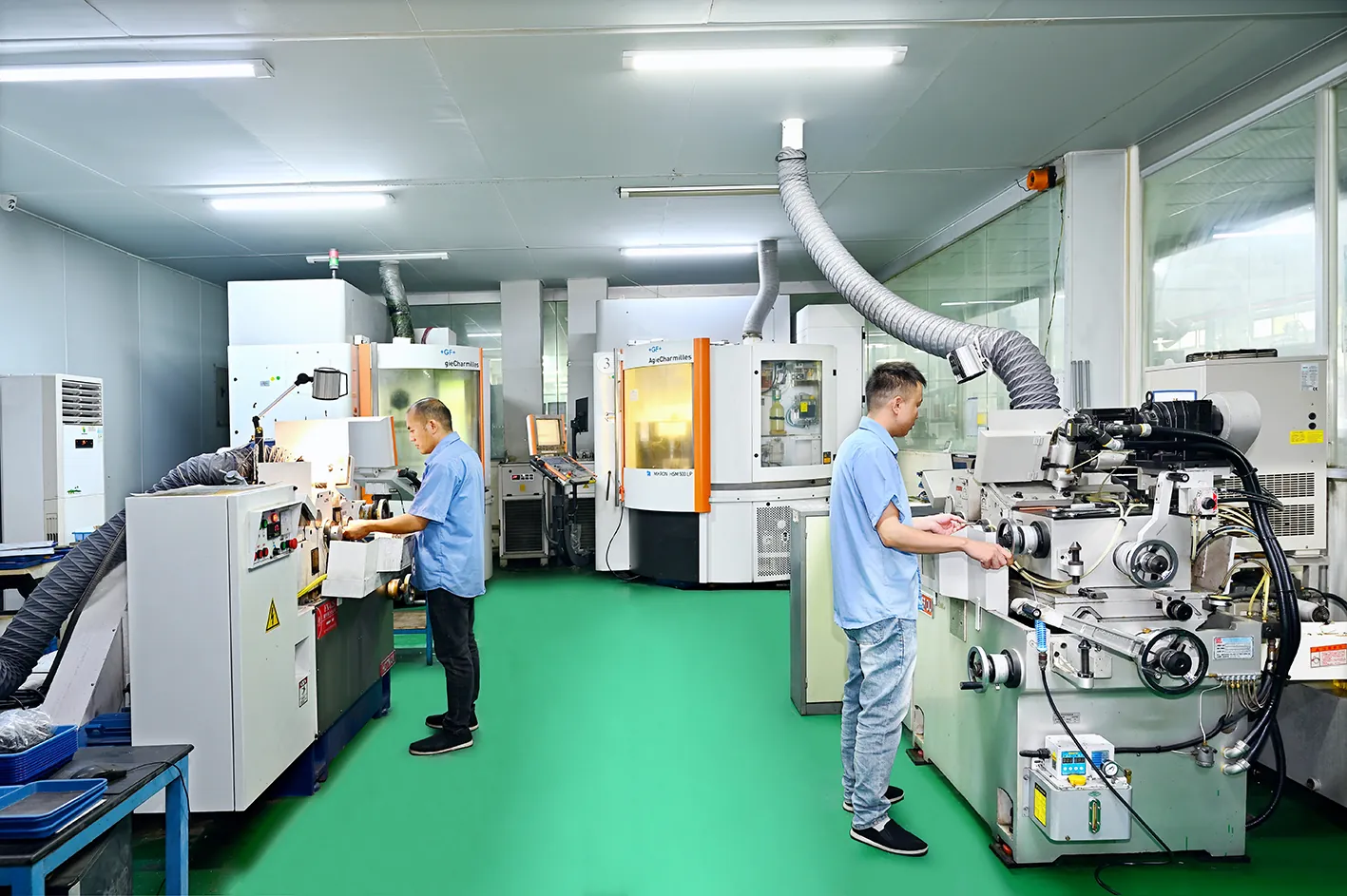
Verification separates the certificate from the claim. A pin certificate should state the measured hardness, and a spot check with a hardness tester, or a microhardness check on a sample pin, confirms the lot. Surface hardness matters as much as bulk: pins are sometimes nitrided for a hard case of 0.05 to 0.15 mm depth, and the case depth and surface hardness belong on the certificate alongside the core hardness. A pin that reads HRC 48-52 on the core but HRC 40 on the surface wears like a soft pin, which is exactly the failure a certificate hides.
DieStrike runs pins to the certified hardness band and verifies with spot hardness checks on the production lot. The same discipline applies whether the pin is SKD61, H13, or SKH51, because the certificate is the only thing that separates a good pin from a cheap pin with the same name.
Properties Compared
Side by side, SKD61 and H13 pins are functionally identical. The table below is the comparison a buyer actually needs, with the differences that matter called out honestly.
| Property | SKD61 (JIS) | H13 (AISI) | Practical impact |
|---|---|---|---|
| Chromium | 4.75-5.50% | 4.75-5.50% | None in service |
| Molybdenum | 1.10-1.75% | 1.10-1.75% | Hot hardness, none in service |
| Vanadium | 0.80-1.20% | 0.80-1.20% | Grain refinement, none in service |
| Hardness (ejector pins) | HRC 48-52 | HRC 48-52 | Same wear and toughness band |
| Temper resistance | Good to ~550°C | Good to ~550°C | None in ejection service |
| Toughness | Good | Good | Equivalent bending behavior |
| Wear resistance | Moderate | Moderate | Both need coating for abrasive resins |
| Certification | JIS certificate | AISI certificate | Documentation, not metallurgy |
| Availability in pin form | Standard in Asia | Standard in US/EU | Drives price and lead time |
← swipe to scroll →
Values are typical published composition and practice ranges. Confirm the exact datasheet with your steel or pin supplier.
The honest summary: the two grades are interchangeable in ejection service, and the differences that matter are the certificate chain, the heat-treatment consistency, and the supplier's tolerance control. Buying on price between the two is reasonable; buying from an uncertified source is not.
How Ejector Pins Fail
Pin failures get blamed on steel, and they are usually caused by something else. The failure modes below are the ones we see in repair work, ranked by how often they actually kill a pin.
| Failure mode | Root cause | Typical fix |
|---|---|---|
| Wear at the tip and land | Abrasive resin, tight clearance, debris | TiN or nitrided surface, larger clearance, SKH51 |
| Bent or buckled pin | Uneven part stick, thin pin on deep feature | More pins, larger diameter, better draft |
| Broken at the head | Impact load, misaligned ejector plate, hard stop | Check stroke and return springs, rework head seat |
| Galled and stuck in bore | Zero clearance, no lube, plating transfer | Ream bore, open clearance to 0.02-0.04 mm |
| Pitting and corrosion | Humid storage, aggressive additives | Coated or stainless pin, storage discipline |
← swipe to scroll →
Failure frequency varies with resin, mold design, and process. Treat the table as a diagnostic map, not a statistics sheet.
Two patterns repeat in repair work. First, thin pins fail by bending, and the fix is layout, not steel: more pins at a larger diameter or a sleeve around a core pin. Second, galled pins fail from clearance, not chemistry: a bore reamed to standard clearance of 0.02 to 0.04 mm and a pin with a clean surface run for years, while a zero-clearance assembly seizes in a shift. Our broken ejector pin repair guide works through the diagnosis step by step.
When SKD61 Wins
SKD61 wins when your supply chain and documentation run on JIS standards. Asian mold shops, most Chinese toolmakers, and plants with Japanese or Korean OEM customers standardize on SKD61, and the pin series interoperates with HASCO and DME ejector pin systems, which are dimensioned identically for standard diameters.
SKD61 is also the default choice when the pin selection happens inside a JIS-specified mold program. The mold base, the core pins, and the ejector pins all carry JIS designations, and the tool room stocks SKD61 blanks for every repair. Introducing H13 into that system breaks the stockroom logic without buying any performance.
Price follows availability. In Asian manufacturing, SKD61 pin stock is produced in high volume, so standard diameters in DIN 1530 or JIS series ship on short lead times, typically 3 to 7 days for standard components. If the program is built in Asia, the SKD61 pin is the cheaper, faster, equally capable option.
None of this is a metallurgical argument. It is a supply-chain argument, and it is the correct one: for a consumable that behaves identically in service, the lowest-friction supply chain wins.
When H13 Wins
H13 wins when the customer documentation demands the AISI designation. Automotive programs built to North American or European OEM requirements, aerospace subcontracts, and any PPAP package that lists steel by AISI grade will specify H13, and the pin must carry an H13 certificate to match the material list.
The certification requirement is not negotiable paperwork. In a PPAP Level 3 submission, the material certificate is part of the evidence package, and a pin labeled SKD61 where the drawing says H13 fails the audit even though the steel is equivalent. When the specification says H13, the supply chain buys H13.
H13 also appears when the mold maker's own standards run on AISI designations, which is common for US and EU toolrooms and for molds built for export into those markets. The repair stock, the drawings, and the maintenance manual all reference H13, and consistency beats cleverness.
As with SKD61, the choice is documentation-driven. If neither your spec nor your supply chain pins you to one standard, buy whichever is cheaper and better certified in your region, because the mold will not know the difference.
The pin-grade decision slots into the broader mold making workflow: ejection system design, bore clearance, and coating selection are resolved together with the cavity layout, cooling, and parting line during DFM. If your project needs the full ejection package engineered rather than a loose pin spec, our injection mold manufacturing service covers pin selection, assembly, and mold trials as one scope.
Beyond SKD61 and H13
The steel decision that actually moves pin life is the step up to high-speed steel. SKH51, the JIS designation for M2 high-speed steel, hardens to HRC 60-63 and carries roughly double the wear resistance of SKD61 or H13 at the same service temperature. For glass-filled resins, abrasive compounds, and long-run automotive molds, SKH51 is the standard upgrade.
Ejector sleeves are the other route. When the part has a deep boss or a thin wall, a solid pin bends where a sleeve around a core pin does not. Sleeve sets are specified as matched pairs with concentricity within 0.010 mm, and they distribute ejection force over a ring instead of a point. Our ejector sleeve versus ejector pin comparison covers when the sleeve wins.
Core pins are a separate decision entirely. A core pin forms a hole or a feature and stays in the mold during ejection; an ejector pin pushes the part out. They are made from the same steel families, SKD61, H13, and SKH51, but the sizing logic and failure modes differ, which is why we treat them separately in the core pin versus ejector pin guide.
The full selection story for demanding applications is in our connector mold ejector pin guide, which walks through diameters, clearance classes, coatings, and a selection gate for 1,000,000-cycle programs.
Coatings Change Real Performance
Pin life is dominated by the surface, not the bulk. A nitrided SKD61 pin gets a hard case for standard service, and a TiN-coated pin extends life 2 to 3 times on glass-filled resins (typical published performance). A coated SKD61 pin routinely outlasts an uncoated SKH51 pin, which is the sentence that should end most grade debates.
Coating choice follows the resin and the failure mode. TiN and TiCN suit abrasive wear and sliding; nitriding suits low-cost standard service; a DLC or CrN coating suits sticky resins where release matters. Each adds a small cost per pin and a large life multiplier, and the coating spec belongs in the RFQ so the supplier cannot quietly ship bare pins.
Coating interacts with fit. A coated pin adds 2 to 5 µm of thickness per side, and the bore clearance must be opened to match, typically to 0.02 to 0.04 mm total. Running a coated pin in a bore sized for a bare pin creates a press fit that seizes in the first shift. The DFM and the pin drawing should state the coated diameter and the clearance together.
The maintenance angle matters too. Coated pins wear in a controlled way, and replacing them on a schedule, typically when tip wear passes 0.01 to 0.02 mm, is cheaper than replacing them on failure. A coated pin with a scheduled replacement program is the lowest-cost solution for any mold running abrasive resin.
Coating is not always worth the cost. On clean unfilled resins like ABS or PP, a bare SKD61 or H13 pin already runs hundreds of thousands of cycles, and the coating premium buys little. The decision rule is resin-driven: coatings pay for themselves on glass-filled, mineral-filled, and flame-retardant compounds, and they are optional elsewhere. That is why the coating recommendation belongs to the DFM review, where the resin and the failure mode are both known.
How to Specify Pins in Your RFQ
A pin spec that reads "SKD61 ejector pins" is incomplete. The spec that gets you a predictable pin names five things: grade and certificate, hardness band, diameter tolerance, clearance class, and coating. DieStrike supplies pins at ±0.002 mm diameter tolerance with certificates for grade and hardness, which is the level a precision mold needs.
Write the clearance explicitly. Standard service runs 0.02 to 0.04 mm total clearance between pin and bore, and coated pins sit at the high end of that band. If the drawing does not state clearance, the mold maker decides, and the decision may not match the resin.
Name the head style and series. DIN 1530 forms A, B, and C differ in head configuration, and HASCO, DME, and MISUMI series differ in head dimensions. A pin that does not seat correctly in the ejector plate rocks, wears, and breaks at the head. Name the series in the RFQ and the supplier quotes the right part.
Finally, state the wear plan. Ask for the expected pin life at your cycle count, the replacement trigger, and whether coated spares ship with the mold. A mold that ships with spare coated pins and a written replacement threshold runs cheaper per year than a mold that waits for a failure. Our mold quote guide shows you which pin lines to check in the supplier's cost breakdown.
Frequently Asked Questions
Q1. Can I use SKD61 pins in a mold built to H13 specs?
Metallurgically yes, the grades are equivalent in ejection service. But if the customer documentation or PPAP package names H13, the certificate must say H13. Match the steel designation to the spec and keep the certificate chain clean.
Q2. Is SKH51 always better than SKD61 or H13?
For wear resistance, yes: SKH51 at HRC 60-63 outwears both. But it costs more and is less forgiving in tight-fit assemblies. Use SKH51 or a coated SKD61/H13 pin for abrasive resins and long runs; use standard SKD61 or H13 for normal service.
Q3. How much clearance should an ejector pin have?
Typical standard service is 0.02 to 0.04 mm total clearance between pin and bore, with coated pins at the high end. Too little clearance causes galling and sticking; too much causes flash and wear.
Q4. Does a TiN coating really double pin life?
On glass-filled and abrasive resins, coated pins typically last 2 to 3 times longer than bare pins of the same steel (typical published performance). On clean unfilled resins the gain is smaller, which is why the coating decision should follow the resin, not fashion.
Q5. What lead time should I expect for ejector pins?
Standard SKD61, H13, and SKH51 pins ship in 3 to 7 days from DieStrike. Custom diameters, coated pins, and matched sleeve sets run 7 to 10 days, and the RFQ should state which category your pin set falls in.
The Bottom Line
SKD61 and H13 are the same steel family under two standards, and in ejector pin service they are interchangeable. Choose by certificate and supply chain, not by metallurgy. The decisions that actually move pin life are hardness consistency, fit and clearance, coating, and the step up to SKH51 or sleeves for abrasive service.
Send your pin list or mold drawing to our ejector pin team and get certified SKD61, H13, or SKH51 pins at ±0.002 mm with 3-7 day standard lead times. If the application is abrasive or high-cycle, ask for the coating recommendation and the expected pin life in the same quote.
KEEP READING
Related Reading
ABS Injection Molding: The Complete Material Guide
ABS injection molding for buyers and mold engineers: shrinkage 0.4-0.
Read articleArticleLiquid Silicone Rubber (LSR) Injection Molding Guide
Liquid silicone rubber (LSR) is a two-component platinum-cured thermoset with -50°C to +250°C service life.
Read articleArticleNylon (PA) Injection Molding: Grades, Properties & Processing
Nylon (PA) injection molding guide: PA6, PA66, PA12, PA46 and glass-filled grades compared — melting points, shrinkage…
Read articleArticlePEEK Injection Molding: High-Temp Material Guide
PEEK injection molding for buyers and mold engineers: shrinkage 1.2-2.
Read articleNEXT STEP
Ready to Start Your Mold?
Send us your element dimensions or part numbers — our team responds within 24 hours with pricing and lead time.

Written by
Ray ChanMold Buyer's Guide Author · Precision Mold Manufacturing Specialist. Ray helps global importers, distributors and OEMs source factory-direct molds and mold parts.