
Mold Total Cost of Ownership: How to Compare Two Quotes
Table of Contents
A plant placed two molds for the same connector housing in 2024. One tool was quoted at $52,000, the other at $64,000. Procurement took the cheaper one and booked a 19% saving. Eighteen months later that cavity needed a full rebuild and unplanned stops had eaten 24 production hours. The 3-year cost landed $63,600 above the other tool, because purchase price hides most of the money.
The Snapshot
- A $52,000 mold with a 350,000 shot life can cost $145,100 over 3 years. A $64,000 tool with 1,000,000 shot life lands at $81,500.
- Tooling cost per part lands at $0.121 for the cheaper tool and $0.068 for the more expensive one across 1,200,000 parts.
- Amortizing purchase price alone shows a 23% gap in favor of the cheap tool, a number that reverses by 78% on full TCO.
- Unplanned downtime on a 100-500 ton press runs $600 to $1,500 per hour in lost output, labor and scrap.
- One extra second of cycle time costs $0.011 per cycle at a $40 per hour machine rate, or $6,700 per year at 200,000 cycles.
Why Two Quotes for the Same Part Diverge by 40%
Two suppliers quote the same drawing and the totals land 20-40% apart. Steel grade and heat treatment explain the first block. A P20 pre-hardened cavity at HRC 30-33 costs 30-50% less in material than H13 hardened to HRC 62. That single choice sets tool life at 300,000-400,000 shots instead of 1,000,000 or more.
Machining hours explain the next block, and they run 30-40% of a mold price. Deep ribs, tight radii and shut-off faces drive EDM and grinding time. A shop with 120+ machines spreads fixed cost across more spindles than a 20-machine shop. The same cavity can take 180 hours in one plant and 240 hours in another.
Standard components add a quieter 10-20%. Off-the-shelf mold bases, ejector pins, guide pins and springs ship in 3-7 days from catalog stock. A DME or HASCO standard part usually costs 20-40% less than a custom equivalent. A supplier quoting custom-everything is not necessarily more careful, just slower and dearer.
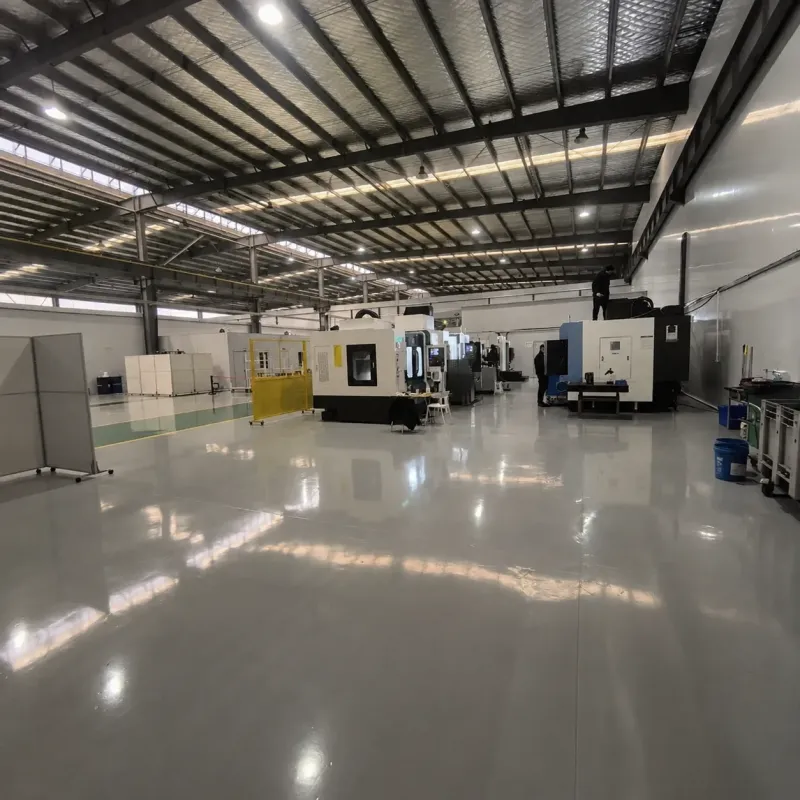
Everything above is visible in the quotation if you know where to look. The invisible part is what the buyer pays later, and that is where the 3-year spread comes from. Our walkthrough on how to read a mold quote line by line covers the seven callouts to check before comparing totals.
What Mold TCO Actually Includes: 7 Cost Buckets
Total cost of ownership for a mold covers every dollar the tool pulls out of the plant between purchase and retirement. Seven buckets appear in a normal 3-year window. Purchase price is only the first one, and it is the only bucket both quotes show.
1. Purchase price. The quoted number plus freight and duty, typically another 3-8% for cross-border delivery. Two quotes 25% apart on paper start this bucket at $12,000 of separation.
2. Cavity rebuild or replacement. A rebuild of a worn cavity set costs 25-45% of the original mold price. That is $13,000 to $23,000 on a $52,000 tool with a 350,000 shot life.
3. Preventive maintenance. Polishing, vent cleaning, alignment checks and corrosion control run $2,600 to $4,200 per year depending on steel grade and resin abrasiveness. Glass-filled nylon sits at the top of that range.
4. Spare and standard components. Ejector pins, core pins, springs and gate drops consume $600 to $2,100 per tool per year. A tool that was built with a spare parts package consumes the low end of that band.
5. Unplanned downtime. The highest unit cost in the model. A stopped 100-500 ton press costs $600 to $1,500 per hour once idle labor, scrap and recovery are counted.
6. Cycle time and energy. Each extra second of cycle costs $0.011 per cycle at a $40 per hour machine rate. Over 600,000 cycles that single second is worth $6,700.
7. Scrap and rework. Flash, short shots and dimensional drift push scrap from a 0.6% baseline to 1.8% on a tool with soft shut-offs. On a $0.55 part, 1.2 points of extra scrap across 1,200,000 parts is $7,900.
The 3-Year TCO Comparison: Two Quotes, One Answer
Run both quotes through the same model and the ranking flips. The example below covers a 2-cavity connector housing mold at 400,000 parts per year, or 200,000 cycles per year and 600,000 cycles across 3 years. Machine rate is $40 per hour fully loaded. Downtime is costed at $900 per hour, the middle of the observed $600 to $1,500 band.
Quote A is $52,000 with P20 pre-hardened cavity steel at HRC 30-33, a 30 second cycle, a 350,000 shot life and no spare parts package. Quote B is $64,000 with H13 hardened to HRC 62 and a 26 second cycle. It carries a 1,000,000 shot life and includes spare ejector pins and core pins.
| 3-year cost bucket | Quote A: $52,000, P20 | Quote B: $64,000, H13 | Delta over 3 years |
|---|---|---|---|
| Mold purchase price | $52,000 | $64,000 | A saves $12,000 |
| Cavity rebuild or replacement | $18,000 (one rebuild at 350,000 shots) | $2,500 (planned polish at 300,000 shots) | B saves $15,500 |
| Preventive maintenance | $12,600 ($350 per month) | $7,800 ($2,600 per year) | B saves $4,800 |
| Spare and standard components | $6,300 ($175 per month) | $1,800 ($600 per year) | B saves $4,500 |
| Unplanned downtime | $21,600 (24 hours at $900 per hour) | $5,400 (6 hours at $900 per hour) | B saves $16,200 |
| Cycle time cost | $26,700 (667 extra hours at $40 per hour) | Baseline, 26 second cycle | B saves $26,700 |
| Scrap above target | $7,900 (1.2 extra points on 1,200,000 parts) | At 0.6% target baseline | B saves $7,900 |
| 3-year total cost of ownership | $145,100 | $81,500 | B is $63,600 lower |
| Tooling cost per part | $0.121 | $0.068 | B is 44% cheaper per part |
← swipe to scroll →
Table note: Figures are typical industry values for a 2-cavity connector mold at 400,000 parts per year, rounded to the nearest $100. Machine rate $40 per hour, downtime $900 per hour.
The shape of the result matters more than the exact dollars. Purchase price is 36% of the 3-year total for the cheap tool and 79% for the expensive one. Buyers who compare only line one compare a minority share of the cost, and they compare it in the wrong direction.
Payback is short. The $12,000 premium returns in roughly 9 months once cycle, maintenance, spares and downtime savings accumulate at about $17,400 per year. Everything after month 10 is profit on the same part volume.
Amortization: Turning a Mold Price into Cost per Part
Amortization is the bridge between a capital number and a part cost, and it is where the cheap quote looks best. Divide $52,000 by 1,200,000 parts and the cheap tool amortizes to $0.043 per part. The $64,000 tool amortizes to $0.053, a 23% penalty.
That comparison is only as good as the lifetime in the denominator. The cheap tool cannot deliver 1,200,000 parts without an $18,000 rebuild. Once the rebuild sits inside the same 36-month window, the amortization spread closes and reverses.
Rule one: amortize over real demand, not over tool life. Amortize across the volume the program will actually run in 36 months. A 1,000,000 shot mold that only sees 600,000 cycles has no advantage in the amortization line.
Rule two: put rebuilds in the amortization period that contains them. A 350,000 shot tool needs one rebuild inside a 600,000 cycle program. Spread the $18,000 across the same parts and the real amortized cost is $0.058 per part before maintenance or downtime.
The 2026 price bands for reference: a 2-cavity precision mold typically lands between $40,000 and $90,000, while a single-cavity prototype tool runs $12,000 to $25,000. Our 2026 injection mold cost guide breaks those bands down by cavity count and steel grade.
Downtime Cost: The Line Missing From Both Quotes
Neither quotation carries a downtime line, and downtime is usually the largest uncontrolled cost in the model. A stopped press spends money three ways at once. Idle machine and labor run $35 to $90 per hour. Work in process becomes scrap, and the recovery shift runs below full output for 2-4 hours.
The observed range for a 100-500 ton press is $600 to $1,500 per hour fully loaded. Use $900 per hour as a planning figure and a single 8 hour unplanned stop costs $7,200. Three such events across 3 years is $21,600, which is 41% of the price of the $52,000 mold that caused them.
Cheap tooling fails in predictable places. Soft P20 shut-off faces wear past 0.02-0.03 mm and start flashing. Ejector pin heads seat deeper as the pin plate wears, so pins break at 2-5% per 100,000 cycles on thin-wall parts. Springs lose 10-15% of preload after 200,000 cycles and ejection timing drifts. Every one of those failures stops the press.
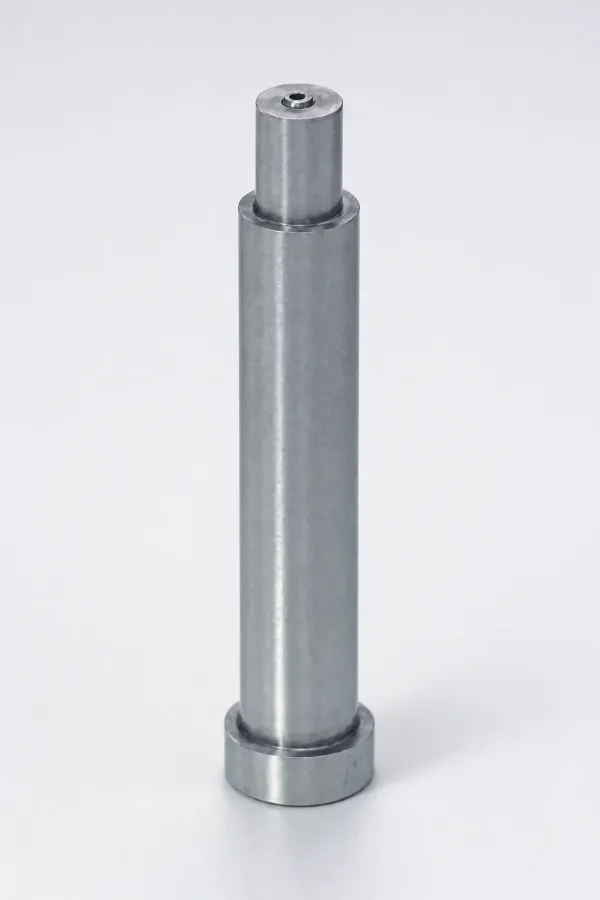
Two cheap controls cut downtime risk sharply. Keep one spare insert set on the shelf, which converts a 5-10 day rebuild into a 2-3 day swap. Standardize pins, springs and gate drops to catalog sizes with 3-7 day lead time. Custom parts turn a 4 hour repair into a 3 week outage.
Maintenance and Spare Parts: The 36-Month Bucket
Preventive maintenance is a scheduled cost that scales with steel quality. A weekly pass covers visual cracks, water flow and vent condition at 15-30 minutes of technician time. A monthly pass adds pin lubrication and parting line cleaning. An annual pass checks alignment, hardness and cooling efficiency.
Annualized, that schedule runs $2,600 per year on a hardened H13 tool and $4,200 per year on a pre-hardened P20 tool. Soft steel needs more frequent polishing because it scuffs and dents faster. Over 3 years the gap between the two maintenance programs is $4,800.
Consumables follow the same pattern. Ejector pins, core pins, springs and gate drops consume $600 per year on a tool with a spare parts package. The same tool without one runs $2,100 per year. The 3-year spread is $4,500, quietly larger than the freight difference between most international quotes.
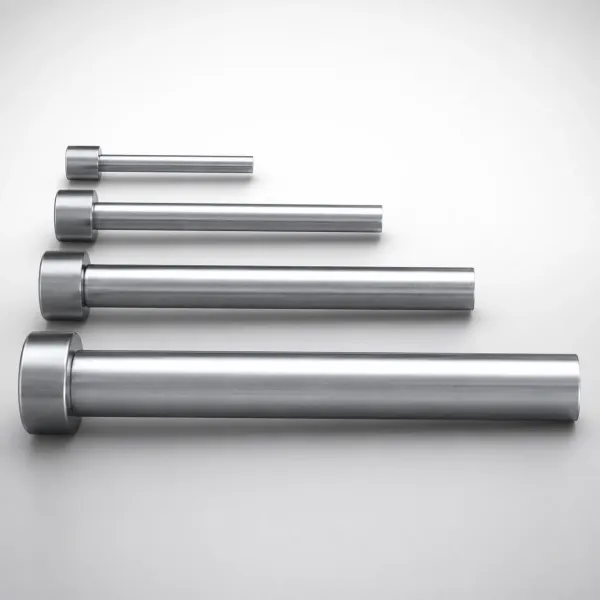
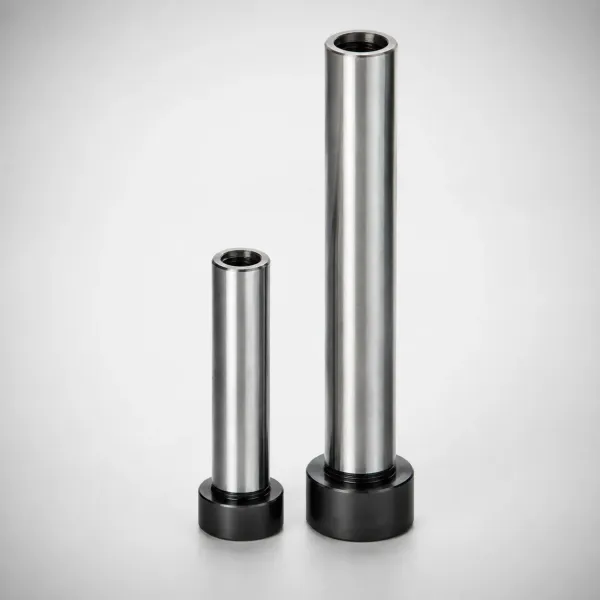
Lead time decides how much of that spend becomes downtime. Standard ejector pins, core pins, sprue bushings, punches and mold springs ship in 3-7 days from catalog stock. A custom-ground pin takes 2-3 weeks. A mold designed around catalog components repairs faster for its whole service life. The full schedule is in our guide to mold maintenance planning.
Cycle Time: 4 Seconds Times 600,000 Cycles
Cycle time is the cost bucket that compounds hardest, because it repeats on every shot. At a $40 per hour fully loaded machine rate, one second of cycle costs $0.011 per cycle. At 200,000 cycles per year that one second is $2,200, and 4 seconds is $8,900 per year.
Cooling controls 60-70% of the cycle on most thermoplastic parts. A cavity with straight drilled channels and a 12 mm pitch cools unevenly, so the operator waits for the hot core side. Baffles, bubblers or a conformal insert cut that wait by 10-20% on wall sections above 2.5 mm.
In the worked example the cycle moved from 30 seconds to 26 seconds. Four seconds across 600,000 cycles is 2,400,000 seconds, or 667 machine hours. At $40 per hour that is $26,700 of press time, and it is more than the entire $12,000 price gap being argued over.
There is a capacity effect on top of the direct cost. Saving 667 hours frees about 9 working days of press capacity per year on a single machine. A plant running 12 presses can absorb one extra program without buying another machine. Our guide to reducing injection cycle time covers the mold-side levers in order of payoff.
Mold Life, Rebuilds and Regrind Economics
Tool life sets how many times you pay for the mold. A P20 pre-hardened cavity at HRC 30-33 delivers 300,000 to 500,000 shots in unfilled resin and far less against glass-filled grades. 718H reaches 500,000 to 800,000 shots. H13 or S136 hardened to HRC 62 reaches 1,000,000 shots and beyond with proper maintenance.
Abrasive resins cut those numbers by 30-50%. Glass-filled nylon at 30% fiber content will wear a soft cavity to the flash point in under 200,000 shots. The same cavity in hardened H13 holds shut-off integrity past 600,000 shots. Steel grade is not a preference in that application, it is a schedule.
A rebuild costs 25-45% of the original mold price. The work is not a polish. It means stripping the tool, cutting out washed-out faces and welding or replacing inserts. Then re-heat treating to HRC 62, wire EDM for shut-offs, hand polish to the original SPI finish and a fresh trial. Budget 5-10 working days of shop time plus a trial.
Stamping tools have a cleaner version of the same math. A progressive die is reground every 100,000 to 300,000 strokes, removing 0.05-0.10 mm per pass, and supports 3-5 regrinds before punches and inserts are replaced. Tool steel choice and a documented regrind log decide whether the die reaches 2 million strokes or 600,000.
Surface treatment changes the equation on both sides. Nitriding adds a 0.1-0.2 mm diffusion layer at 1,000-1,200 HV. PVD and DLC coatings cut abrasive wear 2-4 times in glass-filled work. Both add 3-8% to the mold price and typically push the rebuild date out by 200,000 to 400,000 shots.
Changeover Time and Change Parts Cost
Changeover is a planned stop, and planned stops still cost money. A conventional mold swap takes 1.5 to 3 hours with manual clamps, loose water lines and a separate preheat step. At a $40 per hour machine rate plus two technicians, each changeover runs $250 to $450 in direct cost.
Quick-change tooling cuts that to 30-45 minutes. Hydraulic or magnetic clamps, standardized water manifolds, a mold cart at press height and a preheat station remove most of the waiting. A plant running 20 changeovers per year saves 20-40 hours, or $5,000 to $9,000 annually, from hardware that adds 2-4% to the mold price.
Change parts are the other lever. A second interchangeable insert set costs 15-30% of the mold price, roughly $10,000 to $19,000 on a $64,000 tool. The alternative is a second complete mold at full price. If three part variants share one base, ejection and cooling layout, the base cost is amortized three ways instead of one.
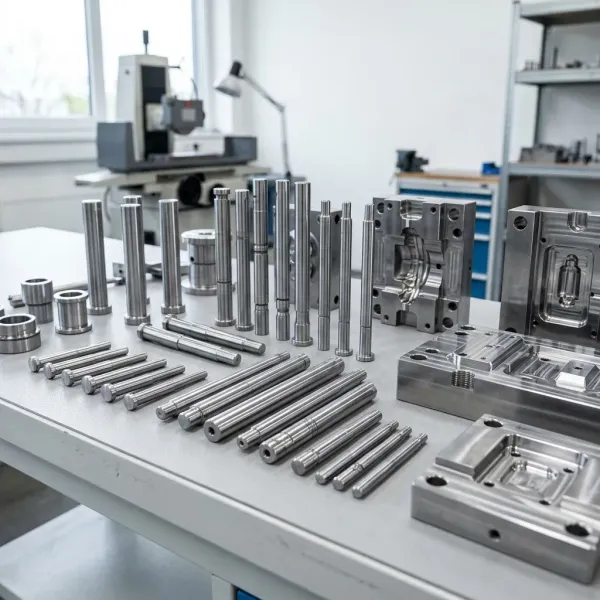
Change parts only pay when the interface repeats. Insert pockets must be wire EDM cut to ±0.005 mm, keyed on dowels and fitted so that a swapped insert holds the same shut-off clearance. A loose pocket adds flash on the first shot and scrap on the first hundred.
Scrap Rate and Launch Delay Exposure
Scrap is priced per part, so it scales with volume in a way that maintenance never does. A well-built tool holds 0.6% scrap on a connector housing with a 0.55 dollar part cost. A tool with soft shut-offs and unstable ejection drifts to 1.8% after 100,000 shots.
The 1.2 point gap produces 14,400 extra scrapped parts across 1,200,000 parts. At $0.55 each that is $7,900 of material, machine time and labor. It never appears as a line item, which is why it survives budget reviews year after year.
Launch delay is the larger exposure when a program is late. One extra trial round costs $2,000 to $6,000 in press time, samples and dimensional reports. More important, each extra round adds 2-5 weeks before first article approval, and a slipped SOP date can cost a supplier a program award entirely.
Prevention is front-loaded and cheap. DFM feedback inside 24 hours catches wall thickness, draft and gate problems before steel is cut. A mold flow study at design stage costs under $3,000 and routinely removes one of the two trial rounds. Buying on price alone tends to add a trial round rather than remove it.
The TCO Worksheet: 12 Fields to Fill Before You Decide
A TCO comparison is only as honest as its inputs. Fill the twelve fields below for each quote before you compare totals. Ten of the twelve come from your own production plan and your own press, not from the supplier.
Two fields are the deciding ones. Expected shot life drives rebuild timing, and downtime hours drive the largest single bucket. Ask each supplier to state the shot life in writing along with the steel grade and hardness.
| TCO field | Where the number comes from | Typical value |
|---|---|---|
| 1. Annual part demand | Customer forecast or purchase order | 400,000 parts per year |
| 2. Program horizon | Contract term or vehicle model life | 36 months |
| 3. Cycles required | Demand divided by cavity count | 600,000 cycles in 2 cavities |
| 4. Mold purchase price | Quotation, steel grade and hardness stated | $52,000 to $64,000 |
| 5. Freight and duty | Incoterm and shipping quote | 3-8% of mold price |
| 6. Expected shot life | Steel grade and surface treatment, in writing | 350,000 shots P20, 1,000,000 shots H13 HRC 62 |
| 7. Rebuild cost and timing | Supplier rebuild quote or benchmark | 25-45% of mold price, at the shot life limit |
| 8. Annual maintenance | Maintenance schedule and technician rate | $2,600 to $4,200 per year |
| 9. Annual spare parts | Consumption history or supplier parts list | $600 to $2,100 per year |
| 10. Cycle time and machine rate | Trial data and plant cost accounting | $0.011 per second at $40 per hour |
| 11. Downtime hours and hourly cost | Maintenance log and plant cost accounting | $600 to $1,500 per hour |
| 12. Scrap rate and part cost | Quality data and part standard cost | 0.6% target, $0.55 per part |
← swipe to scroll →
Table note: Typical values are industry planning figures for a 2-cavity connector mold in a 100-500 ton press. Substitute your own plant data where available.
Three rules make the worksheet trustworthy. Use one horizon for both quotes, normally 36 months. Cost downtime at the same hourly rate for both. Add the rebuild inside the period that contains it rather than parking it outside the model.
FAQ: Mold Total Cost of Ownership
Q1. What is a normal tooling cost per part?
For a 2-cavity mold running 1,000,000 or more parts, tooling contributes $0.05 to $0.08 per part across a 3-year window. A tool needing a rebuild in the same period lands at $0.10 to $0.13. Below $0.05 per part, cavity count is usually the reason rather than tool quality.
Q2. Should I always buy the more expensive mold?
No. If two quotes are within 8-10% on price and both state the same steel grade, hardness and shot life, take the cheaper one. The TCO case is strongest when the price gap buys a measurable life difference, such as 350,000 shots against 1,000,000.
Q3. How do I amortize a mold correctly?
Divide the total mold spend, including any rebuild inside the period, by the parts actually produced in that period. A $52,000 tool plus one $18,000 rebuild across 1,200,000 parts amortizes to $0.058 per part, not the $0.043 the quotation implies.
Q4. How much does press downtime really cost?
Between $600 and $1,500 per hour for a 100-500 ton press once idle labor, scrap and recovery are counted. Use $900 per hour as a planning figure. A single 8 hour stop then costs $7,200, which exceeds most annual spare parts budgets.
Q5. When does a rebuild beat a new mold?
Rebuild when the cost stays under 45% of a new tool and the base, plates and ejection system are sound. Replace the whole tool when plate flatness has moved beyond 0.05 mm or the mold has already been rebuilt twice. Past that point, rebuild cost per shot stops falling.
The Bottom Line
Two molds for one part can look $12,000 apart on paper and $63,600 apart over 3 years. Cycles, rebuild dates, downtime hours and scrap decide the ranking, not the invoice. DieStrike builds IATF 16949 precision molds to ±0.005 mm with 2-5 week lead times.
Send us both quotations and your annual volume, and we will return the 12-field TCO comparison filled in: request a mold cost review.
KEEP READING
Related Reading
How to Read a Mold Quote: Line by Line
Decode every line of a quotation, from steel grade and machining hours to trial and freight.
Read articleArticleHow to Budget an Injection Mold: 5 Cost Levers
The five levers that move a mold budget most, and what each one costs in tool life.
Read articleArticleHow to Extend Mold Life: 5 Proven Strategies
Steel, heat treatment, cooling and maintenance choices that add 300,000 shots to a tool.
Read articleServiceMold Repair and Maintenance
Planned maintenance, cavity rebuilds and spare parts support for production molds.
Read articleNEXT STEP
Ready to Start Your Mold?
Send us your element dimensions or part numbers — our team responds within 24 hours with pricing and lead time.

Written by
Ray ChanMold Buyer's Guide Author · Precision Mold Manufacturing Specialist. Ray helps global importers, distributors and OEMs source factory-direct molds and mold parts.