
How to Extend Mold Life: 5 Proven Strategies
Table of Contents
A 16-cavity automotive connector mold failed at 182,000 cycles on a Monday morning. Ejector pins had dragged for weeks. The drag wore each bore oval by up to 0.02 mm, and one pin finally snapped through the core face. The rebuild cost $25,000, the press sat idle for three days at $120-$250 an hour, and the customer's line-down claim added $8,000. Every warning in that failure was measurable long before the pin broke.
Mold life is a design decision, a material decision, and a maintenance decision. Tools built with the right steel and run on a real schedule hold dimensional accuracy past 500,000 cycles. Tools that skip those choices fail at a fraction of that number. The five strategies below push injection molds toward the 500,000 to 1,000,000 cycle range, and every one of them is measurable.
The Snapshot
- Cavity steel at HRC 62 out-wears unhardened P20 at 28-32 HRC by roughly 3-5 times on abrasive resins (typical industry comparison).
- PVD and TiN coatings add 2-5 µm of surface hardness at 2000-2500 HV and cut gate and core wear rates by half or more.
- A weekly 30-minute in-press check catches ejector pin drag before 0.01-0.02 mm of wear becomes a snapped pin.
- Scale inside a 6 mm cooling channel can cut heat transfer by 40-60% before the flow meter shows any drop.
- Replace standard parts on thresholds: 0.01-0.02 mm ejector pin OD wear, 5-10% spring free length loss, 0.02 mm guide play.
Why Molds Die Early
Most early mold failures follow one of four wear paths. Abrasive wear erodes gates and cores when the resin carries glass or mineral fill. Erosion and corrosion attack cooling channels and cavity surfaces when water chemistry or venting is wrong. Fatigue cracks start at sharp corners and weld lines in the steel. Skipped maintenance then turns each small wear mark into a part-scrapping defect.
The resin decides how fast the steel wears. A 30% glass-filled nylon compound is one of the harshest common resins for a cavity. It drags abrasive fiber across the gate and core surfaces on every shot. Gate land growth of 0.05 mm already changes the pressure drop through the gate, and 0.1 mm is a recut trigger (typical figures).
The numbers behind an early failure are blunt. One unscheduled stop of eight hours at $120-$250 per hour press rate costs $960-$2,000 in machine time alone. Add a damaged cavity insert at $500-$2,000 to recut and a scrapped batch at $10,000-$50,000 in material. A single avoidable failure runs five figures (typical industry estimates). A full year of scheduled maintenance rarely costs more than one such event.
Prevention works because wear is gradual and measurable. Pins lose outside diameter at a measurable rate. Gate lands grow by microns. Vent depths change. The five strategies that follow give each wear path a number, a threshold, and a fix.
Strategy 1: Steel Selection and Heat Treatment
Steel selection sets the ceiling for mold life. No coating or maintenance schedule can fix a cavity that was too soft for the resin from day one. The grade, the heat treatment, and the final hardness decide how many cycles the tool can survive. This is where the largest single life-extension decision happens.
Match the Grade to the Resin and the Volume
Pre-hardened P20 runs 28-32 HRC as delivered (typical). It machines fast and polishes easily, which makes it a good choice for low-volume tools and design validation. It is a poor choice for long production runs of abrasive compounds. A 30% glass-filled part wears a P20 gate visibly within 50,000-100,000 cycles (typical industry observation).
H13 is a hot-work steel that holds hardness at elevated mold temperatures. S136 is a stainless mold steel that resists corrosion from acidic resins and humid cooling circuits. DieStrike specifies cavity grades by resin, fill content, and cycle target, then hardens them through to HRC 62 for production cavities. That hardness level is typical for connector and automotive tooling.
Through-Hardening to HRC 62
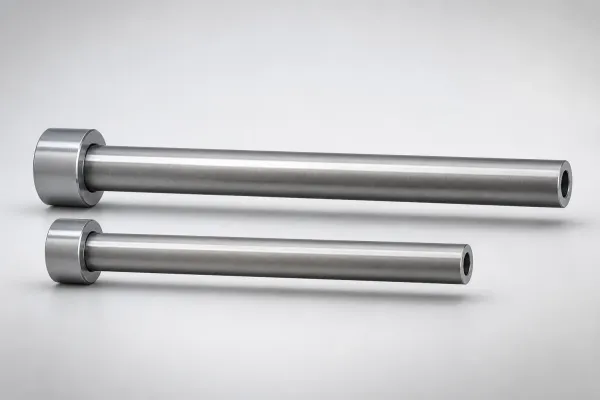
Cavity hardness is the most repeatable predictor of abrasive wear life. At HRC 62, a hardened tool steel cavity out-wears the same geometry in P20 at 28-32 HRC by roughly 3-5 times under the same load. These are typical industry comparison figures. DieStrike runs production cavities at HRC 62 with vacuum heat treatment to keep decarburization and distortion under control.
Heat treatment order matters. DieStrike hardens the cavity block first, then finish-machines and polishes to final geometry. That sequence holds mold part geometry to ±0.002 mm and overall mold accuracy to ±0.005 mm. Hardening after finish machining risks distortion, and grinding away a hardened skin removes exactly the wear resistance you paid for.
Case Hardening for Moving Parts
Slides, core pins, and small inserts cannot always be through-hardened without distortion. Case hardening builds a hard shell on a tough core. Nitriding typically produces a case of 0.2-0.5 mm at 900-1100 HV (typical industry figures). It suits slides and ejector systems that see sliding wear but not heavy bending loads.
Match the treatment to the failure mode. If a core pin bends, it needs toughness, not more surface hardness. If it wears, case hardening or a coating is the answer. Get the failure mode wrong and the steel, no matter how hard, fails on schedule.
Strategy 2: PVD and TiN Surface Treatments
Coatings buy wear resistance without changing the bulk steel. PVD and TiN treatments deposit a thin, extremely hard film on gates, cores, and moving parts. They are the cheapest way to add life to a tool that is already built. The coating decision is a wear-rate decision, not a cosmetic one.
What PVD and TiN Actually Do
Titanium nitride (TiN) deposits at 2-5 µm typical thickness and measures 2300-2500 HV. That is several times harder than the HRC 62 steel underneath (typical industry figures). PVD runs at 200-500 degrees C, so it does not distort the cavity geometry or re-temper the base steel. The coating lowers friction and resists adhesive wear on sliding surfaces.
The payback shows up on gates. Glass-filled resin erodes an uncoated gate land continuously. A TiN-coated gate keeps its land dimension far longer, which holds the pressure drop through the gate stable and keeps part weight in tolerance. DieStrike applies PVD and TiN coatings to gates, cores, and ejector pins on high-volume connector tools.
Where Coatings Pay Back Fastest
Ejector pins are the classic coating candidate. A coated pin slides with lower friction, so drag marks appear later and the pin keeps its fit longer. TiN-coated pins typically last 2-3 times longer than uncoated pins in the same bore (typical industry observation). The cost of coating a pin is small next to the cost of a snapped pin that damages the cavity.
Cores that see abrasive flow also gain from a coating. Apply the coating after final machining, and remember that 2-5 µm of added thickness changes fits. Coat the pin, then check the clearance class against the 0.01-0.02 mm standard for pins up to Ø12 mm (per DME and MISUMI fit classes).
Choose the Coating by Failure Mode
TiN covers general abrasive and adhesive wear. Chromium nitride (CrN) adds corrosion resistance on top of wear resistance. DLC-type coatings handle high contact loads and dry sliding. Match the coating to the observed wear, not to habit.
Coating is not a fix for every failure. If the cavity cracks from heat fatigue or the mold flexes under clamp tonnage, a coating changes nothing. Fix the geometry and the steel first, then coat. That order keeps the coating from masking a structural problem.
Strategy 3: Preventive Maintenance Schedule
Maintenance is where life extension gets paid out in practice. A mold that costs $80,000 to build produces at T1 quality for 500,000 cycles or more when its checks run on time. The same tool dies early when checks are skipped. The schedule below follows DieStrike's mold repair and maintenance service, and every checkpoint has a number attached.
The Weekly Checkpoint
The weekly check runs with the mold in the press and takes 30-60 minutes. Measure flow on every cooling circuit and compare it to the T1 baseline. A drop of 10-20% means scale or debris inside the channel. Watch ejector pins return flush with the core face, and inspect gate lands with a 10x loupe.
Two consecutive readings that drop 10% or more trigger a descale, not a third reading. Gate land growth of 0.05 mm shifts the pressure drop through the gate, and 0.1 mm is a recut trigger. Log every reading in the mold book with the cycle count.
The Quarterly Checkpoint
Quarterly work moves the mold to the bench for 1-2 hours. Descale the cooling circuit, replace O-rings and seals, and audit bolted joint torque with a calibrated wrench. Clean vents at the parting line and verify vent depth at 0.02-0.05 mm with a depth gauge (typical industry values).
A vent packed solid burns the part edge within a few hundred shots. Over-lubrication traps dust and turns into lapping compound, so use the grease grade written in the mold book. A dry guide that runs 20,000 cycles can score its bushing and shift mold base alignment by 0.02-0.05 mm.
The Annual Overhaul
Once a year, or every 500,000-1,000,000 cycles, the mold gets a full teardown. Strip every plate, inspect bores with an air gauge, and recertify the cavity steel with a hardness tester. This is the checkpoint that catches hidden cracks before they become total failures. Budget 1-2 days of bench time.
The annual event is also the moment to compare measured wear against the mold book. Pins that dropped below threshold get replaced in matched sets. Springs at 5-10% free length loss get replaced in sets. The mold goes back together documented, and the next cycle count starts from zero.
Strategy 4: Cooling Channel Maintenance
Cooling channels fail silently. The cavity surface can look perfect while the water side carries scale, corrosion, and eroded walls. Because cooling drives cycle time, a degraded channel raises cost on every single shot. This is the least inspected and most expensive system in the mold.
Scale: The 40-60% Heat Transfer Killer
Scale forms when hard water deposits calcium and magnesium salts on channel walls. Water at 100-200 ppm total hardness is common in many plants (typical). A 1 mm deposit inside a 6 mm cooling channel can cut heat transfer by 40-60% (typical industry figures). The flow meter may not show a measurable drop yet.
The first symptom is a cycle time that creeps up by 10-20%. The second is a hot spot that shows up as sink marks or differential shrinkage on the part. Descale quarterly with the acid chemistry recommended by the mold or cooling system OEM, then flush and neutralize completely.
Corrosion and Erosion
Tap water and tool steel form a galvanic pair. Uncontrolled coolant chemistry pits the channel wall, and the pits hold bacteria and scale that accelerate the damage. Use a corrosion-inhibited coolant and check its concentration during the quarterly flow audit.
Erosion is the high-velocity side of the same problem. Coolant flow above roughly 3 m/s can erode soft channel walls over time (typical industry limit). Keep flow velocity inside the design range, and inspect channel walls during the annual overhaul with a borescope.
Flow Verification With Numbers
Every cooling circuit needs a T1 baseline: flow rate in liters per minute and inlet-to-outlet temperature delta. Record both at first sampling. A delta above 5 degrees C means the circuit is not removing heat evenly, which shows up as a longer cycle or sink marks.
Re-measure on the same schedule every week. A 10-20% flow drop against baseline triggers a descale. Two consecutive drops mean the descale is due now, not next month. These two numbers give the cooling system a pass or fail answer every time.
Strategy 5: Standard Part Replacement Thresholds
Standard parts are the cheapest insurance in the mold. An ejector pin costs a few dollars and ships fast. A snapped pin that damages the cavity costs $500-$2,000 to repair and days of downtime. The rule is simple: replace on the threshold, never on the failure.
Ejector Pins: 0.01-0.02 mm and Out
Measure pin outside diameter against the T1 baseline with a micrometer. OD wear of 0.005-0.02 mm is normal progression. Wear beyond 0.01 mm on the land calls for a micrometer measurement, not a guess. OD loss of 0.01-0.02 mm is the replace threshold for standard pins.
Drag lines and polish wear on the pin land are visible with a 10x loupe long before the pin snaps. A pin that stands proud or lags by 0.1 mm on return is dragging. Replace worn pins with the same grade and diameter, and record the change in the mold book.
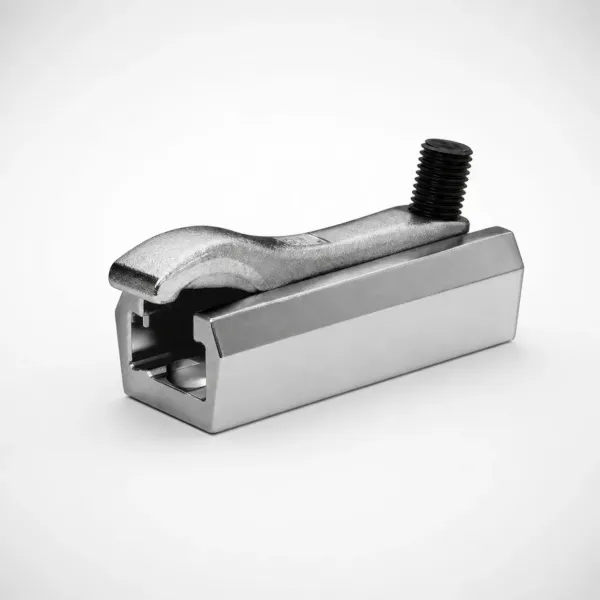
Springs: Replace at 5-10% Free Length Loss
Return springs lose free length as they fatigue. Measure free length against the catalog value with a caliper. Loss beyond 5-10% means the spring is done, because remaining force drops fast after that point. Replace springs in matched sets, never one at a time, and log the set numbers.
DieStrike stocks and ships standard mold springs in 3-7 days, and the selection guide covers load classes from light to extra heavy. A spring that collapses mid-run jams the ejector plate and bends pins, so the set replacement rule protects more than the spring itself.
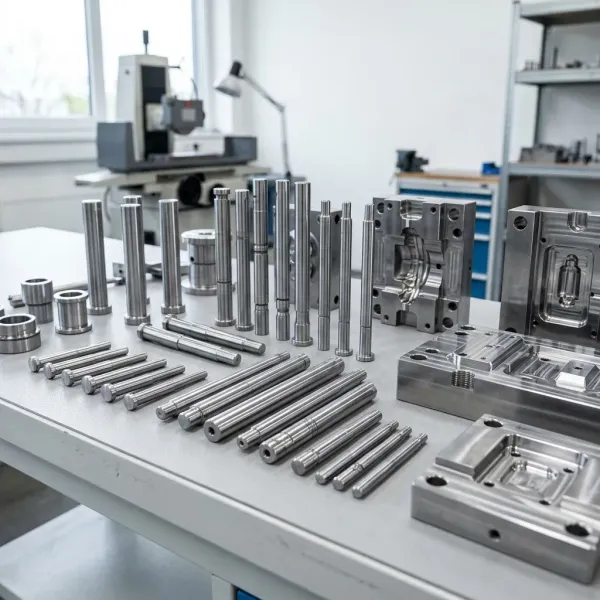
Guides and Bushings: 0.02 mm Play
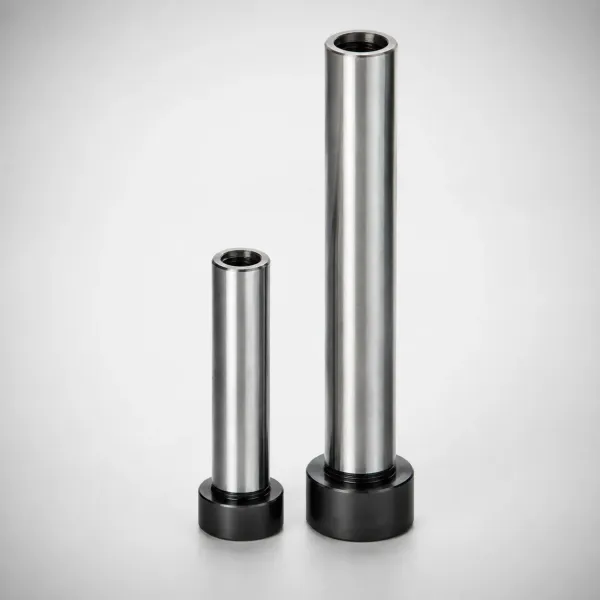
Guide pillar and bushing play is the mold's alignment alarm. Check radial play with a dial indicator on the closed mold. Play past 0.02 mm means the base is no longer holding cavity alignment. Misalignment shows up as flash, core shift, and uneven wear on every part.
Replace worn bushings and pillars in pairs, and check the mold base plates for flatness while you are there. Plate flatness out past 0.02 mm per 300 mm after regrind is a base-level problem, not a bushing problem. DieStrike supplies mold bases to standard and custom footprints.
Apply the same threshold thinking to every standard component. The table below collects the five replacement triggers that protect the most expensive steel in the tool.
| Component | Replacement Threshold | Check Tool | Cost of Ignoring |
|---|---|---|---|
| Ejector pin | OD wear 0.01-0.02 mm vs T1 baseline | Micrometer, 10x loupe | Snapped pin, cavity damage $500-$2,000 |
| Return spring | Free length loss 5-10% | Caliper | Stuck ejector plate, bent pins |
| Guide pillar and bushing | Radial play past 0.02 mm | Dial indicator | Flash, core shift, uneven wear |
| Gate land | Growth 0.05-0.1 mm | 10x loupe, borescope | Blush, flash, dimensional drift |
| O-rings and seals | Every 6 months or first leak | Visual check | Water leak, rust, corrosion |
← swipe to scroll →
Table: thresholds are typical industry values. Confirm against the mold book and OEM data.
The Cost Math of Mold Life
Mold life extension is a cost problem with a clear answer. Take a 16-cavity connector mold valued at $25,000, a typical price for this class of tool. At 200,000 cycles per life, the buyer pays for a rebuild every few months of production. At 500,000 cycles per life, the same production volume needs a fraction of the rebuilds.
The comparison below uses a $25,000 rebuild cost and $120-$250 per hour downtime, both typical industry figures. Every avoided rebuild is avoided downtime, avoided scrap, and avoided requalification of the tool.
| Metric | Short-Life Tool | Extended-Life Tool |
|---|---|---|
| Useful life per rebuild | 200,000 cycles | 500,000 cycles |
| Rebuilds per 1,000,000 cycles | 4 | 1 |
| Rebuild spend per 1,000,000 cycles | $100,000 | $25,000 |
| Downtime per rebuild (typical) | 2-5 days | 2-5 days |
| Net savings per 1,000,000 cycles | Baseline | $75,000 plus avoided downtime |
← swipe to scroll →
Table: example math for a 16-cavity connector mold at $25,000 per rebuild. Typical industry estimates, verify against your tool and press rates.
The extended-life tool also delivers steadier part quality, because dimensions stay inside tolerance for longer stretches between overhauls. For automotive customers like TE Connectivity, Amphenol, Luxshare, and Dongshan Precision, that stability is what keeps production lines running. DieStrike builds connector tooling with this cost model in mind.
Real-World Mold Life Targets
Expected mold life depends on resin, steel, and maintenance, so targets vary by application. These ranges are typical industry figures, not guarantees. Use them to set the mold book baseline for a new tool.
- Automotive connector molds: 500,000-1,000,000 cycles with HRC 62 cavities, coated gates, and a real maintenance schedule.
- Medical disposables: 1,000,000+ cycles with S136 steel, TiN-coated cores, and quarterly cooling checks.
- Glass-filled structural parts: 200,000-400,000 cycles typical, because abrasive wear sets a harder ceiling.
- High-cavitation thin-wall parts: 300,000-600,000 cycles typical, with gate erosion as the limiting factor.
- Progressive stamping dies: 10-50 million strokes typical with hardened die steel, where DieStrike quotes 2-5 week stamping die delivery.
Track every tool against its target. Log cycle counts, record every reading, and measure wear at the checkpoints. DieStrike's DFM feedback arrives within 24 hours of part submission. Steel, coating, and maintenance decisions get set before the tool is cut, not after it fails.
FAQ: Mold Life Extension
Q1. What is the biggest cause of early mold failure?
Abrasive wear on gates and cavities from filled resins, combined with skipped maintenance. A P20 cavity running 30% glass-filled nylon wears visibly within 50,000-100,000 cycles. The same geometry at HRC 62 with a coated gate runs several times longer. Maintenance checks catch the wear before it becomes a failure.
Q2. How much does PVD or TiN coating extend mold life?
Coated gates and cores typically last 2-3 times longer than uncoated surfaces under the same abrasive load (typical industry observation). The coating is 2-5 µm thick at 2300-2500 HV for TiN, applied at 200-500 degrees C with no distortion. Coating cost is a small fraction of an insert rebuild.
Q3. When should I replace ejector pins instead of polishing them?
Replace at 0.01-0.02 mm of outside diameter wear against the T1 baseline. Polishing removes material, changes the fit, and shortens the next service interval. Standard pins ship in 3-7 days, so the replace decision never needs to stall production.
Q4. How many cycles should a well-built injection mold last?
Automotive connector molds typically run 500,000-1,000,000 cycles, and medical disposables pass 1,000,000 with stainless steel and coated cores. Reaching those numbers depends on HRC 62 cavity hardness, correct coating, and a maintenance schedule that actually runs. DieStrike quotes injection molds in 2-4 weeks and builds to ±0.005 mm accuracy.
The Bottom Line
Every skipped threshold is a future failure with a five-figure invoice. DieStrike builds IATF 16949 certified precision molds with HRC 62 cavities and ±0.005 mm accuracy. The 120+ machine shop answers DFM feedback within 24 hours.
Send us your part drawing for a mold life plan with your quote.
KEEP READING
Related Reading
5 Mold Cooling Channel Design Tips for Faster Cycles
Mold maker's 5 cooling channel design rules: channel-to-cavity distance 2-2.
Read articleArticle5 Shrinkage Compensation Rules for Mold Design
Shrinkage compensation decides mold accuracy. Five rules: material rates from 0.3% to 2.
Read articleArticle5 Ways to Reduce Mold Cost Without Cutting Quality
Five proven ways to reduce injection mold cost without cutting quality: DFM before quoting, right-sized cavity count,…
Read articleArticle7 Gate Design Best Practices for Balanced Filling
Mold maker's 7 gate design rules for balanced multi-cavity filling: gate depth 50-80% of wall thickness, land 0.5-1.
Read articleNEXT STEP
Ready to Start Your Mold?
Send us your element dimensions or part numbers — our team responds within 24 hours with pricing and lead time.

Written by
Ray ChanMold Buyer's Guide Author · Precision Mold Manufacturing Specialist. Ray helps global importers, distributors and OEMs source factory-direct molds and mold parts.