
How to Choose Mold Springs by Life Cycle and Load
Table of Contents
A snapped ejector return spring cost one DieStrike customer more than USD 4,800 in a single shift. The blue medium-load spring on a 16-cavity connector mold fractured at 210,000 cycles. The broken coil wedged between the ejector plate and the B plate. The plate jammed at mid-stroke, and the press stopped at 14,800 parts of a 500,000-part order. The replacement spring cost USD 11.50.
Mold spring selection looks like a catalog lookup, but it is not. The load class, the free length, the preload, and the pocket all interact with the ejector stroke and the plate mass. Get the ratio wrong and the spring fails early. Get the class wrong and the plate does not return on time. This guide covers spring types, load classes, life ratings, compression limits, and the force math behind each choice.
The Snapshot
- Load classes follow ISO 10243 color coding. Light (yellow) allows 40% deflection of free length at 1M cycles, medium (blue) 32%, heavy (red) 25%, and extra heavy (green) 20%.
- Force is linear. F = k × x, and preload plus ejector stroke must stay under the class limit or fatigue life drops sharply.
- Rectangular wire springs carry roughly 15% to 30% more load than round wire at the same outside diameter (typical industry figures).
- Replace a return spring when free length drops 3% or more, when measured load falls 10% below rated, or at a preventive 500k cycle interval.
- DieStrike ships standard mold springs in 3 to 7 days and returns spring selection advice within 48 hours of a drawing.
Why Mold Spring Selection Fails
Mold springs do two jobs in an injection mold. Ejector return springs push the ejector plate back to the closed position after each ejector stroke. Slide return springs pull or push a slide back before the mold closes. A stripper plate uses springs the same way when it is spring driven. Every one of these functions is mechanical, and every one fails when the spring is undersized, oversized, or over-compressed.
The cost math explains why the class matters. A standard mold spring costs between USD 3 and USD 25 depending on size and class (typical catalog range). One hour of unscheduled downtime on a running automotive mold costs roughly USD 200 to USD 600 in lost machine time and labor. These are typical industry figures. One wrong spring can therefore erase the savings of a thousand correct ones.

The most common selection errors repeat across mold shops. Oversized free length leads to buckling in the pocket. Over-compressed springs lead to fatigue fracture at 200k to 400k cycles. An under-specified class leads to a soft return where the ejector plate lands late and the next cycle starts with the pins proud. Each error is preventable at the drawing stage, which is why DieStrike reviews spring sizing during DFM and returns feedback within 24 hours.
The spring package is a small line on the mold BOM. A typical two-plate mold carries 4 to 16 ejector return springs, plus slide springs and stripper springs where the design needs them (typical industry layouts). The parts cost a few hundred dollars at most. The design decisions behind them decide whether the mold holds its 1M cycle target or stops at 250k for a repair. That is why DieStrike treats spring sizing as a design review item, not a catalog order.
Spring Types: Round Wire, Rectangular Wire, and Gas Springs
Three spring families cover nearly every mold application. Each has a different load curve, life behavior, and price point.
Round Wire Coil Springs
Round wire springs use a circular wire cross section. They are the cheapest option, with the lowest spring rate per outside diameter. At the same OD, a round wire spring delivers less force than a rectangular wire spring. Round wire units are used for light duty work such as low-mass ejector returns or prototype tools. Expect their catalog price to sit 20% to 40% below an equivalent rectangular wire spring (typical industry figures).
Rectangular Wire Coil Springs
Rectangular wire springs are the standard for production mold tooling. The square cross section packs more steel into the same envelope. That raises the rate and the load capacity by roughly 15% to 30% at the same OD (typical industry figures). They are shot-peened and preset, which improves fatigue life and removes the first-load set. MISUMI, DANLY, and ISO 10243 catalogs use the same color classes for these springs: yellow, blue, red, and green.
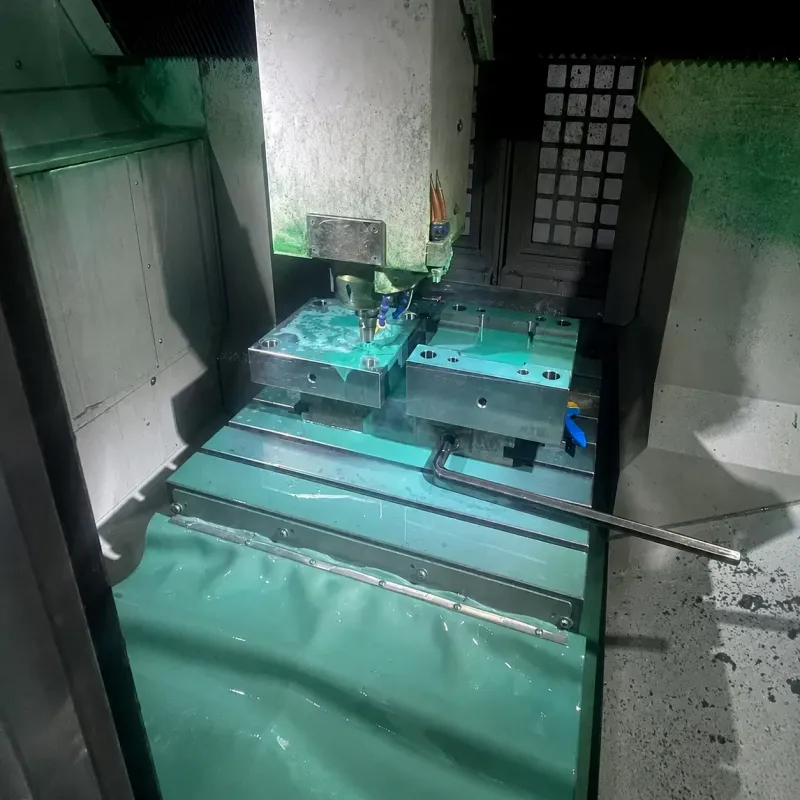
DieStrike stocks rectangular wire mold springs as standard parts with 3 to 7 day delivery. See the mold spring range for available sizes, classes, and rates before you finalize the BOM.
Nitrogen Gas Springs
Nitrogen gas springs replace coil springs when force density matters. A gas spring delivers high force from a small cylinder because the nitrogen is pre-charged under pressure. The force curve stays nearly flat, rising roughly 10% over full stroke, where a coil spring force rises linearly with deflection. A gas spring costs 5 to 10 times more than a coil spring at typical industry prices, but it fits where a coil spring cannot. It is rated for 1M or more cycles, with typical uses in slide returns, lifter returns, and compact cavities with limited pocket depth.
Load Classes: Light to Extra Heavy
Load class defines how far a spring may be compressed for a given life target. The class is set by wire size and coil geometry. Standard color coding shows it in ISO 10243 and in MISUMI and DANLY catalogs.
The percentages in the table refer to maximum deflection as a share of free length. A medium-load spring with 100 mm free length may be compressed 32 mm at 1M cycles, or 40 mm at 300k cycles. Push past the limit and the spring still works for a while, then fractures early.
| Load class (color) | Max deflection at 1M cycles | Max deflection at 300k cycles | Typical mold application | Relative cost |
|---|---|---|---|---|
| Light (yellow) | 40% of free length | 50% of free length | Light ejector returns, low-mass strippers | $ |
| Medium (blue) | 32% of free length | 40% of free length | Standard ejector returns, small slide returns | $$ |
| Heavy (red) | 25% of free length | 32% of free length | Heavy slide returns, stripper plates | $$$ |
| Extra heavy (green) | 20% of free length | 25% of free length | Compact cavities, shallow pockets | $$$$ |
← swipe to scroll →
Table: typical industry figures; verify against your program.
Color coding is not universal. Some suppliers use black or gold for ultra-heavy classes, and a few use reversed colors. Always verify against the supplier datasheet before you order, and keep the datasheet in the mold file for the maintenance crew.
Life Cycle Ratings and Compression Ratio Limits
Catalog life ratings come in three common tiers: 300k, 500k, and 1M cycles. The rating assumes clean, lubricated, and guided operation at the rated deflection. The same spring can often hit 1M cycles at the class limit, while a spring run past its limit may fail at 200k or earlier.
The 500k tier sits between the two common ratings. Many catalogs list 500k as a standard rating, and it maps to deflection limits roughly 10% below the 300k values. For a mold built for a 500k part order, sizing at the 1M limit leaves margin and costs almost nothing. Free length is a catalog dimension, not a custom one.
The compression ratio rule of thumb is simple. Keep total deflection between 25% and 50% of free length, with the exact number set by the class and the life target. Light class at 300k cycles may reach 50%. Heavy class at 1M cycles stays at 25%. Anything above the class limit trades life for envelope, and the trade is almost never worth it in a production mold.
Two practical consequences follow. First, a longer free length lowers the ratio at the same stroke, so life goes up. Second, a longer spring needs guidance, because free length above 4 times the OD invites buckling. When the pocket depth is fixed, choose a smaller OD with a higher class instead of a longer spring.
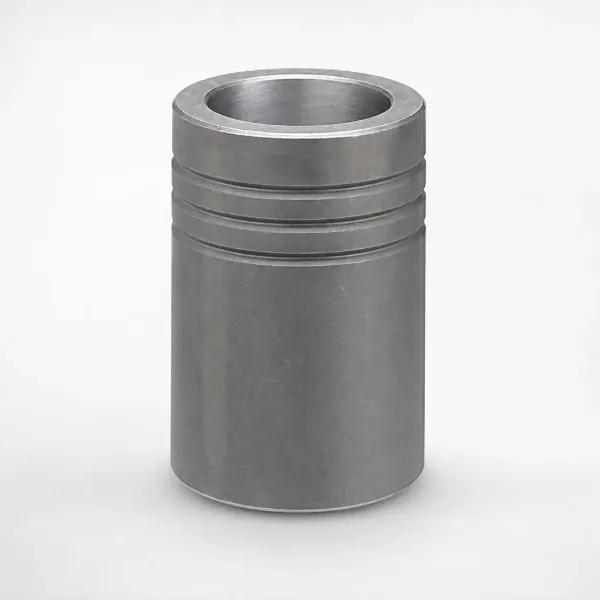
Temperature shifts the numbers. Coil spring rate drops as the spring warms, and most coil springs are derated above 120 °C (typical industry limit). Gas spring precharge pressure rises with temperature, so gas springs are derated above 80 °C and should never be painted or welded. Keep both facts in the mold design file.
Life ratings also assume a clean spring. Rust pitting and nicks act as stress raisers and can cut fatigue life by half or more. Springs that run in coolant mist need coated or stainless wire, and springs in dry pockets last longer with a light oil film.
Preload, Travel, and the Force Math
Every mold spring follows one equation: F = k × x. F is force in newtons, k is the spring rate in newtons per millimeter, and x is deflection in millimeters. Total deflection at full stroke is preload plus travel. Both must be checked against the class limit.
Preload is the compression set at assembly. It keeps the spring in contact with the ejector plate, and it supplies the return force before the plate moves. Typical preload sits between 5% and 15% of free length, or high enough to cover the return load with margin. Travel is the ejector stroke, and it is fixed by the part geometry and the ejector layout.
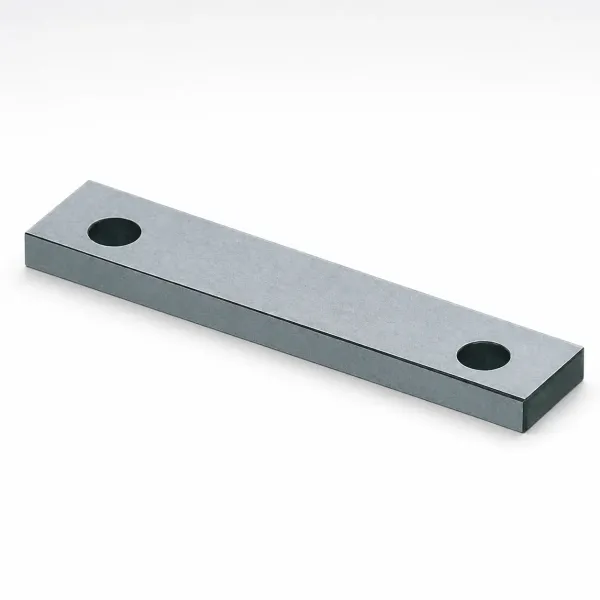
The Worked Example
Take a two-plate mold with a 40 mm ejector stroke. The ejector plate assembly, return pins, and springs move 8 kg. At a 0.3 friction coefficient on the guide pins, friction adds about 24 N, and return pin resistance from melt pressure adds roughly 120 N. The total return resistance is about 220 N. With a 2.0 safety factor, the design load is 440 N across 4 springs, or 110 N per spring.
The candidate is a blue medium-load rectangular wire spring, 25 mm OD, 170 mm free length, 8 N/mm rate (typical catalog value). Set preload at 14 mm, so preload force is 8 × 14 = 112 N per spring. That covers the 110 N requirement with a small margin. At full stroke, deflection is 14 + 40 = 54 mm, and force is 8 × 54 = 432 N per spring. Total return force is 1,728 N.
Two checks close the example. The ratio check: 54 mm divided by 170 mm free length is 31.8%, under the 32% medium-class limit at 1M cycles. The solid height check comes next, and the spring must not reach coil bind before full stroke. Keep maximum deflection below 90% of the travel range to solid height, and both checks pass for the 500k cycle target with margin to 1M.
If the same mold only needs 300k cycles, the medium-class limit rises to 40%. A 150 mm free length spring would then pass the ratio check and save about 12% of pocket depth. This is the lever that separates a sized spring from a copied one.
The force check has two ends. At assembly, the preload must exceed the return resistance, or the plate floats and the pins stay proud at mold close. At full stroke, the force must stay within the class ratio and below the solid height. Springs act in parallel on a plate, so total force is the sum of individual forces. Unequal springs on one plate create uneven return and should be avoided on ejector assemblies.
Mold Spring Selection Matrix
The matrix below maps common mold functions to a starting class, deflection limit, life target, and relative cost. Use it as a first pass, then run the F = k × x check with the actual ejector stroke and plate mass.
| Application | Load class | Max deflection | Life rating | Cost |
|---|---|---|---|---|
| Ejector return, standard production | Medium (blue) | 32% of free length | 1M cycles | Low |
| Ejector return, high-speed press above 60 cpm | Light (yellow) | 40% of free length | 1M cycles | Low |
| Slide return, heavy slide or long travel | Heavy (red) | 25% of free length | 1M cycles | Medium |
| Slide or lifter return, tight envelope | Nitrogen gas spring | Full rated stroke | 1M cycles | High |
| Compact cavity, shallow pockets | Extra heavy (green) | 20% of free length | 1M cycles | Medium |
| Prototype or short-run tool | Medium (blue) at 300k rating | 40% of free length | 300k cycles | Low |
← swipe to scroll →
Table: typical industry figures; verify against your program.
Reading the matrix starts with the ejector stroke and the plate mass, not with the spring. Calculate the design load first, then pick the class, then confirm the ratio. Gas springs change the math, because their force is set by precharge pressure at the build, not by deflection. A Ø19 mm gas spring holds about 1,000 N in a 20 mm bore. A coil spring of the same OD holds roughly 200 to 300 N at 32% deflection (typical industry figures).
Two patterns matter when you read the matrix. First, the ejector return is the highest-frequency spring application in a mold, so it deserves the 1M rating at a conservative ratio. Second, gas springs appear where the envelope wins, and their higher price is justified by a smaller pocket and a flatter force curve.
DieStrike runs this matrix inside every DFM review. Spring selection advice and a cost breakdown for the spring package come back within 48 hours of the drawing. The standard springs themselves ship in 3 to 7 days.
Spring Cavity Design
The pocket is where spring selection is won or lost. A correct spring in a bad pocket still fails, usually by binding, cutting, or buckling.
Pocket Dimensions
Bore the pocket to spring OD plus 1.0 to 1.5 mm total clearance for coil springs. A tighter bore makes the spring bind on the wall, and a looser one lets it walk and wear the bore oval. Counterbore the pocket deep enough for the solid height plus preload plus a 3 to 5 mm margin. Seat the spring on a flat, hardened surface. Gas springs need a different fit, with a pilot bore held to 0.05 to 0.10 mm on the body diameter.
Venting and Seating
Trapped air and oil slow a spring down. Drill a 1 to 2 mm vent hole through the pocket floor so air escapes on compression. Chamfer or radius the pocket mouth so the coil does not cut against a sharp edge. Deburr every edge the spring touches.
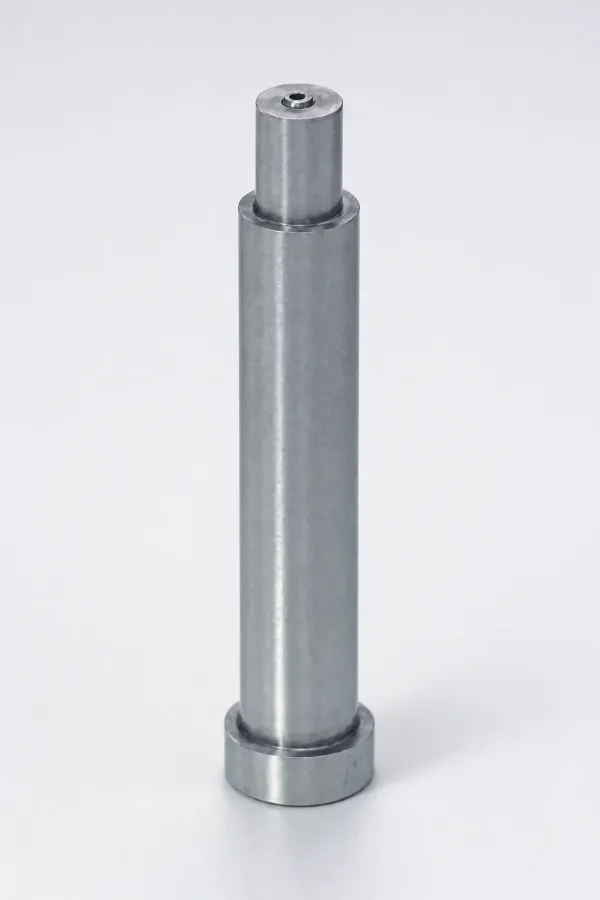
Long springs need guidance. When free length exceeds 4 times the OD, run a guide rod through the spring bore or use a close-fit counterbore sleeve. Without guidance the spring bows sideways, gouges the pocket, and eventually buckles. On the ejector side, spring pockets live in the ejector plate and the B plate. Coordinate the layout with the ejector pin pattern and the mold base design.
At mold assembly, springs are installed with the preload marked on the drawing. The ejector return is checked by hand before the mold goes to the press. In the T1 trial, the return timing is verified against the press cycle, and any plate float is corrected before sampling starts. DieStrike machines spring pockets to ±0.002 mm where the fit demands it, inside a mold held to ±0.005 mm overall. See how to specify a mold base for the pocket and guide layout rules.
Failure Modes and Replacement Intervals
Springs fail in four predictable ways. Each has a signature, and each is preventable with the right class, ratio, pocket, and schedule.
Fatigue Fracture
Fatigue fracture is the number one failure mode, and over-deflection is the usual cause. The crack starts at the inner surface of an end coil, where bending stress peaks, and grows at roughly 45 degrees to the wire axis. Running a medium spring at 40% deflection instead of 32% raises the bending stress. In a typical S-N curve for spring wire, a 20% stress increase can cut life by an order of magnitude (typical industry behavior). Shot-peened preset springs resist this better than plain wire springs.
Corrosion
Corrosion pitting is a stress raiser. A spring that looks fine but shows light pitting can lose half its fatigue life, because every pit is a crack starter. Coolant mist, mold release residue, and humid storage all cause it. Use coated or stainless wire springs in wet environments, keep pockets dry, and oil coil springs at every maintenance event.
Buckling
Buckling happens when a slender spring is compressed straight. Free length over 4 times the OD, or a spring seated off-center, makes the coil bow sideways and score the pocket wall. The fix is a guide rod, a shorter spring, or a larger OD with the same rate. Never extend free length to fix a ratio problem without adding guidance.
Replacement Intervals
Preventive replacement beats failure replacement, and it runs on three triggers. First, measure free length at every maintenance event and replace the spring when it has lost 3% or more. Second, check load at a fixed deflection and replace when the measured force sits 10% below the new-spring value. Third, schedule preventive replacement at 500k cycles for ejector return springs and at 1M cycles for gas springs. At every major mold overhaul, do the same, and track the count on the press cycle counter, not on a calendar.
The economics are one-sided, and a 25 mm return spring costs about USD 10 to 15 (typical catalog price). Replacing it on schedule costs one hour of bench time. Replacing it after fracture costs a stopped press, a damaged plate, and possibly a scrap shot. Mold maintenance is cheaper than mold repair, and the same rule applies to the parts it protects. Check the ejector pins for wear in the same maintenance pass.
FAQ: Mold Spring Selection
Q1. What is the difference between round wire and rectangular wire mold springs?
Round wire springs use a circular cross section and cost less, but they deliver less force at the same outside diameter. Rectangular wire springs pack more steel into the same envelope, so they carry roughly 15% to 30% more load and fatigue better. Production mold tooling almost always uses rectangular wire springs, with round wire reserved for light duty or prototype work.
Q2. What does the 32% compression ratio mean?
It is the maximum deflection a medium-load spring may take at 1M cycles, expressed as a share of free length. A 100 mm spring may compress 32 mm. At 300k cycles the same class may compress 40%. Exceeding the limit shortens life sharply, so the ratio is the first check in any spring sizing.
Q3. How many cycles should a mold spring last?
Ejector return springs are typically rated for 300k to 1M cycles depending on class and deflection. Run at the class limit with clean, guided, lubricated conditions and 1M cycles is realistic. For a 500k part order, schedule preventive replacement at 500k cycles and the spring will not be the reason the mold stops.
Q4. When do I need nitrogen gas springs instead of coil springs?
Use gas springs when the envelope is tight and the force is high, or when the force curve must stay flat over the stroke. A gas spring delivers high force from a small bore with roughly 10% force rise over full stroke. Budget for 5 to 10 times the price of a coil spring (typical industry figures) and for a precise pilot fit in the pocket.
Q5. How do I know when to replace a mold spring?
Three signals. Free length loss of 3% or more from new. Measured load at a fixed deflection 10% below rated. Visible cracks, rust pitting, or coating damage. Run these checks at every maintenance event, and add a preventive 500k cycle replacement for ejector return springs.
The Bottom Line
Spring selection is a ratio check, a force check, and a pocket check. Skip any one and the mold stops mid-run on a part worth less than the spring. DieStrike builds IATF 16949 certified molds with verified spring packages and confirms the selection within 48 hours.
Send us your mold drawing and we will size the springs with you.
KEEP READING
Related Reading
5 Mold Cooling Channel Design Tips for Faster Cycles
Mold maker's 5 cooling channel design rules: channel-to-cavity distance 2-2.
Read articleArticle5 Shrinkage Compensation Rules for Mold Design
Shrinkage compensation decides mold accuracy. Five rules: material rates from 0.3% to 2.
Read articleArticle5 Ways to Reduce Mold Cost Without Cutting Quality
Five proven ways to reduce injection mold cost without cutting quality: DFM before quoting, right-sized cavity count,…
Read articleArticle7 Gate Design Best Practices for Balanced Filling
Mold maker's 7 gate design rules for balanced multi-cavity filling: gate depth 50-80% of wall thickness, land 0.5-1.
Read articleNEXT STEP
Ready to Start Your Mold?
Send us your element dimensions or part numbers — our team responds within 24 hours with pricing and lead time.

Written by
Ray ChanMold Buyer's Guide Author · Precision Mold Manufacturing Specialist. Ray helps global importers, distributors and OEMs source factory-direct molds and mold parts.