
Urethane Springs Replace Corroding Metal Springs in a Wet Stamping Die
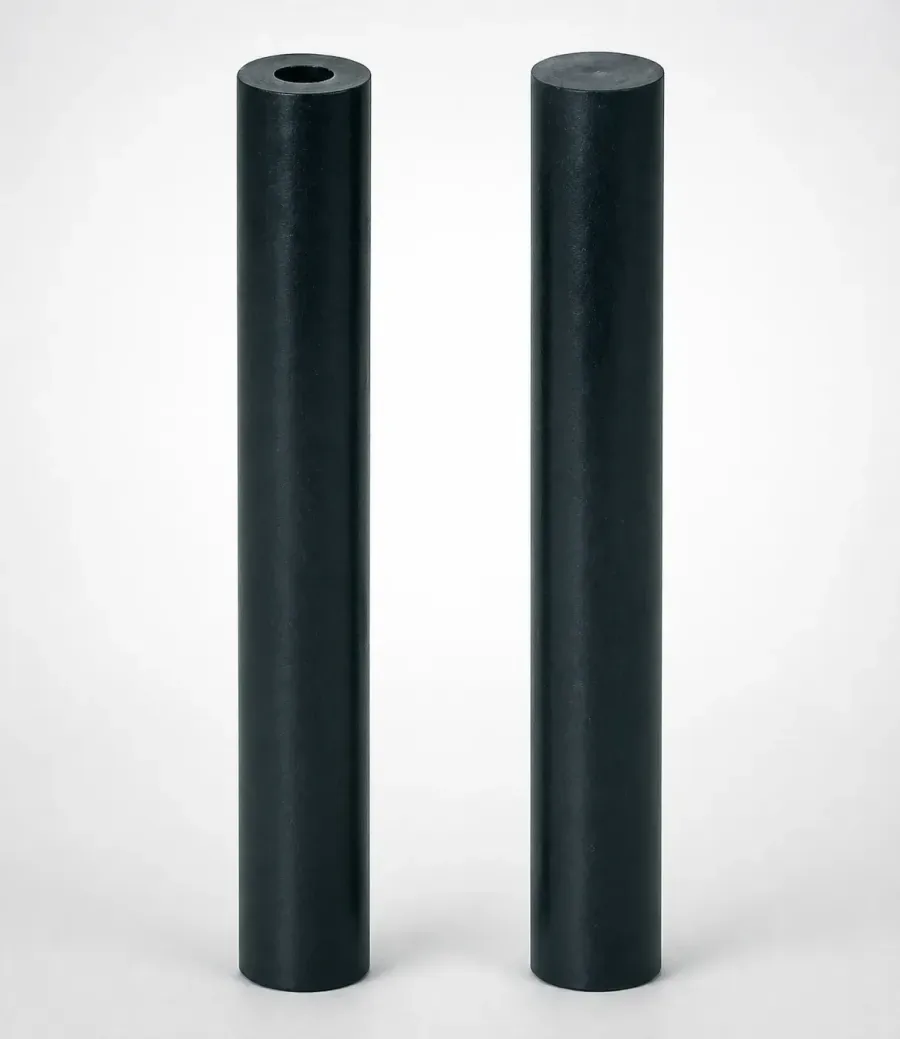
Table of Contents
Introduction
An automotive body stamper was running a 2-stage draw and trim transfer die that produced 1.2 million galvanized chassis reinforcement panels a year. Galvanized sheet is the obvious choice for chassis parts — the zinc coating is what keeps structural steel alive through winters of road salt — but it is a demanding material to stamp wet. The die was a wet stamping setup: a water-soluble coolant — 95% water, 5% oil — flooded the draw area to keep the draw ring at its 18,000 daN holding force, and that force was delivered by twenty-four heavy-load ISO 10243 coil springs packed in pockets under the ring. On paper it was a standard, well-built tool. In production it was failing on a schedule.
The coolant did what coolant is supposed to do — it kept the die cool, it kept the draw lubricated, and it kept fines from sticking to the steel. But it also washed away the protective grease the coil springs depended on. Left exposed to the water-based fluid, the chrome-silicon coils started cracking after just 50,000 to 80,000 cycles. Not at some distant end-of-life horizon: the springs were being replaced almost as often as the dies they served, and each failure was not a quiet one. When a coil lets go mid-run, it does not tap you on the shoulder — it drops a fragment into the draw and lets the press do the rest.
The stamper came to DieStrike after the pattern became impossible to ignore — 18 line stops a year, scrap climbing, and a maintenance log that treated steel coil springs as a consumable. The production target was fixed, the press schedule was fixed, and the die design was otherwise sound; the holding force, the draw geometry, the coolant itself all worked. What they did not want was another steel coil anywhere near the water. They asked us to make the spring package disappear from the failure conversation entirely.
The Snapshot
Here is the project at a glance — the part, the environment, the tool, and the numbers that mattered.
| Part / Component | Galvanized chassis reinforcement panel |
| Resin / Material | Galvanized steel sheet / polyether urethane spring blocks |
| Mold / Die Type | 2-stage draw and trim transfer die, wet stamping |
| Annual Volume | 1.2 million panels/year |
| Critical Tolerance | ±0.005 mm pocket bores; 18,000 daN draw ring holding force |
| Initial Problem | Chrome-silicon coil springs cracking at 50,000–80,000 cycles |
| Result Summary | Zero spring failures in 12 months, 72% lower tool operating cost |
- 1.2 million galvanized chassis reinforcement panels per year through a 2-stage draw and trim transfer die.
- Twenty-four heavy-load ISO 10243 coil springs carried the 18,000 daN holding force under the draw ring.
- Springs cracked after 50,000–80,000 cycles — 18 line stops a year and USD 54,000 in downtime alone.
- Polyether urethane blocks ran 1,200,000+ cycles with zero breakages — and cut tool operating cost 72%.
The Challenge
The failure mode was stress corrosion cracking (SCC) on the coil surface after 50,000–80,000 cycles, with fragments breaking loose mid-run. SCC is insidious in a stamping die because the spring looks fine until it is not. There is no gradual wear to schedule around: the crack grows under the combination of sustained tensile stress and a wet, chloride-bearing environment, then lets go while the press is running — usually at the exact moment the draw ring is loaded to its full 18,000 daN. The chrome-silicon alloy that makes a coil strong in a dry die is exactly the alloy that SCC attacks hardest in a wet one.
The consequences cascaded. Broken spring fragments scratched drawn panels — 3.1% scrap plus polishing time after every stop. Polishing drawn galvanized steel is not a five-minute touch-up; every scratched panel had to be pulled, inspected, and reworked, and the polishing itself risked thinning the zinc coating that the part exists to carry. Meanwhile the emulsified lubricant formed a sticky residue that clogged the coils, unbalanced the draw ring and caused wrinkling. So one spring failure was never one problem: it was scrap panels, rework hours, a re-set draw ring, and the risk of a wrinkled part coming off the next stroke.
The economics made it urgent. Eighteen failures a year, each a 2-hour line stop at USD 1,500/hour — USD 54,000 in downtime alone, before a single replacement spring was paid for. On a program producing 1.2 million panels a year, every stopped hour was real output lost, and every stop on a transfer die ripples backward and forward through the press schedule. The stamper did not need a better coil; they needed the failure mode gone from the die.
How We Solved It
The chemistry first. We replaced all 24 coils with custom-cast polyether urethane spring blocks at Shore A90, specified across A70–A95 for different stations. The hardness range mattered: different stations see different loads and different stroke depths, so we tuned each block's durometer to its station instead of running one spring rate everywhere. The chemistry mattered more. Polyether urethane resists hydrolysis — the ether linkage (R-O-R) does not break down in water the way polyester-based urethane does. In a die flooded with coolant that is 95% water, that single property is the difference between a spring that lasts and one that softens from the inside out. Treating the operating environment as part of the design input — not an afterthought — is exactly the discipline we apply in our DFM and mold design review process.
The geometry second. Each block is a hollow cylinder with a center vent hole, so under load it bulges inward and outward instead of trying to squeeze sideways out of its pocket. That bulge is the block's spring action — and it is also why a solid cylinder would not work. We widened the pockets with ~15% diametral clearance for the bulge — open enough to let the block deform freely, tight enough to keep it seated through millions of strokes. The hollow core spreads the deflection over the whole wall instead of concentrating strain at one point, which is what lets urethane cycle far beyond the fatigue life of a wire coil. No coil, no crevice, no place for sticky residue to pack in and unbalance the ring.
The installation third — and the part the stamper liked most. The blocks drop straight in over the existing guide pins, with the pocket bores machined to ±0.005 mm and no die base modification. No rework of the die base, no changes to the trim stations, no re-plumb of the coolant lines — the die kept its draw geometry, its trim alignment, and its press registration exactly as they were. The changeover was planned as a weekend job and executed as one: the old coils came out, the bores were opened and re-finished to spec, the blocks dropped in, and the press was back on the schedule Monday morning. It was a drop-in retrofit designed for the tool they actually have — the standard we hold across every mold-making project we take on.
The Results
| Spring service life | 80,000 cycles (chrome-silicon coil) → 1,200,000+ cycles (polyether urethane) — 15× longer |
| Corrosion / SCC failures | Eliminated — zero spring breakages in 12 months |
| Line stops | 18 per year → 0 per year; 36 hours of downtime saved |
| Downtime + spring cost | USD 54,000 + USD 18,600 → USD 20,300 (maintenance only) — 72% total operating cost reduction |
| Part scrap rate | 3.1% → 0.05% — 98% reduction in scrap and rework |
The first number that matters: spring service life went from 80,000 cycles to 1,200,000+ cycles — 15× longer. The die ran a full year without a single spring breakage. Zero. The maintenance log that used to be dominated by emergency spring changes is now a routine schedule, and the maintenance crew stopped treating the spring pockets as a weekly inspection point.
The operating economics followed. Line stops dropped from 18 per year to 0, saving 36 hours of downtime. Downtime plus spring cost fell from USD 54,000 + USD 18,600 to USD 20,300 — maintenance only — a 72% total operating cost reduction. And the part scrap rate fell from 3.1% to 0.05%, a 98% reduction in scrap and rework. The panels that used to be scratched by spring fragments now come off clean, the polishing bench stopped being a permanent station on the line, and the 3.1% scrap line is a rounding error.
Why It Held
The fix held because it removed the failure mechanism instead of trying to outlast it. The chrome-silicon coils failed by stress corrosion cracking — a chemistry problem in a 95% water environment. The polyether urethane blocks have none of those modes: no corrosion, no SCC, no fatigue crack initiation, and a polyether backbone that resists hydrolysis in the wet coolant. The hollow-cylinder geometry with its center vent hole flexes in a controlled way every cycle, with the ~15% diametral clearance and ±0.005 mm pocket bores keeping it stable in service from the first stroke to the millionth. There is nothing left in the pocket that can crack, corrode, clog, or let go mid-run.
There is also a maintenance story. With coils, every 50,000–80,000 cycles was a gamble and every gamble carried a 2-hour stop. With urethane blocks, the die runs 1,200,000+ cycles on USD 20,300 of routine maintenance — against USD 54,000 in downtime plus USD 18,600 in springs before. The stamper kept the same 18,000 daN holding force and the same panels, the draw ring stayed balanced through the run, and the die stopped being the emergency generator on the maintenance log. That is the difference between fixing a spring and fixing a failure mode — the first buys you 80,000 cycles, the second buys you the program.
KEEP READING
Related Reading
Gas Spring Upgrade Cuts Progressive Die Operating Costs 48%
Four manifolded nitrogen gas springs replaced sixteen coils, cutting progressive die operating cost 48% and stops 94%.
Read case studyCase StudyProgressive Die for Precision Terminal Stamping
A 24-station SKH51 + TiCN progressive die holds ±0.01 mm terminal features at 400 SPM with 2M+ strokes between regrinds.
Read case studyArticleHow to Choose Mold Springs by Life Cycle and Load
Spec springs by required load, life-cycle class, and operating environment — and know when a metal coil is the wrong material for the job.
Read articleArticleHow to Extend Mold Life: 5 Proven Strategies
The five strategies that genuinely extend tool life in production — steel selection, maintenance discipline, environment control, and design-level failure analysis.
Read articleNEXT STEP
Ready to Start Your Mold?
Send us your element dimensions or part numbers — our team responds within 24 hours with pricing and lead time.

Written by
Ray ChanMold Buyer's Guide Author · Precision Mold Manufacturing Specialist. Ray helps global importers, distributors and OEMs source factory-direct molds and mold parts.