
DME vs HASCO vs MISUMI: Mold Standards Compared
Table of Contents
In week 31 of a 32-cavity automotive connector program, the plant discovered that 6 mold bases bought from a new supplier followed HASCO geometry instead of the DME geometry used on the other 41 tools in the line. The ejector pin grid sat 0.4 mm off on 214 of the 360 pin holes per base, and every spare spring in the crib carried a color code from the wrong load chart.
The plant spent 11 weeks and roughly $26,000 re-drilling plate sets, re-cutting pin holes and re-ordering springs before the first tool ran. A mold standard is the reference grid for every plate, pin and spring purchased over the tool's 5 to 10 year life. The choice made at buy-off decides whether a spare costs $4 or $140 and arrives in 3 days or 5 weeks. Repair shops stock what their region uses, and your tool lives inside that ecosystem whether you planned it or not.
This guide compares DME, HASCO, MISUMI and LKM for buyers who write RFQs and approve quotes. It covers origins, plate sizes, components, interchangeability, price, lead time and the clauses that lock a standard into a contract. Values are typical industry figures; DieStrike ships to the standard the customer names, so this is a sourcing map, not a brand pitch.
The Snapshot
- DME is US-based with inch legacy ejector pins from 1/16 to 1/2 in; HASCO is German with DIN metric K-series bases and 1 to 20 mm DIN 1530 pins.
- MISUMI configurable components typically ship in 3 to 7 days; stocked DME and HASCO standards leave the warehouse in 1 to 2 days.
- Prehardened plate steels P20, 718 and 2311 equivalents run 28 to 36 HRC across all four systems.
- Base footprints run 1515 to 6060 (150 to 600 mm) with plate parallelism held to 0.02 to 0.05 mm in standard classes.
- Spring color codes are proprietary, so DME blue and gold never equal HASCO or MISUMI codes without a load check at 30% deflection.
Why Mold Standards Matter at Buy-Off
A standard system defines the hole pattern of the ejector grid, the guide pillar spacing, the pin diameter series and the spring load codes on every tool you buy. A 32-cavity base carries 96 to 192 ejector pins, so one grid mismatch repeats 96 to 192 times per plate set. Nothing about that error shows at buy-off; it appears at the first spare order, usually at 2:00 a.m. on a down press.
The four systems answer the same job differently. DME is the North American default, built on an inch legacy with a full metric line added later. HASCO is the German DIN standard whose K-series bases dominate Europe.
MISUMI sells Japanese configurable components built to order with fast ship times. LKM is the Chinese economy base maker that supplies tool shops worldwide. Units, hole patterns, pin sizes and spring codes all differ between them.
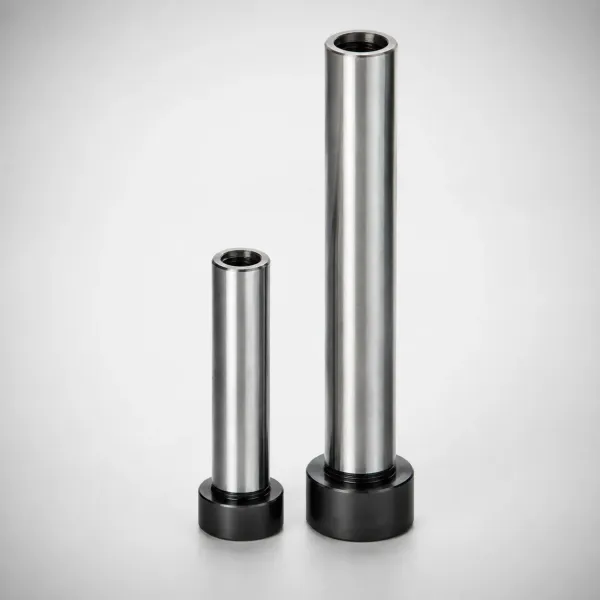
Mismatch costs are measurable. Re-drilling a 1515-class plate pair for a wrong pin grid runs $300 to $900 typical; a 6060-class pair runs $1,500 to $4,000, and the press waits while the work happens. The alternative is a drawing change at buy-off, which costs minutes instead of weeks. Catch the standard question before the base PO releases, and the whole line of parts stays consistent.
Buy-off is the only point where you control the standard at zero rework cost. Name the base standard, the class, the plate steel and the parallelism tolerance in the contract, the same way you would in our guide on how to specify a mold base. Every silent RFQ line converts into a toolmaker default, and defaults become surprises on the repair bench.
Origins and Coverage: DME, HASCO, MISUMI, LKM
DME was founded in Detroit in 1942 and grew into the standard of the North American toolroom. Its catalog started in inches: plates sized in inch steps, ejector pins from 1/16 to 1/2 in, and spring codes such as blue and gold that US shops still order by name. A full metric line now sits beside the inch catalog, because export tooling forced the change. Distributor stock across the US keeps DME spares within 1 to 2 days for most cities.
HASCO started in Germany in 1924 and built its system on DIN metric geometry. Its K-series bases and component numbering follow the metric module that European toolrooms learned in apprenticeship. Pins run 1 to 20 mm under DIN 1530, plates come in metric footprints, and the numbering appears on drawings from Stuttgart to Shanghai. European Tier 1 mold repair shops read HASCO numbers the way US shops read DME.
MISUMI began in Tokyo in 1963 and built the opposite model: configurable, not stocked. You order a plate pre-cut to your coordinates, a pin trimmed to your length, or a spring sized to your stroke, and the factory ships the configured part in 3 to 7 days typical. The trade is price per part against DME or HASCO stock, and the strength is breadth: one catalog covers pins, springs, bushings, punches and plate blanks.
LKM, rooted in Hong Kong since 1975, is the volume economy producer of mold bases. It builds both inch and metric geometries, holds 1515 to 6060 footprint sizes, and prices below the branded systems because the factories run at scale. Its bases appear inside tools made by shops in China, Vietnam, Mexico and increasingly the US, often carrying a DME-compatible pattern when the buyer asks.
Coverage follows repair geography, not quality. North America defaults to DME, Europe to HASCO, Japan to configurable sourcing, and China to economy bases with export-compatible patterns. A program that spans 3 continents and 4 repair networks should force one standard per component class. Doing so collapses spare SKUs from 4 catalogs to 1, and spare inventory value drops by 50 to 70% because nothing sits dead in a crib.
Mold Base Plates: Sizes, Steels and Tolerances
Base footprints use a compact naming convention across the Asian systems. A 1515 designation means a 150 by 150 mm plate footprint, and 6060 means 600 by 600 mm, with intermediate sizes stepping in 50 mm increments typical. DME keeps an inch-based naming for legacy plates, so always confirm the millimeter footprint on the drawing instead of trusting the name. The same physical plate can be described three different ways across four catalogs.
Plate steel does not separate the systems, because the same mills supply all four. The prehardened grades are P20, 718 and 2311 class, equivalent across suppliers, running 28 to 36 HRC as delivered. The 718 and 2311 grades sit at the upper hardness end and hold it better in thick section plates above 200 mm. If your RFQ names the grade and the hardness band, any base maker can quote the same plate steel.
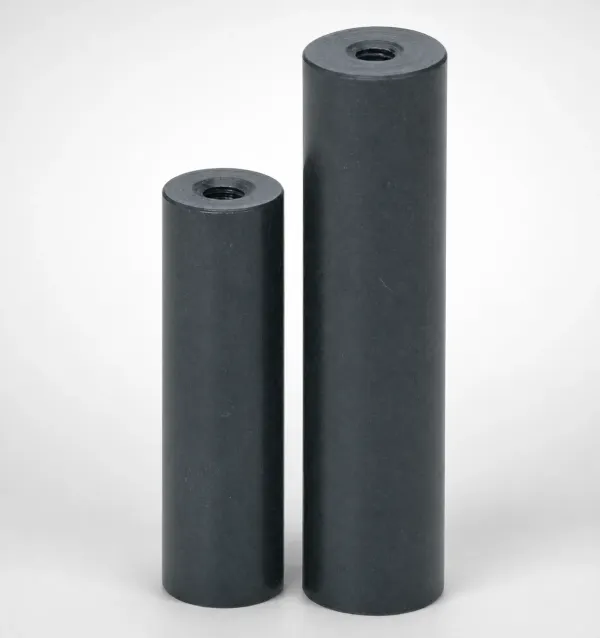
Tolerance classes repeat inside every system, so class beats brand as a spec. Standard class parallelism across a plate pair runs 0.02 to 0.05 mm typical, and precision classes tighten further. Guide pillar hole positions typically hold ±0.01 to 0.03 mm from the datum edges, and the class uplift from standard to precision runs 15 to 40% on the base price. Put the class in the PO; the same catalog number at standard class will not arrive precision.
Incoming inspection settles the argument in 20 minutes. Check plate parallelism against the 0.02 to 0.05 mm class call-out, verify the hardness certificate against 28 to 36 HRC, and measure guide pin bore centers on the grid. Buyers who check the first base of every new supplier catch drift before 5 identical plates repeat the error. The check costs nothing next to re-cutting 214 pin holes per plate set.
Standard Components: Pins, Springs, Bushings
Ejector pins divide into two unit families that never mix. DME inch pins run 1/16 to 1/2 in diameters, about 1.6 to 12.7 mm, and follow inch length steps. Metric pins follow DIN 1530 from 1 to 20 mm with defined head diameters and shoulder lengths, and DIN 1530 geometry is now the de facto export default even inside US-built tooling. Most new connector molds order metric pins and buy inch spares only for legacy fleet tools. Our ejector pin line covers both families to DIN and DME-compatible geometry.
Springs carry the most dangerous difference because they look alike and behave differently. DME uses blue and gold codes for its load classes, while HASCO and MISUMI each publish their own color charts, and the colors do not cross-reference. Two springs of identical free length and outside diameter can differ 20 to 30% in load at the same deflection across brands. Always compare load at a defined deflection point, such as 30%, before ordering or substituting, and keep the same code within one ejector assembly. Mold springs should be chosen on the same data sheet logic.
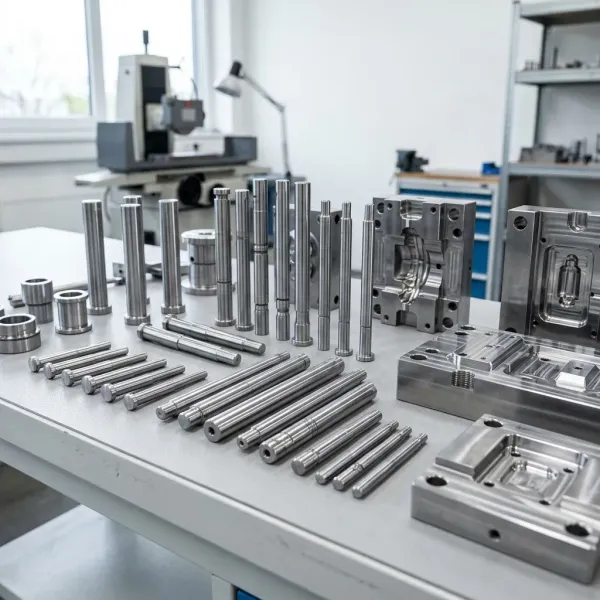
Leader pins and bushings set the slide quality of the whole stack. Guide pin to bushing clearance runs 0.01 to 0.05 mm typical, sized to the base class, with larger bases taking the upper end. Bushings come in press-in and shoulder styles, plain or with grease grooves, and the pin steel is hardened and ground while the bushing takes the wear. The clearance call-out on your drawing matters more than which catalog the bushing came from.
The rest of the standard kit follows the same logic: locating rings, sprue bushings, support pillars, interlocks and slide retainers. Every system numbers them differently, and the numbering is where RFQ confusion starts. Ask the supplier to map every standard part to the named standard's catalog number in the quote, so the repair bench orders by your drawing and not by memory. Component spares stay lean when the drawing names the series: 10 to 20 spare pins per active size and springs replaced in matched sets of 4 to 8.
Interchangeability: What Swaps and What Does Not
Component-level swaps work when both parts follow the same standard family. A DIN 1530 ejector pin at 6 mm diameter and 100 mm length from any maker fits a base machined to DIN 1530 geometry, because head diameter, shoulder length and body tolerance are defined by the standard. ISO pins that mirror DIN 1530 dimensions give the same result. That is why metric export tools source pins from 3 suppliers without a drawing change.
Complete bases do not swap between systems. A DME base and a HASCO base carry different guide pillar locations, bushing bore patterns, ejector grids and dowel positions, so a HASCO plate set cannot replace a DME set without re-drilling that costs more than the plate. Springs do not swap by color, as covered above. Treat any cross-system change as an engineering task with a drawing, not a warehouse substitution.
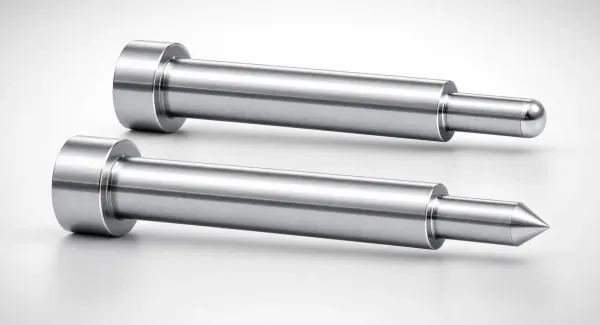
Same-nominal parts still differ in the details that break tools. Two makers can both list a 2 mm ejector pin, yet length tolerance can run ±0.05 mm in one catalog and ±0.1 mm in another, and steel grades may split between H13 and SKD61 at different hardness. Substitute only when material, hardness and tolerance match the drawing call-out, and verify with a 3-piece sample check. A $4 sample pin beats an $18,000 re-qualification run.
The durable fix is drawing-based buying. Give every supplier your part number, the standard number it follows and the tolerance call-outs, and the catalog becomes an execution detail. Our mold bases follow the named standard's hole pattern, so the plate arrives ready for the component grid you specified. When the drawing rules, any compliant maker becomes an interchangeable source.
Price and Lead Time by System
Price differences follow a consistent index shape, not a fixed price list. Set the economy base at index 1.0 as the reference. LKM sits at that reference, MISUMI configurable parts typically run 1.2 to 1.8, and DME and HASCO branded stock typically runs 1.8 to 3.0 for equivalent geometry, steel and tolerance class. Actual quotes move ±30% with volume, steel grade and class, so use the index to structure negotiation, not to promise a price.
| System | Origin | Units and Geometry | Typical Cost Index | Typical Component Lead |
|---|---|---|---|---|
| DME | United States, 1942 | Inch legacy plus metric | 1.8 to 3.0 | 1 to 2 days stocked |
| HASCO | Germany, 1924 | DIN metric, K-series bases | 1.8 to 3.0 | 1 to 2 days stocked |
| MISUMI | Japan, 1963 | Metric configurable | 1.2 to 1.8 | 3 to 7 days configured |
| LKM | Hong Kong, 1975 | Inch and metric economy | 1.0 reference | 1 to 3 weeks ex-factory |
← swipe to scroll →
Table: typical index comparison with the economy base set at 1.0. Quotes vary with steel grade, tolerance class, volume and freight. Verify against your supplier's current price list.
Lead time depends on how the part is made. Stocked DME and HASCO standards ship in 1 to 2 days from regional warehouses, and distributor networks stretch that to 2 to 5 days. MISUMI configures to order in 3 to 7 days typical because the plate or pin is cut after you order. LKM factory bases quote 1 to 3 weeks before freight, and ocean transit adds weeks to Americas delivery, so economy sourcing needs inventory in front of the press.
Hidden costs decide the real price. Freight and customs on a 2 kg spring set rarely matter, but engineering time does: converting drawings and re-drilling plates for a mismatched standard runs 0.5 to 2 days per base typical. Single-source risk adds another layer, so the strongest setup pairs one primary standard with one backup supplier that can prove interchangeability. Total landed cost beats catalog price every time, and the standard call-out should be the first line you check when a quote arrives.
What the Standard Choice Does to Your RFQ
An RFQ that stays silent on standards hands the decision to the toolmaker, and different toolmakers make different calls. A program that spans 3 plants and 4 suppliers can finish with 4 base patterns, 4 pin series and 4 spring codes for the same molded part. Every mold then needs its own spare kit, and the repair bench holds inventory that fits exactly one tool. Name the standard once, and the whole fleet converges.
The RFQ should name six things: the base standard and class, the plate steel grade with a 28 to 36 HRC band, the parallelism tolerance in the 0.02 to 0.05 mm range, the ejector pin series such as DIN 1530 or DME inch, the spring color code reference, and the catalog numbering basis. Add one clause that substitutions require written approval with dimensional and material data. The clause costs nothing and stops a $4 spring swap from killing a $40,000 tool.
Audit at buy-off with a short checklist. Six checks take under 30 minutes and close the loop that the opening failure left open.
- Confirm the standard is named on the drawing title block.
- Verify pin diameters match the RFQ series.
- Check spring codes against the named catalog.
- Request steel certificates inside 28 to 36 HRC.
- Measure parallelism within 0.02 to 0.05 mm.
- Confirm every standard part maps to one catalog number in the spares list.
Put the same standard language in the repair and spare PO, not just the new-tool RFQ. Our guide on how to write a mold RFQ carries the full clause set, and it applies to spares as tightly as to new builds. A standard that survives from the first base to the last spring keeps the fleet interchangeable for the tool's whole life.
Decision Table: Which Standard for Your Program
Match the standard to your repair geography, your existing fleet and your lead time needs. Brand reputation matters less than the question of who stocks the spare and how fast it reaches your press. The matrix below starts from the situation most buyers actually face.
| Your Program | Leading Standard | Why It Wins | Watch Out |
|---|---|---|---|
| Legacy DME fleet, North American repair shops | DME-compatible | Existing spares, drawings and bench skills match | Confirm metric versions for new export builds |
| European Tier 1 export, DIN toolrooms | HASCO or DIN metric | Repair network reads DIN 1530 and K-series numbers | K-series numbering must match the local source |
| Short-run prototypes, rapid iteration | MISUMI configurable | Cut-to-order parts ship in 3 to 7 days | Tolerance class and steel may differ from branded |
| Volume cost-driven Asia sourcing | LKM economy | Lowest base index with 28 to 36 HRC prehard steel | Verify 0.02 to 0.05 mm parallelism at incoming |
| Global multi-plant connector programs | One metric standard, forced everywhere | One spare kit fits every plant and every mold | Suppliers must sign the same substitution clause |
← swipe to scroll →
Table: typical decision logic for choosing a mold standard system. Final choice should match your repair network and existing fleet inventory.
Mixed systems work only with drawing control. You can run a HASCO base with DME-compatible inserts if the drawings say so and the holes are cut to match, but each mix multiplies the spare list and the risk of a wrong order. Pick one standard per component class per program, document any exception in writing, and let the repair bench order from one catalog.
FAQ: Mold Standards
Q1. Which mold standard is the worldwide default?
None is universal. DME dominates North America, HASCO leads Europe on DIN metric geometry, MISUMI serves configurable Japanese sourcing, and LKM supplies economy bases worldwide. New export tooling with no legacy fleet usually goes metric DIN. Confirm where the mold will be repaired, then write that standard into the RFQ.
Q2. Can I swap a DME base for a HASCO base in an emergency?
Not as a set. Guide pillar locations, bushing bores, ejector grids and dowel patterns differ between the systems, so a HASCO base will not take a DME stack without re-drilling that costs more than a correct base. Component-level swaps are safer, but only after a dimension and material check against the drawing.
Q3. Are MISUMI parts interchangeable with DME or HASCO parts?
Dimensionally in many cases, because most metric parts follow DIN geometry such as DIN 1530 pins. Tolerance class, steel grade and hardness can still differ between catalogs. Treat any cross-brand part as a substitute that needs written approval and a 3-piece sample check before it enters a production tool.
Q4. Do spring color codes match across DME, HASCO and MISUMI?
No. DME blue and gold, HASCO codes and MISUMI codes each follow the maker's own load chart, and the colors do not cross-reference. Compare free length, outside diameter and load at 30% deflection before mixing springs in one stack, and replace springs in matched sets.
Q5. What happens if my mold RFQ does not name a standard?
Each toolmaker applies its own default, so identical parts from two suppliers can carry different plate patterns, pin series and spring codes. Spares multiply, repairs slow down and re-qualification cost appears later. Name the standard, class, plate steel and tolerance band in the RFQ and hold every supplier to the same line.
The Bottom Line
The standard choice is a sourcing decision, not an engineering ornament. It sets spare prices, repair speed and multi-plant consistency for the 5 to 10 year life of the tool, and it locks in at buy-off when changes are still free. Pick the system your repair network actually stocks, then write it into every RFQ, PO and spares order.
Converge on one standard per component class per program, and document any mix in writing. Buy on the drawing rather than the catalog, check samples before substitution, and treat spring codes as proprietary until the load data proves otherwise. Six audit checks at buy-off close the gap that cost the opening program 11 weeks and $26,000.
DieStrike builds every tool to the standard the customer names, and defaults to metric DIN geometry for export tooling with DME-compatible geometry for North America. Plates hold ±0.005 mm parallelism as standard and ±0.002 mm in precision work, standard components ship in 3 to 7 days, and mold programs run for connector OEMs including TE Connectivity, Amphenol and Luxshare.
KEEP READING
Related Reading
How to Choose Mold Springs by Life Cycle and Load
Spring selection by load, life and color code: DME blue and gold, HASCO and MISUMI codes, 30-50% deflection limits, 4-8 springs per action.
Read articleArticleHow to Select Leader Pins and Bushings
Guide pillar fits, clearance classes and steel options for leader pins and bushings, with installation and wear limits for long tool life.
Read articleArticleThe Mold Component Manufacturers Guide
Mold component sourcing map: pin grades, spring sources, bushing suppliers and what to verify before standard parts enter your tool.
Read articleArticleHow to Specify a Mold Base for ±0.002mm Tolerances
Specifying plate steel, parallelism class and pocketing allowance so the base matches the cavity work that sits on top of it.
Read articleNEXT STEP
Ready to Start Your Mold?
Send us your element dimensions or part numbers — our team responds within 24 hours with pricing and lead time.

Written by
Ray ChanMold Buyer's Guide Author · Precision Mold Manufacturing Specialist. Ray helps global importers, distributors and OEMs source factory-direct molds and mold parts.