
Mold Component Manufacturers: How to Choose a Standard Parts Supplier
Table of Contents
A mold shop replaces an ejector pin with a "matching" pin from a different source, and the bore drags from the first stroke. The drag scores the core face, the part rejects, and the press stops at $120-$250 an hour while the mold comes apart again. The pin saved $3 and cost the line a shift. This is the economics of mold components in one story: the cheapest pin is the one that fits, and the most expensive is the one that almost fits.
Standard mold components — ejector pins, core pins, springs, guides, sprue bushings, and sleeves — are the consumables and wear parts that keep molds running. Choosing the supplier is a reliability decision, not a shopping decision. The supplier determines how fast you get replacements, whether they match the original fit, and whether the documentation supports your quality audits.
This guide lays out the five criteria that separate a component manufacturer from a parts reseller, how to verify each claim, and what changes — and what does not — when you source from China. Use it before you set up a component supplier, and again before you audit one.
The Snapshot
- Five criteria decide a component supplier: standards compliance, stock depth, documentation, lot consistency, and custom capability.
- Interchange fit is the point: a pin marked HASCO Z must fit a HASCO Z pocket, verified by dimension, not by brand claim.
- Lead time is a reliability metric: DieStrike ships standard components in 3-7 days, custom in 7-10 days, and rush orders in 24-72 hours, with MOQ 1.
- Material certificates (EN 10204 3.1) and CMM reports on critical lots separate a manufacturer from a reseller.
- Replacement thresholds matter: replace ejector pins at 0.01-0.02 mm OD wear and springs at 5-10% free length loss — the numbers are in the maintenance plan, not the marketing.
Why Component Sourcing Is a Reliability Decision
Mold downtime is dominated by component failures. Ejector pins wear, springs fatigue, guides lose fit, and each failure stops a press that is billed by the hour. The component supplier does not just sell parts — it sets the failure rate of the mold's moving system and the response time when a failure happens.
Run the math once and the decision stops looking like a shopping decision. An unscheduled eight-hour stop at $120-$250 per hour press rate costs $960-$2,000 in machine time alone (typical published press rates). Add a damaged cavity insert at $500-$2,000 to recut, a scrapped batch, and the mold repair labor, and a single component failure runs four figures — often five. A few dollars saved per pin is nothing against a production line stop.
The maintenance plan closes the loop. Components with known grades, known tolerances, and known replacement thresholds let a mold shop schedule replacements instead of reacting to failures. Our mold life extension guide gives the thresholds: 0.01-0.02 mm ejector pin OD wear, 5-10% spring free length loss, 0.02 mm guide play. Those numbers only work if the component supplier can deliver a replacement that matches the original — which is criterion one.
The Component Categories That Drive Mold Uptime
Standard mold components divide into families, and each family has its own failure mode and replacement logic. Know which families your molds carry, because the supplier decision is really several decisions stacked together.
| Component Family | What It Does | Primary Failure Mode | Typical Replacement Trigger |
|---|---|---|---|
| Ejector pins | Push parts off the core after ejection | OD wear, drag, bending on deep-draw parts | 0.01-0.02 mm OD wear, drag marks on parts |
| Core pins | Form internal features, bosses, holes | Wear and breakage at the root | Visible wear at the forming shoulder |
| Ejector sleeves and center pins | Eject thin-wall and annular features | Concentricity loss, wall thinning | Out-of-round eject or mark transfer |
| Mold springs | Return plates, drive slides, assist ejection | Fatigue, free length loss | 5-10% free length loss |
| Leader pins and bushings | Align the mold halves on every cycle | Wear, play, galling | 0.02 mm guide play |
| Sprue bushings and gates | Deliver melt to the cavity | Gate wear, sprue sticking | Gate land growth 0.05-0.1 mm |
← swipe to scroll →
Typical industry thresholds; confirm the trigger values in your own maintenance plan.
Each family has specialist knowledge attached. Ejector pin grades (SKD61 vs H13) decide how long pins survive on abrasive resins — covered in our SKD61 vs H13 ejector pin guide. Spring selection is a load-and-life engineering decision, not a size lookup — see how to choose mold springs. Sleeve selection carries its own concentricity rules — see ejector sleeve selection. A supplier that only sells pins without the engineering context is a distributor; a manufacturer can advise on each family because it makes them.
Criteria 1: Standards Compliance and Interchange Fit
Interchange fit is the point of a standard. A pin marked HASCO Z must fit a HASCO Z pocket, a MISUMI-spec ejector pin must seat in a MISUMI-spec bore, and a DME-series component must drop into a DME-series assembly. Standards (HASCO, DME, MISUMI, Meusburger) exist so components are interchangeable anywhere in the world — but only if the manufacturer actually grinds to the standard dimension and verifies it.
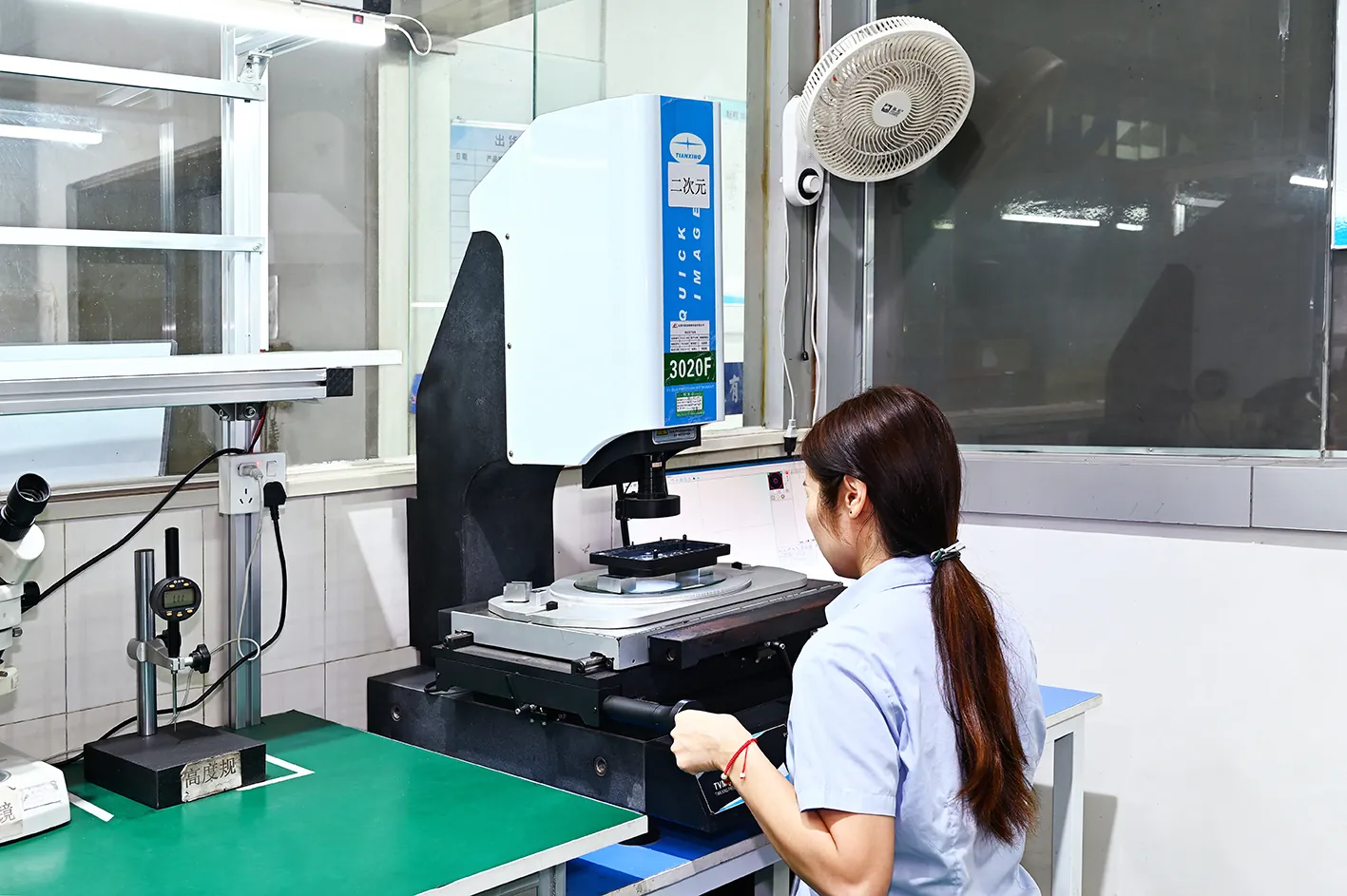
DieStrike builds components to HASCO, DME, and MISUMI interchangeability, with dimensions verified on CMM after grinding. The verification method matters more than the brand claim: ask how a supplier proves interchange fit, not whether they claim it. A manufacturer that quotes the CMM report as standard documentation has an answer; a reseller that quotes a catalog page has a hope.
The dimensional specifics are where the fit lives. Ejector pins ship at 0.5-20 mm diameter with mirror finishes at Ra 0.2. Ejector sleeves hold H7 bore / g6 OD tolerances with concentricity at or below 0.015 mm, built to JIS B5009 and DIN 16756 compatibility. Leader pins run Ø20-80 mm in hardened SUJ2, precision-ground to h5/g6 with ±0.002 mm alignment. Each number is a spec a manufacturer can produce and verify — and a buyer should be able to read on a data sheet. The full ranges are on our mold parts catalog.
Criteria 2: Stock Depth and Lead Time
Component lead time is a reliability metric, not a logistics detail. When a pin snaps on a Monday morning, the question is not whether the supplier can make it — it is how fast a replacement lands. A supplier with real stock depth ships common sizes immediately; a supplier that makes everything to order turns a $3 pin into a week of downtime.
DieStrike quotes standard components in 3-7 days, custom components in 7-10 days, and rush orders in 24-72 hours, with MOQ 1. Those brackets matter in practice: a rush bracket exists because mold shops live and die by press schedules, and a supplier that cannot quote a rush lane cannot support a production line.
Stock depth is also a design decision for the mold builder. Standard sizes ordered to a standard series keep the spare-parts problem small: a few shelves of pins, springs, and bushings cover most of the mold fleet. Our mold maintenance guide covers which spares to stock per mold — the supplier's catalog depth determines whether that plan is affordable or fantasy.
Custom components are a different lane. A custom core pin with stepped geometry and heat treatment takes machining and hardening time, which is why custom lead times run longer. The discipline for the buyer: know which components are stock and which are custom before the mold is built, so the spare-parts plan does not discover the difference during a breakdown. See our core pins page for the standard-to-custom options.
Criteria 3: Material Certificates and Traceability
Material certificates are the difference between a component and a guess. A certificate (EN 10204 3.1) names the steel grade, the heat number, and the mill — which means the pin that failed at 200,000 cycles can be traced to its material and the question "was it the right grade?" can be answered with a document instead of a shrug.
Traceability matters most where the failure is expensive: automotive programs under IATF 16949, medical devices, and any mold running abrasive or corrosive resins. Under IATF 16949, lot-level traceability is a requirement, not a favor — the audit trail follows the component from the mill certificate through grinding, heat treatment, and inspection.
Ask what ships with a critical lot: the material certificate, the CMM report on critical dimensions, and the heat treatment log if the component is hardened. A supplier that treats documentation as optional is a supplier that cannot prove its grade claims — and grade is exactly where the cheap-pin trap lives. A pin marked SKD61 that is actually a softer substitute will wear, drag, and fail at a fraction of the expected life, and the documentation is the only way to catch it.
Criteria 4: Lot-to-Lot Consistency
The replacement must match the original. Lot-to-lot consistency means the pin you order in June fits the bore that the pin you ordered in January fits — same diameter, same finish, same hardness, same behavior in the mold. Inconsistent lots convert scheduled maintenance into unplanned fitting sessions.
Consistency is a process property, not a promise. It comes from controlled grinding, verified dimensions on every lot, and heat treatment with logged parameters. It is measurable: the CMM report on a replacement lot should show the same measured values as the original lot within the stated tolerance. Our ejector pin replacement guide walks through what to check when a replacement arrives — dimension, finish, hardness — because the checks are cheap and the failure is not.
Consistency also decides whether the spare-parts plan works. If replacements vary, the mold shop re-fits every time, and the "quick swap" that maintenance plans are built on disappears. A supplier whose lot data is stable gives you the one thing a reliability decision needs: predictable parts.
Criteria 5: Custom Machining Capability
Most molds need at least one non-standard component: a stepped ejector pin, a core pin with an unusual shoulder, a custom insert with a special radius. The supplier's custom capability decides whether those parts are built in-house to your drawing or sourced onward to an unknown third party.
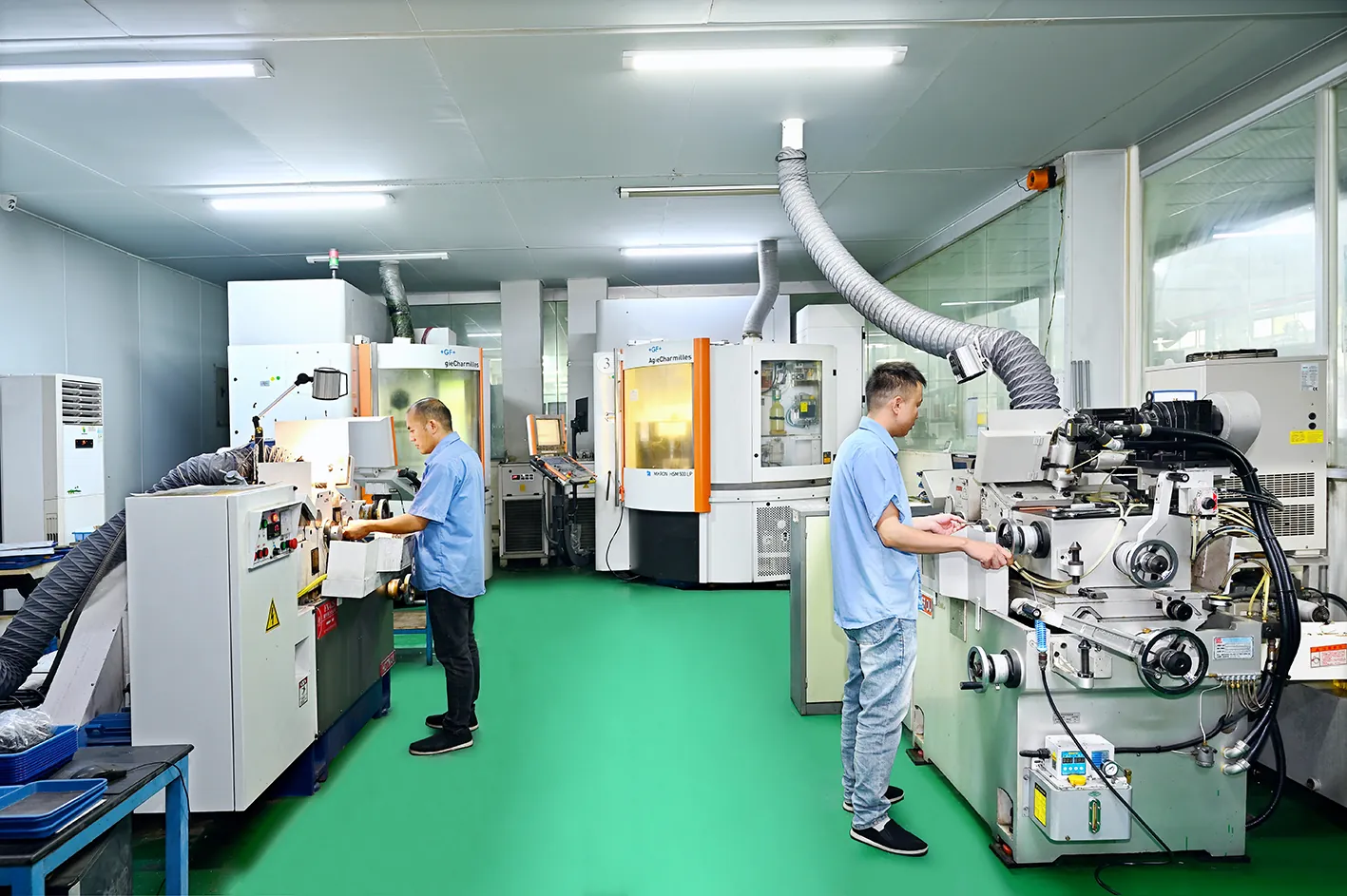
In-house custom capability shows up in the machine list. Centerless grinding for pin diameters, surface and jig grinding for flats and tolerances, wire EDM for profiles, CNC turning for stepped geometry, and CMM or vision inspection to close the loop. DieStrike runs this full chain on its own floor — 120+ machines, from the factory floor that also builds complete molds. When a custom pin is machined, hardened, and inspected under one roof, the drawing control and the quality control are one system.
Custom capability also changes the failure response. When a standard component fails in an unusual geometry, a manufacturer can reverse-engineer the worn part, reproduce it, and ship a replacement in days. A reseller can only reorder what it stocks. For molds with custom ejector systems and inserts, this is the difference between a scheduled fix and a long outage.
How to Verify a Supplier's Claims
Every claim on a component supplier's page can be verified with a question. The grid below maps the common claims to the evidence that proves them.
| Claim | What to Ask For | Red Flag If… |
|---|---|---|
| "HASCO/DME/MISUMI interchangeable" | Dimensional verification method and CMM report sample | Brand claim only, no measured data |
| "Grade: SKD61 / H13" | Material certificate (EN 10204 3.1) with heat number | No certificate, grade not traceable |
| "Fast delivery" | Standard, custom, and rush lead time brackets in writing | One vague number, no rush lane |
| "In-house machining" | Machine list: grinders, EDM, CNC; factory floor proof | Cannot name machines or shows a warehouse |
| "Lot consistency" | CMM data from two different lots of the same part | No lot records kept |
| "Quality system" | Certification (IATF 16949, ISO 9001) and what it covers | Certification named but no process evidence |
← swipe to scroll →
Verification prompts for supplier audits; adapt to your program's requirements.
Add a first-article inspection to the verification plan. Order a small critical lot, measure the key dimensions on your own CMM or with calibrated gauges, and compare the certificate to the part. The first lot costs little; the pattern it reveals — fit, finish, documentation, response — is the supplier's real process, not its brochure.
Sourcing Components from China
Chinese component manufacturers can match global standards at significantly lower cost — that is the reason most of the world's molds are built in China in the first place. But sourcing from China changes the verification requirements, not the quality expectations. The same five criteria apply; the verification has to be more explicit because distance removes the easy visit.
Check the machine floor first. The claims that matter — jig grinding and CMM capability, in-house heat treatment, controlled grinding — are process properties that exist only where the machines exist. Ask for the machine list and factory evidence, exactly as the verification grid above prescribes. A factory with in-house precision grinding and inspection is different from a reseller with a catalog, and the difference shows up in fit consistency and documentation.
Request material certs and a CMM report on the critical dimensions of every lot, and confirm the coating process for coated series. Coated ejector pins and TiN-treated components are common in high-wear molds, and the coating thickness and process affect both life and fit — a coated pin is sized differently than an uncoated one. Our mold life guide covers coating selection; the supplier question is whether the coating is applied in-house with process logs, or outsourced with no record.
Lead time brackets still apply. A Chinese manufacturer shipping direct to your mold shop needs the same 3-7 day standard lane, 7-10 day custom lane, and 24-72 hour rush lane as a domestic supplier — the distance changes shipping, not the schedule promise. What changes is your buffer: with a longer freight leg, the spare-parts plan carries more stock, and the supplier's consistency (criterion four) matters more, because a bad lot costs a freight cycle to correct.
Manufacturer vs Reseller: Reading the Difference
The single most useful question in component sourcing is simple: are you the manufacturer, or a reseller? Both can sell you a pin. Only one can control the grade, the grinding, the heat treatment, the inspection, and the documentation — which are the five criteria in this guide, all in one answer.
DieStrike is a manufacturer: components are machined, hardened, and inspected on the same 120+ machine floor in Dongguan that builds complete injection molds. The practical difference for a buyer is traceability with one throat to choke. When a mold and its components come from the same floor, the fit, the material certs, and the repair path are one system. When components come from a reseller, every quality question becomes a phone chain to an unknown factory.
Resellers have a legitimate role — breadth of catalog, local stock, and credit terms. The trap is paying reseller prices for manufacturer claims, or buying manufacturer-grade expectations from a reseller's catalog. Ask the question in the first conversation, verify the answer with the evidence in the grid above, and price the two paths accordingly.
The Cost of a Bad Component
A bad component fails in one of three ways, and all three are measurable. A dimensionally wrong pin drags in the bore, scores the core face, and rejects parts until someone notices the marks. A wrong-grade pin wears early, silently converting a 500,000-cycle component into a 100,000-cycle one. An inconsistent lot forces unplanned fitting every time it is stocked, and unplanned fitting is where molds get damaged.
Put numbers on it and the sourcing decision prices itself. An eight-hour press stop at typical rates costs $960-$2,000 in machine time. A scored cavity insert runs $500-$2,000 to recut. A scrapped production batch runs into five figures in material. One component failure a year — the kind a documented, consistent supplier prevents — pays for the difference between a manufacturer and a reseller several times over.
The prevention is a plan, not a purchase: known grades, known tolerances, documented lots, and replacement thresholds written into the maintenance schedule. Our mold repair and maintenance service runs that plan for production molds, and the maintenance guide gives the schedule. The component supplier is the other half of the plan — the source that makes the numbers hold.
Frequently Asked Questions
Q1. What are the most important standard mold components?
Ejector pins, core pins, ejector sleeves, mold springs, leader pins and bushings, and sprue bushings are the families that drive mold uptime — they are the moving and wear parts of the tool. Each has a known failure mode and a replacement threshold, which is what makes component management a plan instead of a fire drill.
Q2. Why does HASCO/DME/MISUMI interchangeability matter?
Because standards exist so components are drop-in interchangeable anywhere in the world. A pin marked to a standard must fit the standard's pocket — verified by dimension on a CMM, not by brand claim. Interchange fit means a replacement from any certified manufacturer works in any mold built to that standard.
Q3. How fast can I get replacement mold components?
DieStrike ships standard components in 3-7 days, custom components in 7-10 days, and rush orders in 24-72 hours, with MOQ 1. The brackets matter: a rush lane exists because mold shops cannot let a press sit for a $3 pin.
Q4. What documentation should come with mold components?
Material certificates (EN 10204 3.1) with the heat number, CMM reports on critical dimensions, and heat treatment logs for hardened components. Under IATF 16949, lot-level traceability is a requirement — ask for the document trail before you order critical lots, not after a failure.
Q5. Should I buy from a manufacturer or a reseller?
Buy the capability you need. A manufacturer controls grade, grinding, heat treatment, and inspection under one roof — the full five-criteria chain. A reseller offers catalog breadth and local stock. If your molds carry custom components or critical tolerances, the manufacturer's traceability is usually worth the difference.
Q6. How do I verify a Chinese component supplier?
Apply the same five criteria with more explicit verification: machine floor evidence, material certs and CMM reports on every lot, coating process logs, and written lead time brackets. Distance does not change the quality bar — it raises the evidence bar.
The Bottom Line
Mold components are the reliability layer of every mold: the moving parts, the wear parts, and the consumables that decide uptime. Five criteria — standards compliance, stock depth, documentation, lot consistency, and custom capability — separate a manufacturer from a reseller, and each one is verifiable with a question and a document.
Start the audit where the risk is highest. Send a critical component drawing or part number to DieStrike's component team for a quote and a documentation sample — and read the answer against the grid in this guide before you add a supplier to the approved list.
KEEP READING
Related Reading
5 Mold Cooling Channel Design Tips for Faster Cycles
Mold maker's 5 cooling channel design rules: channel-to-cavity distance 2-2.
Read articleArticle5 Shrinkage Compensation Rules for Mold Design
Shrinkage compensation decides mold accuracy. Five rules: material rates from 0.3% to 2.
Read articleArticle5 Ways to Reduce Mold Cost Without Cutting Quality
Five proven ways to reduce injection mold cost without cutting quality: DFM before quoting, right-sized cavity count,…
Read articleArticle7 Gate Design Best Practices for Balanced Filling
Mold maker's 7 gate design rules for balanced multi-cavity filling: gate depth 50-80% of wall thickness, land 0.5-1.
Read articleNEXT STEP
Ready to Start Your Mold?
Send us your element dimensions or part numbers — our team responds within 24 hours with pricing and lead time.

Written by
Ray ChanMold Buyer's Guide Author · Precision Mold Manufacturing Specialist. Ray helps global importers, distributors and OEMs source factory-direct molds and mold parts.