
Mild Steel vs Tool Steel for Mold Components: Which to Use
Table of Contents
A prototype mold built from AISI 1018 mild steel went into production anyway. The customer saved 38% on the tool, ran 22,000 shots of glass-filled PA66, and the core corner eroded 0.4 mm by week three. Every housing out of that cavity failed the wall check. Scrap hit 17%, and the toolmaker spent 60 hours on a replacement H13 core. The total bill exceeded the price of a correct P20 tool from day one. That arithmetic repeats where "steel is steel" replaces an engineering decision.
Mild steel costs 3 to 8 times less per kilogram, machines fast and welds easily. Tool steel costs more and survives 500,000 to 2,000,000 cycles. The difference is fit, not quality. This guide compares AISI 1018, 1020 and A36 against P20, H13 and S136 for mold components: properties, applications, hardness limits, surface treatments, cost and a decision rule for any mold RFQ. Figures are typical industry values unless marked as DieStrike capabilities.
The Snapshot
- Mild steel runs 71 to 79 HRB (120 to 130 HB, under 20 HRC equivalent); P20 ships at 28 to 32 HRC and H13 or S136 harden to 46 to 52 HRC.
- Raw material spreads 3 to 8 times: A36 and 1018 bar near $0.6 to $1.0 per kg against $3.5 to $8.0 per kg for H13 and S136.
- Carburizing lifts a mild steel case to 58 to 62 HRC, but only 0.5 to 1.5 mm deep. The core stays near 120 HB.
- A mild steel prototype mold typically survives 1,000 to 50,000 cycles; a hardened tool steel mold runs 500,000 to 2,000,000.
- DieStrike builds every melt-contact surface of a production mold in tool steel and returns DFM steel feedback within 24 hours.
Why Mild Steel Fails in Mold Service
A mold component fails four ways: abrasive wear, plastic deformation, corrosion and galling. Mild steel fails all four faster than any tool steel, because hardness was traded for price on a surface that touches melt, slides, or carries clamp load.
Abrasive wear is the first killer. A 30% glass-filled PA66 melt erodes an unhardened mild steel surface 5 to 10 times faster than a nitrided H13 surface, per typical shop data. The gate orifice grows, shear rises, and part weight drifts outside tolerance before the first maintenance interval.
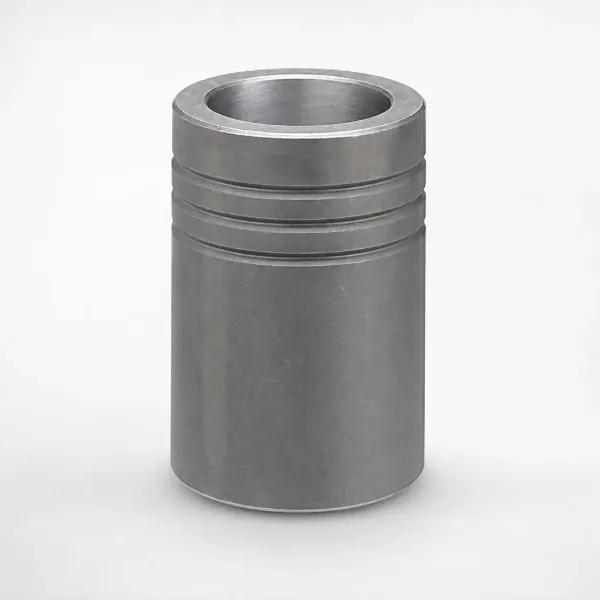
Plastic deformation is second. Mild steel at 120 HB yields under injection pressure where a 46 HRC surface does not, and the parting line opens to flash. Corrosion is third: mild steel rusts in a humid press shop, and cooling line chemistry attacks it above 50 ppm chloride, a limit S136 ignores. Galling is fourth. Two soft steel surfaces cold-weld in streaks, so slides and wear plates score within thousands of cycles. Each failure stops the press; the stop costs the same whether the component was cheap or not.
What Mild Steel Actually Is
Mild steel is low-carbon steel at 0.05% to 0.30% carbon. The tooling grades are AISI 1018, AISI 1020 and ASTM A36 plate, used exactly as received. AISI 1018 carries 0.14 to 0.20% carbon, yields near 370 MPa and hits 71 to 79 HRB cold-drawn. AISI 1020 runs 0.18 to 0.23% carbon at similar strength. A36 allows up to 0.26% carbon and guarantees 250 MPa yield.
None of them responds to quench hardening. At 0.20% carbon there is not enough carbon to form a martensitic structure of any depth. That single fact sets the comparison: mild steel is a machinable, weldable, cheap structural material with a hardness ceiling near 130 HB. It becomes useful as a mold material only through case hardening or plating.
Tool steel is alloyed for the job. P20 (1.2311) is chromium-molybdenum steel supplied pre-hardened at 28 to 32 HRC. H13 (1.2344) is hot-work steel at 44 to 52 HRC, tough enough for 300 °C mold temperatures. S136 (AISI 420 modified) is stainless mold steel at 48 to 52 HRC. These are a different family, made to hold geometry under heat, pressure and abrasion.
Mild Steel vs Tool Steel: Property Comparison
The table below puts the two families side by side. Read it as a specification sheet. The columns that decide mold service are hardness, tensile strength and weldability.
| Grade | Carbon | Hardness | Tensile | Machinability | Weldability | Relative Cost |
|---|---|---|---|---|---|---|
| AISI 1018 / 1020 mild steel | 0.14-0.23% | 71-79 HRB (120-130 HB) | ~440 MPa | Excellent, 70-78% rating | Excellent, no preheat | 1.0x baseline |
| ASTM A36 plate | ≤0.26% | ~120 HB typical | 400-550 MPa | Good | Excellent | 1.0-1.2x |
| P20 (1.2311) pre-hardened | ~0.37% | 28-32 HRC | ~980-1100 MPa | Good pre-hardened | Fair, preheat 200-315 °C | 2-3x |
| H13 (1.2344) hot-work | ~0.40% | 44-52 HRC typical | 1400-1990 MPa | Fair annealed, EDM hardened | Fair, preheat 300-400 °C | 3-5x |
| S136 (AISI 420 mod) | ~0.38% | 48-52 HRC | ~1400-1700 MPa | Fair, work-hardens | Poor-fair, strict controls | 4-8x |
← swipe to scroll →
Table: typical industry figures; verify against your program.
Two numbers decide most arguments. Mild steel tops out near 130 HB. P20 starts at 28 HRC, roughly 270 HB, and H13 at 48 HRC sits near 460 HB. Machinability runs the ladder in reverse: mild steel roughs out 30 to 50% faster than pre-hardened P20, but a 130 HB surface cannot hold a polished finish through 50,000 cycles the way 48 HRC steel does. For the full three-way tool steel comparison, see P20 vs H13 vs S136 mold steel.
What Mild Steel Is Good For
Mild steel has a legitimate place in tooling. The rule: use it where the load is low, the run is short, the geometry is non-critical, or the part is temporary.
Non-critical inserts and support plates
Backup plates, clamp plates, risers, spacer blocks and support pillars carry clamp load but never touch melt. Mild steel at 120 HB handles 800-ton clamp forces when the area is adequate. Most mold makers build these details from A36 or 45-grade plate.
Trial and prototype cores
A prototype core or cavity that will see 1,000 to 10,000 shots of unfilled resin, then be discarded, belongs in mild steel. It machines in days instead of weeks and answers the geometry question before production tooling is cut. The classic mistake is leaving that trial insert in service when the program goes to production.
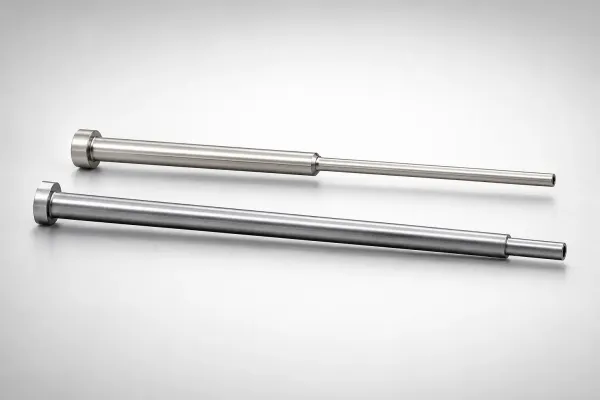
Jigs, fixtures and checking fixtures
Assembly fixtures, inspection nests and clamping jigs see hand cycles, not injection cycles. Mild steel is the toolroom default, and welding lets you modify a fixture in an afternoon. The same applies to purge plates.
Bridge and low-cycle molds
A bridge mold that must deliver 10,000 to 50,000 parts of soft, unfilled resin can run in mild steel with carburized wear surfaces. TPU, PP and PE are kind to soft steel. Budget it as a bridge and schedule the production tool.
What Must Be Tool Steel
Every surface that touches melt in a production tool is a tool steel surface. No exception survives a full production year.
Cavities and cores
Production cavities and cores carry injection pressure, see abrasive flow and hold cosmetic surfaces. P20 covers 50,000 to 100,000 cycles of non-abrasive resin. H13 and S136 cover 500,000 to 2,000,000 cycles, glass-filled melts and corrosive off-gassing. A mild steel cavity here fails every acceptance criterion except the invoice.
Slides, lifters and wear components
Slides and lifters slide against other steel under load. H13 or S136 at 46 to 52 HRC is the minimum for moving steel-on-steel contact. Mild steel galls, and a galled slide is a mold teardown.
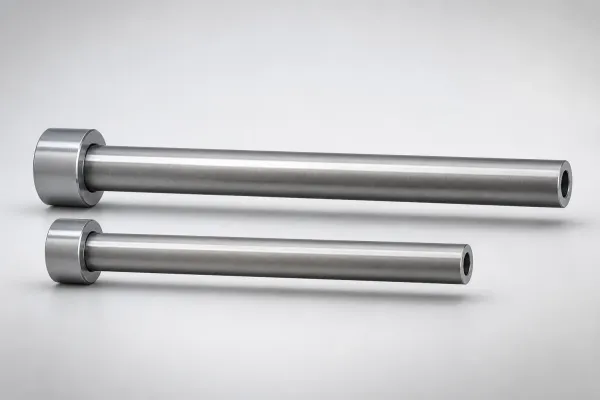
Ejector pins, cores and gate inserts
Ejector pins run in SKD61 (H13 class) at 46 to 52 HRC or SKH51 at 60 to 63 HRC because they carry ejection load against a hot cavity wall. Gate inserts, sprue bushings and runner components face maximum shear and erosion, so H13 nitrided or S136 is standard. Mold bases themselves use P20 or S50C medium-carbon plate, a step above mild steel for exactly this reason.
Production mold building applies this discipline from the cavity to the base. The full scope is part of our mold-making overview and belongs in your mold RFQ before the first quote.
Hardness and Wear Limits
The hardness gap sets wear rate, tolerance and cycle count. Mild steel at 120 to 130 HB wears where 28 HRC P20 barely changes and 48 HRC H13 ignores the same load.
Take a gate carrying 30% glass-filled PA66. Typical shop data shows an unhardened mild steel gate growing 0.1 to 0.2 mm within 10,000 to 50,000 cycles, versus the same erosion at 100,000 to 300,000 cycles on unnitrided tool steel and 2 to 3 times longer again on nitrided H13. Part weight follows gate growth, and weight drift is a scrap generator before any visible defect appears.
Dimensional stability is the quieter limit. A soft cavity deflects under injection pressure where a hardened cavity does not, so the molded wall reads high mid-cavity. On a part holding 0.05 mm tolerance, that deflection alone can exceed the band. Temperature writes the last limit: mold surfaces run 40 to 150 °C, mild steel has no hot-hardness reserve, and H13 is designed to hold hardness to 600 °C.
Surface Treatments That Rescue Mild Steel
Surface treatments put a hard shell on a soft core, and they work when the load stays inside the shell. The three that matter are carburizing, hard chrome plating and electroless nickel. Nitriding is the trap: plain low-carbon steel has no chromium, molybdenum or vanadium to form a deep nitride case, so results are thin, brittle and short-lived. Specify carburizing instead.
Carburizing
Carburizing diffuses carbon into the surface at 900 to 950 °C, then quenches. A 1018 or 1020 part ends with a case of 58 to 62 HRC at 0.5 to 1.5 mm depth, growing roughly 0.1 to 0.15 mm per hour of soak. It suits wear surfaces, shutoffs and gate areas on bridge tools. Watch two things: carburizing distorts thin sections, so grind after treatment, and a thin case over a soft core crushes under point loads.
Hard chrome plating
Hard chrome deposits 10 to 50 µm at 900 to 1100 HV, roughly 65 to 70 HRC equivalent, and improves wear, release and corrosion resistance. It is the standard fix for a worn gate or a scored shutoff on a bridge mold. Chrome cracks under point impact, so it protects against abrasion, not crushing. Re-plating is a 1 to 2 day turnaround.
Electroless nickel
Electroless nickel-phosphorus deposits a uniform 5 to 25 µm layer at 48 to 52 HRC equivalent with no line-of-sight limits, and it suits waterline fittings and ejector components. It is not a wear surface for abrasive melts, where carburizing or chrome outperforms it.
One more warning about coatings. A 2 to 5 µm PVD coating on a 130 HB substrate fails by crushing: the soft steel yields underneath and the hard film shatters. If the application needs a hard substrate, buy tool steel or carburize the mild steel first.
The Real Cost Gap
The raw material spread is real: A36 and 1018 bar near $0.6 to $1.0 per kg, P20 at $1.8 to $3.0, H13 at $3.5 to $6.0, S136 at $4.0 to $8.0. That is the 3 to 8 times gap on the invoice. But material is 5 to 15% of a finished mold component. Machining, heat treatment, grinding and finishing carry the rest, and those costs move the opposite way.
Mild steel machines 30 to 50% faster with cheaper tooling and needs no vacuum heat treatment. Tool steel adds hardening cycles, carbide tooling, EDM for hardened details and slower finishing. The finished-part gap between a mild steel insert and an equivalent hardened tool steel insert typically lands at 2 to 3 times, not 8 times. The service life gap is 10 to 100 times, which is where the decision belongs.
Run the lifecycle arithmetic. A mild steel prototype mold at 30 to 50% of the P20 quote, good for 10,000 to 50,000 parts, beats buying a production tool for a product still in validation. The same insert left in service past 50,000 shots costs more than the production tool it postponed, in scrap, downtime and emergency rework.
| Component | Typical Steel | Expected Life | Why |
|---|---|---|---|
| Prototype core/cavity, unfilled resin | AISI 1018/1020 mild steel | 1,000-10,000 cycles | Fast to machine, validates geometry, discard after trial |
| Bridge mold, soft resin, carburized wear zones | 1018/1020 carburized, 0.5-1.5 mm case | 10,000-50,000 cycles | Case at 58-62 HRC handles moderate abrasion |
| Clamp plates, risers, support plates | A36 / 45-grade plate | Full mold life | Compressive load only, no melt contact |
| Jigs, fixtures, checking nests | A36 / 1018 | Indefinite | Hand load, easy to weld and modify |
| Production cavity, non-abrasive resin | P20, 28-32 HRC | 50,000-100,000 cycles | Good polish, no heat treatment step |
| Production cavity, glass-filled or corrosive resin | H13 46-52 HRC or S136 48-52 HRC | 500,000-2,000,000 cycles | Hot hardness, erosion and corrosion resistance |
| Slides, lifters, wear plates | H13 or S136, hardened | Full mold life | Steel-on-steel contact, galling resistance |
| Ejector pins, gate inserts, sprue bushings | SKD61/H13, SKH51, S136 | Full mold life | Maximum shear, erosion and sliding load |
← swipe to scroll →
Table: typical industry figures; verify against your program.
Selection Decision Rules
Apply these rules in order and the steel choice stops being an argument.
Rule 1. Count the cycles first. Under 10,000 shots with unfilled resin, mild steel is a legitimate trial or bridge material. From 10,000 to 100,000 shots, step to P20 for non-abrasive service. Above 100,000 shots, plan for H13, S136 or D2 class hardened steel.
Rule 2. Check the resin chemistry. Fillers above 20% push the steel one class harder. Corrosive off-gassing from PVC, POM or flame-retardant grades demands S136. Hot melts over 120 °C mold temperature demand hot-work steel.
Rule 3. Mark every melt-contact surface. Cavity, core, gate, runner, sprue and shutoff surfaces on a production tool are tool steel, period. Mild steel belongs only where the drawing says "trial" or "bridge".
Rule 4. Treat every sliding surface as hardened. Slides, gibs, wear plates, ejector guides and locking blocks run at 46 to 52 HRC minimum. Soft steel here fails by galling, which is a teardown event.
Rule 5. If you carburize, respect the case. Spec 0.5 to 1.5 mm case depth, grind after treatment, and keep point loads off the soft core. A carburized bridge mold is a plan, not a promise of production life.
Rule 6. Verify the whole tool, not just the cavity. A hardened cavity in a mild steel base is normal and correct. A mild steel cavity in a production tool is a risk call. When in doubt, send the drawing to a mold maker. DieStrike's injection mold manufacturing service returns steel selection with every DFM, at no cost before the quote.
FAQ: Mild Steel vs Tool Steel
Q1. Can I use mild steel for a production injection mold?
Not for melt-contact surfaces. A production mold must hold tolerance and surface quality over 100,000 to 1,000,000+ cycles, and mild steel at 120 to 130 HB cannot do that against abrasive, hot or corrosive resin. Mild steel is legitimate for prototype cores, bridge tools, support plates and fixtures.
Q2. What is the cheapest mold steel that still works for low-volume parts?
For 10,000 to 50,000 parts of unfilled resin, P20 at 28 to 32 HRC is the standard low-cost production choice. For a true one-off trial of 1,000 to 10,000 shots, AISI 1018 or 1020 with carburized wear surfaces costs least and machines fastest.
Q3. Does carburizing make mild steel as good as tool steel?
No. Carburizing gives a 58 to 62 HRC case of 0.5 to 1.5 mm over a 120 HB core. The case resists abrasion until it wears through or crushes under point load, then the soft core takes over. Tool steel is hard all the way through, holds edge geometry for millions of cycles, and survives re-polish and re-nitride cycles. Carburizing extends a bridge tool; it does not create a production tool.
Q4. Why is tool steel 3 to 8 times more expensive than mild steel?
Alloy content and processing. Tool steel carries chromium, molybdenum, vanadium and nickel, melts to tighter chemistry, and ships as forged or ESR-remelted plate. Mild steel is commodity bar. On a finished component the gap narrows to 2 to 3 times once machining and heat treatment are included, and the service life gap of 10 to 100 times decides the real economics.
Q5. How many shots will a mild steel mold survive?
A trial mold of unfilled resin typically survives 1,000 to 10,000 cycles, and a carburized bridge mold 10,000 to 50,000, depending on resin, gate design and maintenance. Compare 500,000 to 2,000,000 cycles for a properly built H13 or S136 production tool.
The Bottom Line
Mild steel is a material, not a mistake. It belongs in prototype cores, bridge tools, support plates, jigs and fixtures. Tool steel belongs everywhere melt touches steel in a production mold, and on every surface that slides under load. The 3 to 8 times material gap shrinks to 2 to 3 times on the finished part and reverses entirely on the first unplanned teardown.
Send us your part drawing and DieStrike will return a steel recommendation, DFM notes and a cost breakdown within 48 hours, with the material scope written on the RFQ where it belongs.
KEEP READING
Related Reading
Mold Steel Guide: P20 vs H13 vs S136 — Which One Do You Need?
P20, H13 and S136 cover 90% of injection mold applications. P20 (28-32 HRC) is the economical default; H13 (48-52 HRC)…
Read articleArticleThermoset vs Thermoplastic: Mold Design Impact
Thermoset vs thermoplastic mold design: heated molds at 150-180°C vs cooled 20-80°C, shrinkage 0.2-1.0% vs 0.5-2.
Read articleArticle5 Mold Cooling Channel Design Tips for Faster Cycles
Mold maker's 5 cooling channel design rules: channel-to-cavity distance 2-2.
Read articleArticle5 Shrinkage Compensation Rules for Mold Design
Shrinkage compensation decides mold accuracy. Five rules: material rates from 0.3% to 2.
Read articleNEXT STEP
Ready to Start Your Mold?
Send us your element dimensions or part numbers — our team responds within 24 hours with pricing and lead time.

Written by
Ray ChanMold Buyer's Guide Author · Precision Mold Manufacturing Specialist. Ray helps global importers, distributors and OEMs source factory-direct molds and mold parts.