
Mold Steel Guide: P20 vs H13 vs S136 — Which One Do You Need?
Table of Contents
A medical mold maker builds a syringe tool in S136 because "medical means stainless." The resin is a standard polypropylene that would never corrode steel, the tool runs at 30,000 cycles a year, and the S136 premium — paid on every insert — buys nothing the part ever asks for. Three years later, an automotive connector shop skips the hardened H13 and runs a 30% glass-filled nylon in P20. The gates erode by 0.1 mm within 90,000 cycles and the mold is recut mid-program.
One buyer over-specified steel he never needed. The other under-specified steel his resin demanded. Both mistakes are the same failure: choosing a grade by habit instead of by requirement.
P20, H13, and S136 cover roughly 90% of injection mold applications, and each one exists for a reason. This guide explains what each grade is for, the property trade-offs behind the price difference, the payback math of steel selection, and how to match the grade to the resin — without over-specifying your way out of a budget.
The Snapshot
- P20 (pre-hardened, 28-32 HRC) is the economical default for standard thermoplastics and low-to-mid volumes.
- H13 (hot-work steel, hardened 48-52 HRC, HRC 62 for critical inserts) carries glass-filled, high-temperature, and high-cycle applications.
- S136 (stainless, hardened 48-52 HRC) is the answer to transparent, food-contact, medical, and corrosive environments.
- Steel cost follows a ladder — H13 typically adds 30-60% over P20, and S136 adds more — but tool life on abrasive resins multiplies 3-5x at the top of the ladder (typical industry comparisons).
- The grade decision belongs in the 24-hour DFM review, before the steel is ordered — not in a change order after it arrives.
The Three Workhorse Grades
Every mold steel decision starts with the same three names. The table below is the reference card: what each grade is, how hard it runs, and where it belongs.
| Grade | Type | Hardness | Typical Use |
|---|---|---|---|
| P20 | Pre-hardened mold steel | 28-32 HRC as supplied | General production molds, standard thermoplastics |
| H13 | Hot-work tool steel | 48-52 HRC heat-treated, up to HRC 62 for critical inserts | Glass-filled, high-temperature, high-cycle molds |
| S136 | Stainless mold steel | 48-52 HRC heat-treated | Transparent, food-grade, medical, corrosive environments |
← swipe to scroll →
Hardness ranges are typical published values; final targets are set per application.
Two more grades deserve a mention even though they are outside this guide's title. 718H is a pre-hardened grade at the P20 end of the spectrum with better polishability, often used where P20 polish is borderline. Stavax is a mirror-grade stainless in the S136 family, specified for optical and high-polish medical applications — our medical mold steel guide covers the extended family, and the syringe case study shows Stavax in service.
What Mold Steel Actually Has to Do
A cavity steel works in five axes at once, and each grade trades them differently. Understanding the axes is what turns a steel table into a decision.
- Hardness — resistance to abrasive wear from glass- or mineral-filled resins. The single most repeatable predictor of wear life: a hardened cavity out-wears a soft one by multiples, not percentages.
- Toughness — resistance to cracking under mechanical and thermal stress, especially at sharp corners, thin cores, and high mold temperatures.
- Corrosion resistance — survival against acidic resins, flame-retardant off-gassing, humid cooling circuits, and condensation on cold molds.
- Polishability — the ability to reach and hold SPI A1/A2 mirror finishes for optical and cosmetic surfaces.
- Machinability and grindability — the cost of cutting the grade, which decides both the price and the schedule.
No grade wins all five axes. P20 wins on machinability and price. H13 wins on toughness at temperature. S136 wins on corrosion and polishability. The art of steel selection is knowing which axis the resin, the part, and the program actually load — and paying only for that one.
P20 — The Economical Default
P20 is pre-hardened to 28-32 HRC and machines easily, which keeps both steel cost and machining time low. It polishes well enough for most cosmetic parts, welds acceptably for repair, and suits the majority of production molds for standard thermoplastics — ABS, PP, PE, PC/ABS, and similar compounds that run at normal mold temperatures.
P20 is the right default until your resin or cycle count justifies an upgrade. That phrasing is deliberate: the burden of proof sits with the upgrade. A standard resin at a standard cycle in P20 is not a compromise — it is the economically correct choice that funds the rest of the tooling budget.
P20's limit is the wear axis. On a 30% glass-filled compound, a P20 gate erodes visibly within 50,000-100,000 cycles (typical industry observation), and the erosion changes the pressure drop through the gate as it grows. If the program is 200,000 parts of glass-filled nylon, P20 is the wrong floor for the cavity — regardless of how nice the price looked at the DFM stage.
P20 also carries a hardness ceiling. At 28-32 HRC it cannot support razor-thin cores under high injection pressure without deflection, and it cannot hold a polish on abrasive materials long-term. When the design asks for thin-wall molding or long-wear service, P20 stops being the default and starts being the risk.
H13 — For Heat and Wear
H13 is a hot-work tool steel that hardens to 48-52 HRC and keeps its toughness at elevated mold temperatures — the property that gives it its name and its job. It is the standard answer for three load cases: glass-filled and abrasive resins, high-temperature materials, and very high cycle counts.
Abrasive resins are the first H13 trigger. Glass-filled nylon, mineral-filled compounds, and any material carrying fiber drag fiber across the gate and core surfaces on every shot. At 48-52 HRC — and HRC 62 for critical inserts on the DieStrike floor — H13 survives several times longer than P20 on the same abrasive load. Typical industry comparisons put the multiple at 3-5x before the same gate wear appears.
High-temperature resins are the second trigger. PBT, PA66, LCP, PPS, and PEEK run at mold temperatures where a pre-hardened steel softens or anneals in service. H13 holds its hardness at temperature, which is why it is the default for under-the-hood automotive, EV battery, and high-heat applications — see our EV and energy page for the part families involved.
High cycles are the third. A mold that runs 1 million cycles in a year pays for its steel multiple times over; the incremental cost of H13 over P20 amortizes across the life. The harder surface also polishes better over time — a hardened cavity holds its finish while a soft one wears and requires re-polishing.
H13 costs more and machines slower, which is why it is not the default for everything. The price premium typically lands at 30-60% over P20 (published price relationships), and the machining time premium is real. It pays back only where the resin or the volume loads the wear axis — which is exactly the kind of judgment a DFM review should make explicit.
S136 — Stainless for Optics and Corrosion
S136 is a stainless mold steel, hardened to 48-52 HRC, that polishes to SPI A1/A2 mirror finishes and resists the corrosion that ends the life of standard steels in hostile environments. It is the answer to four specific load cases.
Transparent parts are the first. PC, PMMA, and optical-grade resins demand a cavity that polishes to mirror and holds that mirror over production. S136 reaches and holds SPI A1/A2 finishes that standard grades cannot maintain long-term, which makes it the default for lenses, light guides, and clear housings.
Corrosive resins are the second. PVC and flame-retardant compounds release corrosive agents at processing temperature, and humid cooling circuits corrode unprotected steel from the inside out. S136's chromium content is the armor — and it is the only one of the three grades that fights corrosion instead of tolerating it.
Food-contact and medical applications are the third. FDA-contact parts, medical disposables, and clean-room-adjacent programs favor stainless for its corrosion resistance and its cleanability — no pits, no rust, no contamination reservoirs. Our medical mold steel guide walks the full medical-grade selection, and the syringe case study shows the mirror-grade extreme of the family.
S136 is the most expensive of the three, and its cost premium buys properties that standard thermoplastics never load. A cosmetic ABS part in S136 is a budget leak; a transparent light guide in P20 is a quality failure. The discipline is the same in both directions — let the requirement name the grade.
Side by Side: The Full Comparison
The three grades side by side, with the axes that matter for selection. Use this table when a resin or a part characteristic is pushing you toward one corner of the decision.
| Property | P20 | H13 | S136 |
|---|---|---|---|
| Hardness (typical) | 28-32 HRC, as supplied | 48-52 HRC, up to HRC 62 critical | 48-52 HRC |
| Relative steel cost | Baseline | +30-60% (typical) | Highest of the three |
| Abrasive wear resistance | Low — gates erode on GF resins | High — 3-5x P20 life (typical) | High |
| Heat resistance | Standard mold temperatures | Holds hardness at elevated temperature | Good, but specified for corrosion/optics |
| Corrosion resistance | Low | Low | High — acidic resins, humid cooling |
| Polishability | Good for standard cosmetic | Good when hardened | Excellent — SPI A1/A2 mirror |
| Machinability | Best — fast cutting, low cost | Slower, higher machining cost | Slower, higher machining cost |
| Typical programs | ABS/PP/PE/PC-ABS, low-mid volume | GF nylon, PBT, LCP, PEEK, high cycles | Transparent, food, medical, PVC/FR |
← swipe to scroll →
Typical published property comparisons; confirm the final grade with your mold maker's DFM review.
Read the table as a requirement map, not a ranking. P20 loses on wear but wins on price and speed. H13 wins on heat and wear. S136 wins on corrosion and optics. The program decides which win matters.
Steel Cost vs Tool Life: The Payback Math
Steel selection is an investment decision, and the math is straightforward: the premium is paid once, the life difference is earned on every cycle. Run the numbers with your own volumes, but the shape of the decision is consistent.
Consider a 2-cavity mold for a glass-filled part at 300,000 cycles per year. P20 cavities cost less to build but erode visibly by ~100,000 cycles, forcing a gate recut or insert replacement mid-year. Hardened H13 cavities carry a steel premium — typically 30-60% on the insert material (published relationship) — plus additional heat treatment — but run the full year and beyond. The recut of one set of P20 inserts — steel, machining, fitting, and a trial round — typically exceeds the entire H13 premium (typical industry comparison). The hardened tool wins the year by a wide margin.
Now flip the program: the same 2-cavity mold for an unfilled ABS part at 40,000 cycles per year. P20 runs the full life without measurable gate wear, and the H13 premium buys nothing. The soft tool is not a compromise — it is the right capital decision. Over-specifying steel is exactly as expensive as under-specifying it, just on a different schedule.
Cycle count is the multiplier in both directions. A mold that cycles 24 hours a day pays for its steel several times over in a year; a mold that runs quarterly amortizes a premium over a decade. Match the grade to the volume as well as the resin, and the payback math lands on the right side of the decision.
Matching Steel to Resin
The resin is the first question in steel selection, because the resin loads the property axes. The table below is the practical matching grid for the most common resin families.
| Resin Family | Why It Loads the Steel | Recommended Grade |
|---|---|---|
| ABS, PP, PE, PC/ABS (standard) | Normal wear, normal temperatures | P20 |
| Glass-filled nylon, GF PBT | Abrasive fiber erodes gates and cores | H13 hardened, HRC 52+ |
| High-temperature (LCP, PPS, PEEK) | Mold temperature softens low-hardness steel | H13, HRC 52+, hold hardness at temp |
| Transparent (PC, PMMA, optical) | Mirror finish must hold through production | S136, SPI A1/A2 |
| PVC, flame-retardant compounds | Corrosive off-gassing at processing temperature | S136 |
| Food-contact and medical | Cleanability, corrosion, no contamination reservoirs | S136 (or mirror-grade stainless for optics) |
← swipe to scroll →
Typical industry matching; fill content, cycle count, and part geometry can move the recommendation.
Three modifiers shift any row. Fill content — a 10% glass-filled compound is gentler than 40%, and the boundary moves accordingly. Cycle count — high-volume programs justify stepping up a grade even on mild resins. Part geometry — razor-thin cores and deep ribs need hardness and toughness that the volume alone would not demand. When in doubt, run the recommendation through the DFM review rather than the resin chart.
When to Upgrade — and When to Downgrade
Steel decisions get made twice: at the quote, and at the change order. Both directions of the decision deserve explicit triggers.
Upgrade triggers — step up from P20 when any of these is true:
- The resin carries abrasive fill above ~20-30%, and the program exceeds ~100,000 cycles.
- Mold temperature exceeds what a pre-hardened steel holds in service (high-temp engineering resins).
- The part demands a mirror finish that must hold through a long production run.
- The resin or environment is corrosive — PVC, FR grades, humid cooling, condensation risk.
- Thin, unsupported cores risk deflection at 28-32 HRC.
Downgrade triggers — step back down when any of these is true:
- The resin is a standard thermoplastic with no fill, at standard temperatures.
- The annual volume is low enough that the steel premium never amortizes.
- The polished surfaces are hidden — a mirror finish on a cavity that never shows is money spent on nothing.
- The program is a design validation run where the prototype mold will do — see our soft tooling vs hard tooling comparison for when prototype tooling is the right answer.
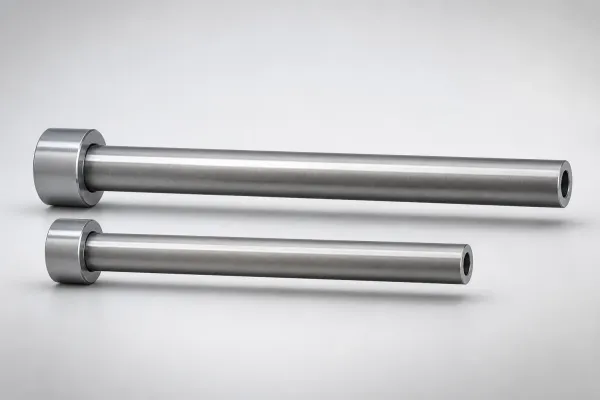
The same discipline applies to moving parts. Ejector pins in SKD61 and H13 follow the same wear logic as cavity steel, and our SKD61 vs H13 ejector pin guide covers that comparison separately — the pin grade should match the resin's abrasiveness just like the cavity grade does.
Hardness, Heat Treatment, and Coatings
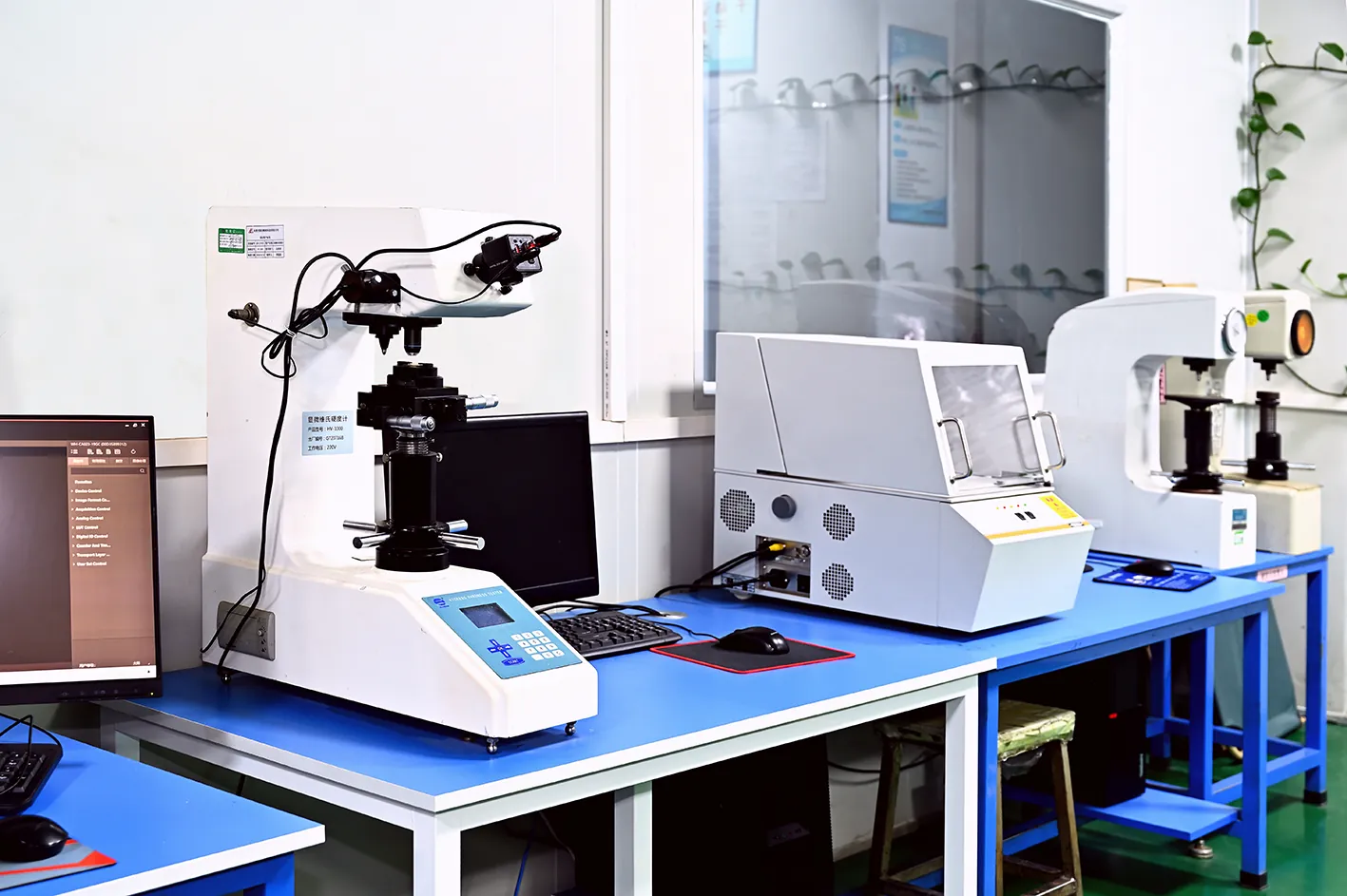
Hardness is the spec line that makes or breaks the steel decision, and it is a number, not a phrase. DieStrike vacuum-hardens production cavities to HRC 62 for critical inserts — the level typical for connector and automotive tooling — with standard ranges of HRC 48-56 for cavity steel and up to HRC 62 for SKD61/H13 ESR grades. A heat treatment line that says "hardened" without a target range is not a spec; HRC 50-54 and HRC 56-60 wear completely differently on an abrasive resin.
Heat treatment order matters as much as the target. DieStrike hardens the cavity block first, then finish-machines and polishes to final geometry — holding mold part geometry to ±0.002mm and overall mold accuracy to ±0.005mm. Hardening after finish machining risks distortion, and grinding away a hardened skin removes exactly the wear resistance the steel premium paid for. The sequence is a quality decision with a measurable outcome.
Coatings extend the steel decision when the resin out-loads even the top of the ladder. Nitriding builds a hard case 0.2-0.5 mm deep at 900-1100 HV (typical industry figures), suited to slides and ejector systems that see sliding wear. PVD and TiN coatings add 2-5 µm of surface hardness at 2000-2500 HV (typical industry figures) and cut gate and core wear rates by half or more. Coatings are the answer for abrasive resins on existing steel — but they add process and cost, which is why our mold life guide treats coating as a strategy, not a default.
How DieStrike Specifies Steel in a DFM Review
Steel selection is a design decision, so it belongs in the design stage. Every DieStrike mold starts with a free DFM review returned within 24 hours, and the review answers three steel questions before any price is attached:
- What resin, at what fill content, at what volume? — the load case that decides whether P20, H13, or S136 is the floor.
- What hardness target, with what heat treatment route? — the spec line that turns the grade into a wear life, including HRC 62 for critical inserts and the hardening-before-finishing sequence.
- Which surfaces need which finish, and which tolerances are critical? — the polish and tolerance callouts that can push an otherwise standard tool into S136 or ±0.002mm territory.
The review also flags over-specification with the same bluntness as under-specification — the cost impact of every tight tolerance and premium grade is stated at the DFM stage, before the price locks. That is the difference between a steel recommendation and a steel sale. Our mold design and DFM service explains the review scope, and the custom mold inserts page shows the steel grades and heat treatment options available on replacement inserts.
Every heat-treated insert ships with its hardness log, and every mold ships with material certificates (EN 10204 3.1), CMM reports, and heat treatment records under the IATF 16949 and ISO 9001 quality systems. The steel decision is documented from the certificate to the finished cavity — which is what a buyer needs when the grade choice is questioned at an audit or after a failure.
Frequently Asked Questions
Q1. Which mold steel is best?
There is no best grade — there is the right grade for the resin, the volume, and the part. P20 is the economical default for standard thermoplastics; H13 carries glass-filled, high-temperature, and high-cycle programs; S136 answers transparent, food, medical, and corrosive requirements. Match the requirement, not the marketing.
Q2. What hardness should an injection mold cavity be?
Pre-hardened P20 runs 28-32 HRC as supplied. Heat-treated cavities typically run 48-52 HRC, with critical inserts at HRC 62 for automotive and connector tooling. DieStrike specifies the target range per insert and verifies it with a hardness log — a quote that says "hardened" without a number is not a spec.
Q3. Is S136 worth the extra cost?
Only where its properties are loaded. S136 pays for itself on transparent parts that need SPI A1/A2 mirror finishes, on corrosive resins like PVC and FR compounds, and on food-contact or medical programs. On a standard ABS part, the S136 premium buys nothing — that is exactly the over-specification a DFM review should flag.
Q4. How long does H13 last compared to P20 on abrasive resins?
Typical industry comparisons put hardened H13 at 3-5x the wear life of P20 at 28-32 HRC under the same abrasive load — a P20 gate on 30% glass-filled nylon erodes visibly within 50,000-100,000 cycles, while hardened H13 runs several times longer before the same wear appears.
Q5. Can I use P20 for a prototype and H13 for production?
Yes, and it is a common two-stage strategy: validate geometry and function in P20 (or aluminum), then commit to hardened production steel once the design is frozen. The prototype investment is recovered the first time it catches a flaw that would have hit the production steel. See our soft tooling vs hard tooling guide for the decision grid.
Q6. Which steel should I use for a transparent part?
S136, or a mirror-grade stainless like Stavax for the highest optical requirements. Transparent PC and PMMA demand a cavity that polishes to SPI A1/A2 and holds that finish through production — a capability standard grades lose as they wear. Our syringe case study documents a mirror-grade build end to end.
The Bottom Line
P20, H13, and S136 cover 90% of injection mold applications, and the difference between them is the difference between paying for a property and paying for a program. P20 for the standard workhorse, H13 for heat and wear, S136 for optics and corrosion — and the grade decision belongs to the resin and the volume, not to habit.
Run your part through the discipline before the steel is ordered: send the drawing, the resin, and the volume plan to DieStrike's engineering team for a free DFM review, and get a steel recommendation with the cost impact stated within 24 hours — before any number is on the page.
KEEP READING
Related Reading
Mild Steel vs Tool Steel for Mold Components: Which to Use
Mild steel vs tool steel for mold components: AISI 1018/1020 vs P20/H13/S136 properties, the 3-8x cost gap, carburizing…
Read articleArticleThermoset vs Thermoplastic: Mold Design Impact
Thermoset vs thermoplastic mold design: heated molds at 150-180°C vs cooled 20-80°C, shrinkage 0.2-1.0% vs 0.5-2.
Read articleArticle5 Mold Cooling Channel Design Tips for Faster Cycles
Mold maker's 5 cooling channel design rules: channel-to-cavity distance 2-2.
Read articleArticle5 Shrinkage Compensation Rules for Mold Design
Shrinkage compensation decides mold accuracy. Five rules: material rates from 0.3% to 2.
Read articleNEXT STEP
Ready to Start Your Mold?
Send us your element dimensions or part numbers — our team responds within 24 hours with pricing and lead time.

Written by
Ray ChanMold Buyer's Guide Author · Precision Mold Manufacturing Specialist. Ray helps global importers, distributors and OEMs source factory-direct molds and mold parts.