
How to Choose a Mold Manufacturer: 8 Checks Before You Sign
Table of Contents
A mold arrives on schedule, on budget, and with a trial report that shows every dimension green. Four weeks into production the ejector pins gall, the core inserts pit, and the customer's gauge reads 0.03 mm out of tolerance. The mold maker's phone number still works, but the warranty clause says repairs are "at the manufacturer's discretion," and the spare parts you ordered are a different series than the mold was built with. That is the difference between choosing a mold manufacturer and choosing a production partner: the invoice is paid once, the consequences run for the life of the mold.
Choosing a mold manufacturer is choosing your production reliability. An injection mold runs 500,000 to 1,000,000 cycles over its life, and the shop that builds it controls most of what happens in that life: the precision of the cavities, the quality of the steel, the documentation trail, and the speed of the repairs. This guide lays out eight checks that separate factories that deliver working tooling from those that deliver excuses, plus the red flags to catch before signing and the scoring method to rank your shortlist.
The eight checks apply whether you buy from China, Europe, or your own country, and they cost nothing but reading time. Every check has a verifiable answer: a machine list, a tolerance claim, a trial press, a certificate, a standard, a review document. If a supplier cannot answer one, that is an answer.
The Snapshot
- Eight checks: in-house machining, verified precision, trial capability, documentation, standards, DFM-first process, response quality, and warranty.
- Precision claims to verify: jig grinding to 0.0005 mm, wire EDM at ±0.002 mm, CMM verification on every critical dimension.
- DieStrike runs 120+ machines, IATF 16949 and ISO 9001 quality systems, and returns DFM reviews within 24 hours.
- Warranty, spare part series, and repair response time must be written in the PO, not promised in a meeting.
- The cheapest quote usually fails on documentation or trial discipline, the two things that cost most after delivery.
Why the Choice Is a Production Decision
The mold is the only component of your product that gets paid for once and then runs for years. Every hour the mold is down is a lost production hour, and every defect the mold produces is a sorting cost. The manufacturer's precision, steel choices, and documentation become your uptime, your scrap rate, and your audit trail.
Consider what a mold failure costs at scale. A 32-cavity mold that stops mid-shift on a broken ejector pin costs the repair, the lost production, and the rework of any parts molded with the failing pin. The difference between a 500,000-cycle mold and a 200,000-cycle mold is often just the steel and heat treatment specified at the start, a decision made months before the failure appears.
The buyer's leverage runs out at signing. After the deposit is paid and the mold ships, the manufacturer's incentive to respond drops, and the only things that protect you are the clauses in the PO: warranty scope, repair response time, and spare part commitments. That is why checks 6 and 8, the DFM process and the written warranty, matter as much as the machine list.
Finally, the choice compounds. A manufacturer that documents its work gives you the evidence you need for PPAP and customer audits. A manufacturer that does not forces you to generate that evidence yourself, at your cost, after the fact. Documentation is not paperwork, it is the transfer of knowledge that makes the mold yours.
Check 1: In-House Machining
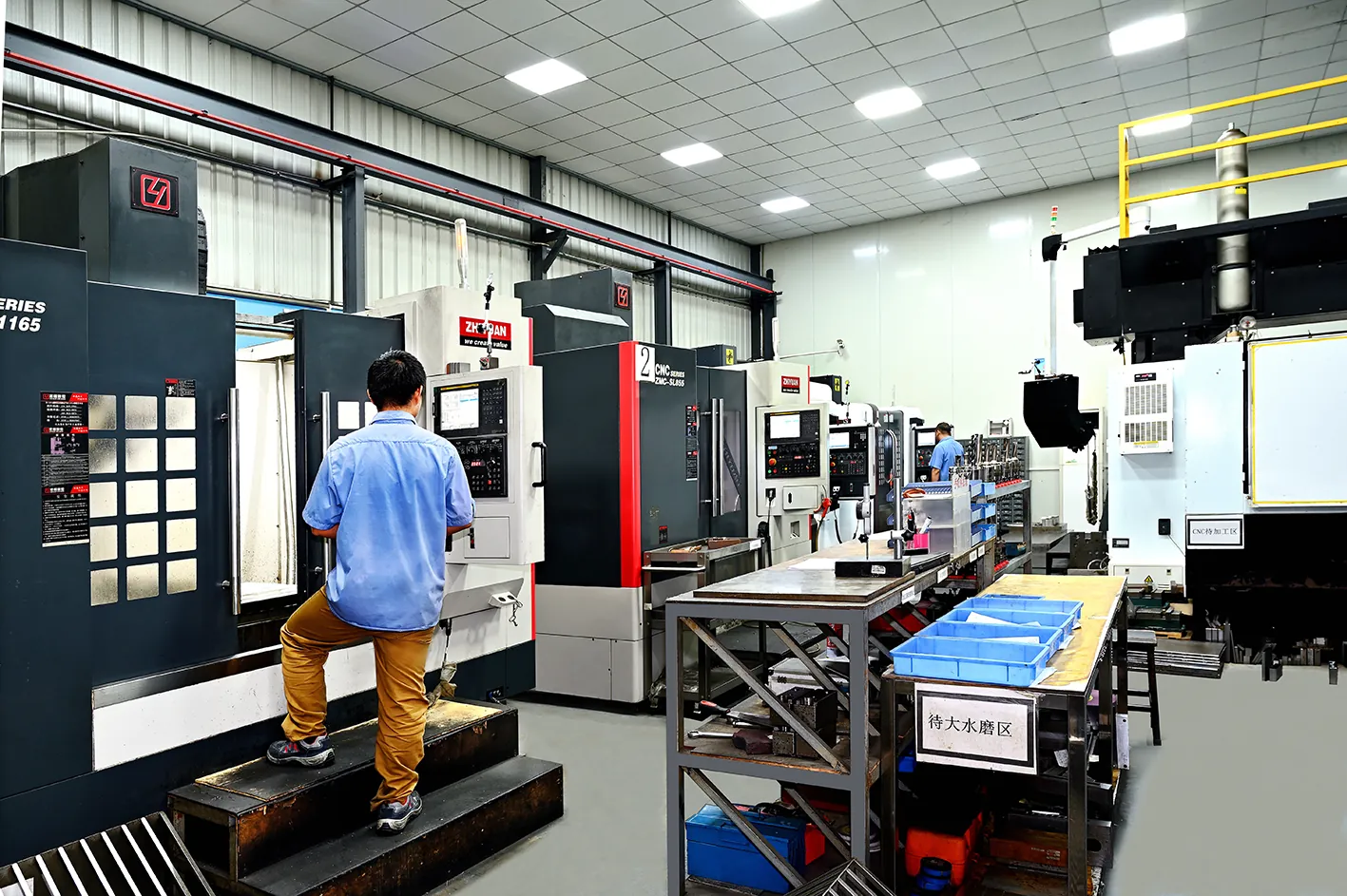
A factory with its own CNC, EDM, and grinding floor controls its quality and its schedule. A trading company, or a factory that subcontracts machining, controls neither. The machine list is the first question, and it should be answered with a list, not a brochure phrase.
Ask for the specific machine categories and counts: CNC milling centers, wire EDM, sinker EDM, jig grinding, surface grinding, and CMM. A precision mold shop runs all of them in-house, because the tolerance chain, roughing, hardening, finishing, and inspection, breaks when the work changes hands between shops. DieStrike runs 120+ machines across these categories, which is the scale that keeps every process step inside one quality system.
In-house machining also decides schedule honesty. A shop that subcontracts its wire EDM cannot commit to a trial date, because the trial date depends on another factory's queue. A shop with its own floor can show you the queue, the machine time booked for your mold, and the actual trial date. Schedule risk is one of the most expensive risks in tooling, and it is priced by machine ownership.
The follow-up question to the machine list is utilization: are the machines working? A visit or video walkthrough should show spindles running, wire EDM tanks cutting, and CMM arms measuring, not a clean floor of idle iron. Idle machines mean either no orders or no work, and both are signals.
Check 2: Verified Precision Claims
Every supplier claims precision. The check is what the precision actually is, in numbers, and how it is verified. Ask for the achievable tolerance on each process: jig grinding to 0.0005 mm, wire EDM finish passes at ±0.002 mm, CNC machining at ±0.01 mm, and the CMM verification that proves it on every critical feature.
Precision claims should map to the part. If your drawing holds critical dimensions at ±0.005 mm, which is DieStrike's standard mold tolerance, the manufacturer's processes must hold mold features to roughly one-tenth of that, and the CMM report must show it. A supplier that says "precision molds" but cannot state a tolerance per process is quoting adjectives instead of capability.
Verification is the second half of the claim. A CMM report that covers every critical dimension, with the measured value against the nominal and tolerance, is evidence. A report that covers three dimensions and calls it complete is theater. Ask for a sample CMM report with a mold, and read whether the critical dimensions are actually listed.
The tolerance conversation also sets expectations for trial. First shots never hit final dimensions; the mold is measured, adjusted, and re-trialed until the report is green. The question is how many trial iterations the quote includes and how the correction loop runs. Our precision mold tolerance guide explains the full chain from machine capability to measurement.
Check 3: Trial Capability
Sampling is where a mold becomes a mold, and in-house trial presses mean sampling is scheduled, not subcontracted. A factory with trial presses runs its own T1, T2, and T3 trials on its own schedule, and the trial reports carry its own quality signature. A factory without trial presses books machine time elsewhere, and every trial slips on someone else's queue.
Ask how many trial presses the factory has, the tonnage range, and whether the trial covers your part size. A mold shop serving automotive connectors should trial in the 50 to 400 ton range in-house; a shop serving large structural parts needs bigger presses. The trial press range must cover your program or the trial schedule is out of the factory's control.
Trial quality is in the report. A real trial report lists the machine, the material batch, the process settings, the defect observations, and the actions taken, per trial round. The T1 report typically shows dimensional deviations and the corrections applied; the T2 report shows the results after correction; the final report shows green dimensions against the drawing. A supplier that sends a photo of parts instead of a report is not trialing, it is hoping.
DieStrike's T1 sampling service runs exactly this loop: trial, measure, correct, re-trial, and the written report at each stage. That loop is also the best audit of the manufacturer's engineering, because trial results expose whether the DFM review, the machining, and the assembly were done right.
Check 4: Documentation Discipline
Documentation discipline is the cheapest reliable predictor of quality. A factory that issues steel certificates, CMM reports, and trial reports without being asked runs a controlled quality system. A factory that produces them only under pressure does not, and the mold quality will match.
The documentation set to demand: steel certificates for every cavity and core block, with grade and heat number; CMM reports for every critical dimension; trial reports for every sampling round; and the dimensional inspection of the finished mold, cavity dimensions, ejector alignment, and shut-off contact. Together they are the evidence that the mold was built as specified.
Documentation also carries the quality system. IATF 16949 and ISO 9001 certifications mean the factory is audited on its process control, and the certificates should be current, not expired and unrenewed. The quality manual and the actual behavior rarely diverge for long in an audited factory, because the audit finds it.
Your own customers will eventually demand this trail. A PPAP Level 3 submission needs material certificates, dimensional reports, and process data, and the mold manufacturer's documentation becomes your PPAP package. Buying from a factory that documents means your PPAP writes itself; buying from one that does not means you reconstruct it from phone calls.
Check 5: Standards Compatibility
A mold built on standard components is maintainable anywhere in the world. HASCO, DME, and MISUMI series components, ejector pins, springs, guide pillars, and mold bases, are interchangeable between manufacturers, which means your tool room can buy replacements from any supplier on any continent. A mold built on proprietary parts is a hostage.
Ask which standard the mold base and components follow, and verify it in the quote. A DME-standard base with HASCO-standard pins is common in export tooling, but the RFQ should name the series so the maintenance manual and the spare parts list match reality. The standard also sets the price: standard series parts ship in days, custom parts take weeks.
Standards matter for precision too. A mold base with guide pillars held to 10 to 20 µm of play cannot hold a ±0.002 mm part tolerance, no matter how good the cavity work is. The standard base series and the part tolerance must be specified together, and our mold base specification guide covers the callouts that get a precision base built right.
Component standards extend to the consumables. Ejector pins in DIN 1530 series, springs to ISO 10243, and guide systems to standard bores keep the mold serviceable without the original manufacturer. A supplier that offers standard-series everything is a partner; one that offers "our system" is building a lock-in.
Check 6: DFM-First Process
A manufacturer that reviews your design before cutting steel saves you money, because geometry corrections are free before the cut and expensive after. The DFM-first process is the single strongest signal of engineering depth, and it is checkable in one question: what did you find in my part, and what did you recommend?
The DFM review should arrive before the quote, in writing, with numbers. Draft angles, wall ratios, gate position, shrink compensation, undercut release, and ejection layout should each be addressed with a specific value, not a generic "the design is manufacturable." A supplier that quotes within hours without asking a question about geometry has not read the file.
The DFM process also sets the change-order baseline. A part that passes a real DFM review generates few surprises during build, because the geometry risk was addressed up front. A part that skips review generates change orders during machining, and each one costs schedule and money that was never in the quote.
DieStrike returns a written DFM review within 24 hours on every new part file, before quoting, at no charge. The review covers the seven checks in our DFM checklist guide, and the quote follows the corrected geometry, not the optimistic version. If a supplier cannot show you a DFM report for your own part, treat that as the report.
Check 7: Response Quality
Response quality is the cheapest capability test you will ever run, because it costs nothing and it is done in the first email. A technical, specific reply to your RFQ signals engineering depth. A vague quote with a price and a delivery date signals a sales desk that forwards files.
Send the same RFQ to three factories and compare the replies on three axes: questions asked, numbers given, and process described. The strong supplier asks about the critical dimensions, the resin grade, the annual volume, and the cosmetic requirements. It quotes cycle, cavity count, steel, and trial milestones. The weak supplier quotes a price and asks for a deposit.
Response time is part of the signal. A 24-hour DFM and quotation turn is the standard DieStrike runs, and a supplier that needs two weeks to answer an email will need two weeks for every decision for the life of the mold. The response cadence you see during quoting is the cadence you will get during repair.
The response also reveals language and engineering translation risk. A reply that misreads a tolerance or a material grade is a preview of the build, and the correction cost is far higher later. If the response quality fails the email test, the factory visit will not save it.
Check 8: Warranty and After-Sales
Warranty terms belong in the PO, written, with scope and duration, not promised in a meeting. The standard to look for: a warranty of 12 months or the defined shot count, whichever comes first, covering material and workmanship defects, with repair response defined in days, not "as soon as possible."
Ask for the repair workflow in writing. Who pays for the return freight on a defective mold? What is the response time for a critical repair? Are spare parts held at the factory, and which parts ship immediately? A mold with a documented repair workflow is an asset; one without is a liability that becomes urgent on a Friday.
Spare parts policy is part of after-sales. The mold should ship with a spare parts list, and critical consumables, ejector pins, springs, and seals, should be either included or available on standard lead times. DieStrike ships standard components in 3 to 7 days and custom parts in 7 to 10 days, which is the response a production line needs.
After-sales also means the manufacturer can stand behind its work. In-house machining and supervised trial capability, checks 1 and 3, are what make repair response real. A factory that can re-machine, re-treat, and re-trial a worn mold is a repair partner; a trading desk is a forwarding service. Our mold repair guide shows what a real repair workflow looks like.
Red Flags in Quotes and Behavior
Some signals are decisive on their own. These red flags should end the conversation or at least move the supplier to the bottom of the shortlist:
- Quotation without DFM feedback or technical questions about your part. The price was made against a file nobody read.
- No machine list or precision parameters on request. The capability claim has nothing behind it.
- Delivery promise without a trial and approval milestone. A mold that ships without trial approval is a mold that was never finished.
- Unwillingness to provide steel certificates or CMM reports. The evidence exists, or it does not, and refusal means the latter.
- Pressure to pay in full before trial results. Standard terms run 30/40/30 or 50/50 with milestones; full-before-trial transfers all the risk to you.
- Guaranteed "perfect" molds. Every mold needs trial iterations; a guarantee of perfection is a promise of the opposite.
Red flags compound. One weak signal is survivable; two or three mean the supplier is selling the story instead of building the mold, and the story ends at the invoice.
What to Look For on a Factory Visit
A factory visit is the fastest way to verify checks 1 through 4, and it can be done in person or by live video walkthrough. The factory with nothing to hide will agree to the walkthrough; the factory that stalls is answering your question.
On the floor, look for organized tool cribs with labeled standard components, working trial presses, CMM equipment actually in use, and molds in progress with structured documentation next to them. A clean, organized floor correlates with controlled processes far better than a showroom ever does.
Look at the work-in-progress, not the finished goods. A mold mid-build shows the real processes: the wire EDM tank with a cutting job, the heat treatment furnace log, the assembly bench with a mold in progress. Ask what is being cut for whom, and check whether the queue matches the schedule claims.
Talk to an engineer, not just the sales manager. Ask the engineer how they would correct a dimension found out of tolerance at T1, and listen for a specific answer: adjust the cavity, re-cut the insert, balance the gate. A specific process answer is worth more than any brochure, and our mold manufacturing process guide tells you what the correct answer sounds like.
Scoring the Shortlist
Score your shortlist against the eight checks and the price, and use a pass bar for each check, not a point system that lets a strong check hide a weak one. A supplier that fails documentation, check 4, fails the list even if the price is 30% lower, because the documentation cost shows up later in your audits.
| Check | What to verify | Pass bar |
|---|---|---|
| 1. In-house machining | Machine list, floor in use | CNC, EDM, grinding, CMM in-house |
| 2. Verified precision | Tolerance per process, CMM sample | Jig grinding 0.0005 mm, EDM ±0.002 mm |
| 3. Trial capability | In-house presses, tonnage range | Presses cover your part size |
| 4. Documentation | Steel certs, CMM, trial reports | Issued without being asked |
| 5. Standards | Base and component series | HASCO/DME/MISUMI compatible |
| 6. DFM-first | Written DFM before quote | Specific findings with numbers |
| 7. Response quality | First RFQ reply | Technical questions and numbers |
| 8. Warranty | PO clauses | Written scope, duration, response days |
← swipe to scroll →
Pass bars reflect typical practice for precision injection molds. Adjust the precision and warranty bars to your program's requirements.
Then compare prices within the qualified set. The cheapest quote usually fails on documentation or trial discipline, the two things that cost you most after delivery. A mid-price quote with verified precision, in-house trial, and structured documentation is typically the lowest total cost of ownership, because the mold runs longer, repairs faster, and documents itself.
Total cost of ownership is the final lens: mold price plus trial iterations plus repair response plus documentation effort, spread over the program life. Our mold quote guide shows how to read the price breakdown line by line, and the injection mold buying guide runs the full procurement checklist end to end.
Frequently Asked Questions
Q1. Do I need to visit the factory, or is a video walkthrough enough?
A live video walkthrough of the machining floor, the trial presses, and the CMM room covers most of what a visit verifies, and a factory with nothing to hide will agree to it. Visit in person when the mold is large, complex, or the program is long-lived, because the floor tells you more than any report.
Q2. How much cheaper can a Chinese mold maker be, and is it worth it?
Offshore molds commonly quote 20 to 40% below domestic shops for equivalent work (typical market range), and the gap closes when you add freight, import, communication, and repair logistics. The eight checks decide whether the discount is real or is coming out of the documentation and the trial discipline.
Q3. What payment terms are normal?
Typical terms run 30/40/30 (deposit, progress, balance) or 50/50 with milestones tied to DFM approval, trial approval, and shipment. Full payment before trial results transfers all risk to the buyer and is a red flag.
Q4. How long should mold delivery take?
Typical lead times run 2 to 4 weeks for plastic injection molds and 2 to 5 weeks for stamping dies from a factory with in-house machining, depending on complexity. The schedule should include a trial and approval milestone, not just a ship date.
Q5. What if the mold fails after the warranty expires?
Ask before signing what repairs cost and how fast they happen. The ideal answer is a documented repair workflow with standard-component lead times, 3 to 7 days for standard parts, so the mold is serviceable by any tool room with the maintenance manual.
The Bottom Line
Choosing a mold manufacturer is a production decision, and eight checks separate real toolmakers from traders: in-house machining, verified precision, trial capability, documentation discipline, standards compatibility, a DFM-first process, response quality, and a written warranty. Score the shortlist against all eight with pass bars, then compare price inside the qualified set.
DieStrike runs 120+ machines under IATF 16949 and ISO 9001, returns written DFM reviews within 24 hours, trials in-house, and documents every mold with steel certificates, CMM reports, and trial records. See the manufacturing capabilities page for the machine list and precision parameters, then send an RFQ that gets you a comparable quote from every supplier on your list.
KEEP READING
Related Reading
How to Read a Mold Quote: Line by Line
Read a mold quote like a buyer: 10 steps from scope lock to PO — cavities, steel grades, tolerances, lead time, change…
Read articleArticleHow to Write a Mold RFQ: 10 Fields That Get You Better Quotes
Your RFQ quality determines your quote quality. These ten fields — 3D part file, resin grade, annual volume,…
Read articleArticle5 Mold Cooling Channel Design Tips for Faster Cycles
Mold maker's 5 cooling channel design rules: channel-to-cavity distance 2-2.
Read articleArticle5 Shrinkage Compensation Rules for Mold Design
Shrinkage compensation decides mold accuracy. Five rules: material rates from 0.3% to 2.
Read articleNEXT STEP
Ready to Start Your Mold?
Send us your element dimensions or part numbers — our team responds within 24 hours with pricing and lead time.

Written by
Ray ChanMold Buyer's Guide Author · Precision Mold Manufacturing Specialist. Ray helps global importers, distributors and OEMs source factory-direct molds and mold parts.